
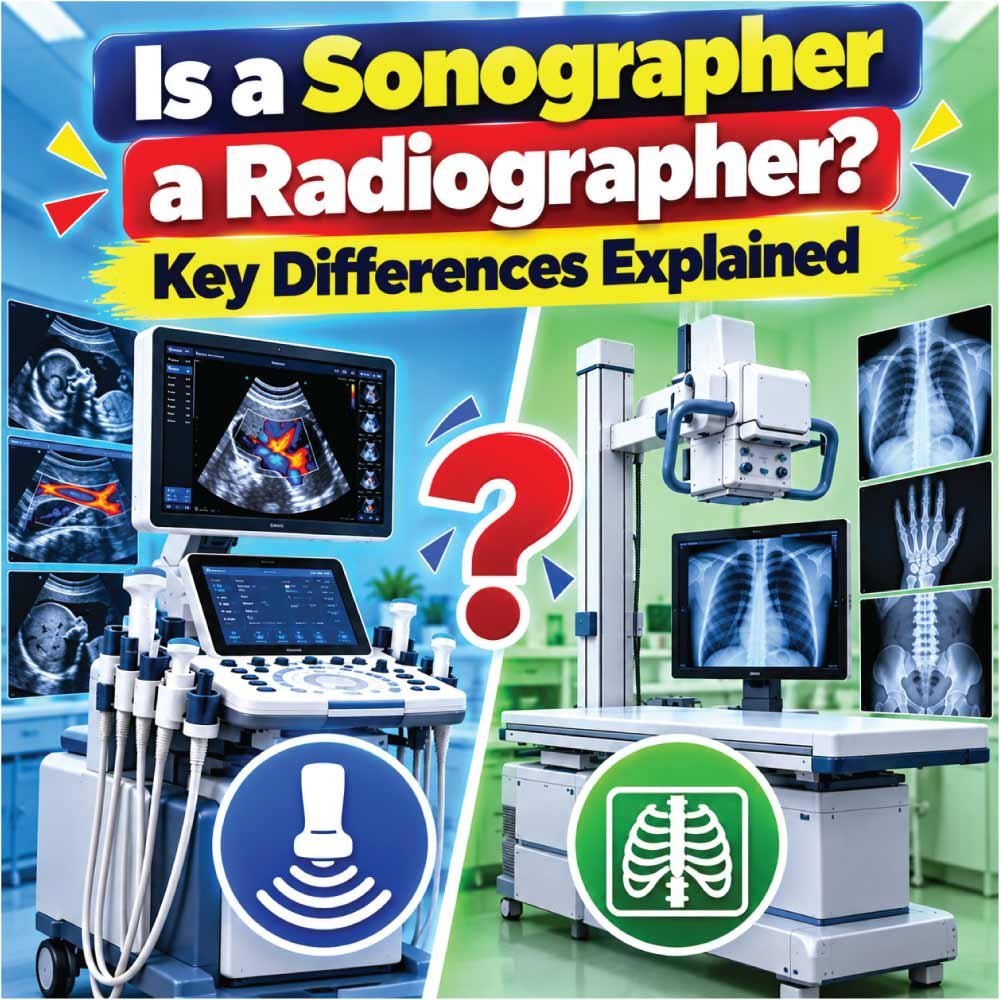
When people first explore careers in medical imaging, the terms sonographer and radiographer can be confusing. Both professionals work with diagnostic imaging equipment, interact directly with patients, and play an important role in helping physicians investigate health conditions. However, they are not necessarily the same profession.
So, is a sonographer a radiographer? The short answer is: not usually. A sonographer specializes in ultrasound imaging, while a radiographer primarily performs radiographic imaging, such as X-rays. Their education, equipment, imaging methods, and day-to-day responsibilities can therefore differ.
There is also an important complication: terminology varies between countries, employers, professional organizations, and training systems. In some settings, sonography may exist as a specialization within the broader medical imaging or radiologic technology field. In others, sonographers and radiographers are clearly separate professional roles.
Understanding this distinction is useful if you are considering a career in healthcare, comparing sonography vs radiography, or simply trying to understand who performs different types of medical imaging.
What Does a Sonographer Do?
A sonographer is a healthcare professional who performs diagnostic ultrasound examinations. Instead of using X-rays, ultrasound equipment uses high-frequency sound waves to create images of structures inside the body.
During an examination, the sonographer generally places a handheld device called a transducer against the patient’s skin. The transducer sends sound waves into the body and receives returning echoes. Specialized equipment processes those echoes into images.
According to the U.S. Bureau of Labor Statistics, diagnostic medical sonographers operate ultrasound equipment to create images of internal body structures and work closely with physicians who use those images in assessing and diagnosing medical conditions.
A sonographer’s work can include:
- Reviewing the examination request and relevant patient information
- Explaining the procedure to the patient
- Positioning the patient appropriately
- Selecting suitable ultrasound equipment and settings
- Obtaining diagnostic-quality images
- Recording measurements and technical information
- Reviewing images for adequate coverage and quality
- Communicating relevant findings and technical information to the appropriate healthcare professional
Sonography also has several specialties. Depending on their education and workplace, professionals may concentrate on abdominal, obstetric and gynecologic, vascular, cardiac, breast, musculoskeletal, or other types of ultrasound examinations.
The role requires more than simply operating an ultrasound machine. Sonographers need knowledge of anatomy, physiology, pathology, imaging techniques, and patient care.
What Does a Radiographer Do?
A radiographer is a medical imaging professional who performs radiographic examinations using X-rays and, depending on training and workplace, may work in related imaging areas.
Radiography uses ionizing radiation to produce images. A common example is an X-ray examination of the chest, bones, or other anatomical structures.
The American Society of Radiologic Technologists describes radiography as a professional practice involving the administration of ionizing radiation for diagnostic, therapeutic, or research purposes. Radiographers perform radiographic and fluoroscopic procedures and acquire and analyze imaging data for interpretation by an appropriate licensed practitioner.
Typical responsibilities can include:
- Preparing patients for examinations
- Explaining procedures
- Positioning patients correctly
- Operating radiographic equipment
- Selecting appropriate technical factors
- Obtaining diagnostic-quality images
- Following radiation-safety procedures
- Checking images for technical quality
- Maintaining accurate examination records
- Communicating with physicians and other healthcare professionals
Radiographers may work in hospitals, imaging centers, outpatient facilities, emergency departments, orthopedic settings, and other healthcare environments.
The exact scope of practice depends on local regulations, credentials, employer requirements, and additional training. Professional standards also recognize that practice can vary by jurisdiction and institution.
Sonographer vs Radiographer: What Is the Main Difference?
The most important difference is the technology used to create medical images.
A sonographer uses sound waves, whereas a radiographer primarily uses X-rays for radiographic imaging.
| Feature | Sonographer | Radiographer |
|---|---|---|
| Main imaging method | Ultrasound | X-ray radiography |
| Energy used | High-frequency sound waves | Ionizing radiation |
| Common equipment | Ultrasound system and transducer | X-ray equipment |
| Main task | Perform ultrasound examinations | Perform radiographic examinations |
| Patient positioning | Important | Important |
| Image acquisition | Dynamic, real-time scanning | Radiographic image acquisition |
| Radiation exposure | Ultrasound does not use ionizing radiation | Uses ionizing radiation |
| Common applications | Soft tissues, pregnancy, abdominal, vascular and cardiac imaging | Bones, chest, trauma and many other examinations |
| Patient interaction | Often substantial | Often substantial |
| Further specialization | Cardiac, vascular, abdominal and other specialties | CT, MRI, mammography and other areas depending on training |
The distinction becomes particularly clear when considering how each professional produces an image.
A sonographer moves the transducer across the body and may continuously adjust the scanning angle, pressure, depth, focus, and other parameters while observing the anatomy in real time.
A radiographer generally positions the patient and equipment to obtain specific radiographic projections while applying appropriate exposure and radiation-safety principles.
Why Are Sonographers and Radiographers Sometimes Confused?
The confusion exists partly because both professions belong to the broader world of medical imaging.
A patient might encounter both professionals during a hospital visit. Both may:
- Work with sophisticated imaging equipment
- Position patients
- Explain examinations
- Capture diagnostic images
- Evaluate technical image quality
- Work alongside radiologists and other physicians
- Maintain patient records
- Follow strict safety procedures
Professional organizations also sometimes group different imaging occupations together. ASRT’s practice standards, for example, identify radiographers and sonographers as distinct professionals within the wider medical imaging and radiation therapy profession.
This means the terms can overlap at the level of the broader profession without meaning that the two jobs are identical.
Another source of confusion is the word radiology. Radiology is the medical specialty concerned with diagnostic and interventional imaging and related procedures, while a radiographer is a professional who performs particular imaging procedures. A sonographer can work within a radiology department without necessarily being a radiographer.
Does a Sonographer Use Radiation?
Diagnostic ultrasound does not use ionizing radiation. Instead, it uses high-frequency sound waves to create images.
This is one of the major technical differences between ultrasound and conventional X-ray imaging.
The sonographer uses a transducer to send sound waves into the body. Different tissues interact with those waves in different ways, and the returning echoes are processed into an image.
The U.S. Bureau of Labor Statistics describes diagnostic medical sonography as an imaging method based on high-frequency sound waves.
This does not mean ultrasound is simply a risk-free technology that requires no professional training. Proper equipment operation, patient assessment, scanning technique, infection control, ergonomics, and adherence to professional standards remain important.
Sonographers also spend considerable time performing repetitive scanning movements and maintaining awkward postures. Professional standards specifically recognize the importance of reducing work-related musculoskeletal risks in sonography.
Does a Radiographer Use Radiation?
Yes, conventional radiography uses ionizing radiation to produce images.
Because ionizing radiation can affect biological tissue, radiographers are trained to apply radiation-safety principles and use appropriate techniques to minimize unnecessary exposure.
This is one reason radiography requires careful attention to:
- Patient identification
- Examination selection
- Positioning
- Exposure factors
- Collimation
- Radiation protection
- Image quality
- Equipment operation
Professional standards for radiography include responsibilities related to radiographic procedures, exposure techniques, image quality, and radiation safety.
It is important to distinguish conventional radiography from every other imaging technology. Medical imaging includes ultrasound, X-ray, CT, MRI, nuclear medicine, and other modalities, each with different technologies and professional requirements.
What Examinations Does a Sonographer Perform?
Sonographers can work in a wide variety of specialties. Their exact responsibilities depend on their education, credentials, and workplace.
Abdominal Sonography
Abdominal ultrasound can be used to examine structures such as the liver, gallbladder, kidneys, pancreas, spleen, and surrounding anatomy.
The sonographer obtains appropriate views and measurements and documents the examination for interpretation by the relevant healthcare professional.
Obstetric and Gynecologic Sonography
This area focuses on imaging related to pregnancy and the female reproductive system.
Obstetric examinations can involve assessing fetal development and anatomy according to the examination requirements and clinical situation.
Cardiac Sonography
Cardiac sonographers, often called echocardiographers, perform ultrasound examinations of the heart.
They acquire specialized views and measurements used to evaluate cardiac anatomy and function.
Vascular Sonography
Vascular sonographers examine blood vessels using ultrasound techniques, including Doppler imaging.
These examinations can provide information about blood flow and vascular structures.
Other Specialties
Depending on the healthcare system and training pathway, sonographers may also work in:
- Breast sonography
- Musculoskeletal sonography
- Pediatric sonography
- Neurosonography
- Interventional ultrasound
- Specialized research applications
The range of specialties demonstrates why sonography is a substantial clinical field rather than simply another name for X-ray imaging.
Also Read:
What Examinations Does a Radiographer Perform?
Radiographers commonly perform conventional X-ray examinations.
These can include imaging of:
- Chest
- Spine
- Arms and legs
- Shoulder
- Hip
- Pelvis
- Skull
- Abdomen
- Other anatomical regions
Radiographers may also perform fluoroscopic procedures depending on their training, credentials, and local scope of practice. ASRT standards specifically describe radiographers as professionals who perform radiographic and fluoroscopic procedures.
Additional education can open pathways into other imaging disciplines. However, a person should not assume that completing radiography training automatically qualifies them to perform every imaging modality. Requirements vary according to the jurisdiction, credentialing organization, and employer.
Also Read:
Is Sonography Part of Radiology?
The answer depends on what is meant by “part of radiology.”
In a hospital, a sonographer may work in a radiology or medical imaging department. The ultrasound examinations may be interpreted by a radiologist or another appropriately qualified physician.
However, being employed in a radiology department does not automatically make someone a radiographer.
This distinction is easier to understand by separating the department from the profession.
For example, one imaging department might employ:
- Radiographers
- Sonographers
- CT technologists
- MRI technologists
- Mammography professionals
- Radiologists
- Other healthcare staff
These professionals can work as one team while having different education and responsibilities.
ASRT’s current practice standards similarly distinguish sonography from radiography while placing both within the broader medical imaging profession.
Also Read:
Can a Radiographer Become a Sonographer?
A radiographer may be able to move into sonography, but additional education, clinical training, certification, registration, or other requirements may be necessary.
The exact pathway depends heavily on the country and regulatory system.
In the United States, for example, professional organizations recognize separate educational and credentialing pathways for sonography. ASRT notes certification routes involving organizations such as the American Registry for Diagnostic Medical Sonography (ARDMS) and the American Registry of Radiologic Technologists (ARRT).
Therefore, having experience with X-ray imaging can provide a useful healthcare and medical-imaging foundation, but it should not automatically be treated as equivalent to sonography training.
A person considering the transition should check:
- Educational prerequisites
- Required clinical hours
- Certification requirements
- State or national regulations
- Employer requirements
- Whether previous education can be credited
Can a Sonographer Become a Radiographer?
The reverse transition can also be possible, but it generally requires the appropriate education and clinical preparation for radiography.
Sonography and radiography share foundational concepts such as anatomy, patient care, medical terminology, image quality, and healthcare communication. Nevertheless, radiography introduces technical and safety requirements specific to ionizing radiation and X-ray imaging.
Someone already working as a sonographer should therefore investigate the requirements of the jurisdiction where they intend to practice rather than assuming their current qualification covers radiography.
The same principle applies to any healthcare career change: related experience can be valuable, but related does not always mean interchangeable.
Sonographer or Radiographer: Which Career Is Different?
Rather than treating one career as simply an alternative version of the other, it is more useful to compare the type of work involved.
| Career factor | Sonography | Radiography |
|---|---|---|
| Primary technology | Ultrasound | X-ray |
| Imaging energy | Sound waves | Ionizing radiation |
| Scanning style | Often dynamic and hands-on | Position-and-expose workflow |
| Real-time imaging | Strong feature | More limited in conventional radiography |
| Patient contact | Often high | Often high |
| Technical focus | Ultrasound optimization and anatomy | Positioning, exposure and radiation safety |
| Specialization | Multiple ultrasound specialties | Multiple radiologic imaging pathways |
| Physical demands | Repetitive scanning and posture demands | Positioning patients and equipment |
| Clinical environment | Hospitals, clinics, imaging centers | Hospitals, clinics, imaging centers and other facilities |
Both careers require technical competence and patient-centered communication.
The better personal fit depends on the type of imaging, clinical environment, education pathway, and day-to-day responsibilities a person prefers.
What Education Is Needed for Sonography and Radiography?
Education requirements differ considerably between countries and even between individual employers.
A sonography program commonly covers subjects such as:
- Human anatomy
- Physiology
- Pathology
- Medical terminology
- Ultrasound physics
- Patient care
- Scanning techniques
- Image optimization
- Clinical practice
Radiography education commonly includes:
- Anatomy
- Physiology
- Radiographic positioning
- Radiation physics
- Radiation protection
- Patient care
- Image production
- Radiographic procedures
- Clinical education
The educational overlap explains why both professions are considered healthcare imaging careers, while the specialized coursework reflects their different technologies.
The BLS currently lists an associate’s degree as the typical entry-level education for diagnostic medical sonographers in the United States, although requirements can differ by employer and jurisdiction.
Do Sonographers and Radiographers Work With Radiologists?
They can.
A radiologist is a physician specializing in medical imaging and image interpretation, while sonographers and radiographers are imaging professionals who perform examinations.
The exact workflow depends on the healthcare system and examination.
For sonography, the sonographer performs the ultrasound examination and produces the images and associated technical information needed for interpretation. ASRT standards describe sonographers as acquiring and analyzing data for interpretation by a licensed practitioner.
Radiographers similarly acquire radiographic images that are subsequently interpreted by an appropriately qualified practitioner.
This collaborative structure is an important reason that imaging professionals need strong communication skills as well as technical knowledge.
Is a Sonographer Considered a Radiographer?
In most practical discussions, it is better to treat sonographer and radiographer as distinct professional titles.
A sonographer specializes in ultrasound imaging, while a radiographer primarily specializes in radiographic imaging using X-rays.
However, terminology and professional classifications differ internationally. Some healthcare systems may place sonography within a broader radiologic or medical-imaging profession, and some professionals may hold qualifications in more than one imaging discipline.
Therefore, if you are researching a specific job, university course, certification, or licensing pathway, look at the exact requirements in your country rather than relying solely on job titles.
Sonographer vs Radiographer: Key Takeaways
The simplest way to remember the distinction is:
Sonographer = ultrasound.
Radiographer = primarily X-ray radiography.
Both professionals are trained healthcare workers who create diagnostic images, work with patients, operate specialized equipment, and contribute to the diagnostic process.
The technologies, however, are fundamentally different. Sonography uses high-frequency sound waves, while conventional radiography uses ionizing radiation.
If you are choosing between these careers, investigate the actual education and credential requirements where you plan to work. Professional titles can have different meanings across countries, and additional qualifications may be required to move from one imaging discipline to another.
Ultimately, the question “is a sonographer a radiographer?” is best answered as no, not automatically. They are closely related healthcare imaging professions, but they generally represent different areas of specialization.

Zak is a dedicated medical and career writer specializing in sonography, healthcare education, and professional development. Through SonographerSalary.com, he shares in-depth insights on sonographer salaries, education pathways, and career tips to help readers build successful futures in medical imaging. His content combines accuracy with practical, easy-to-understand guidance, empowering students and professionals to make confident, informed career decisions.