
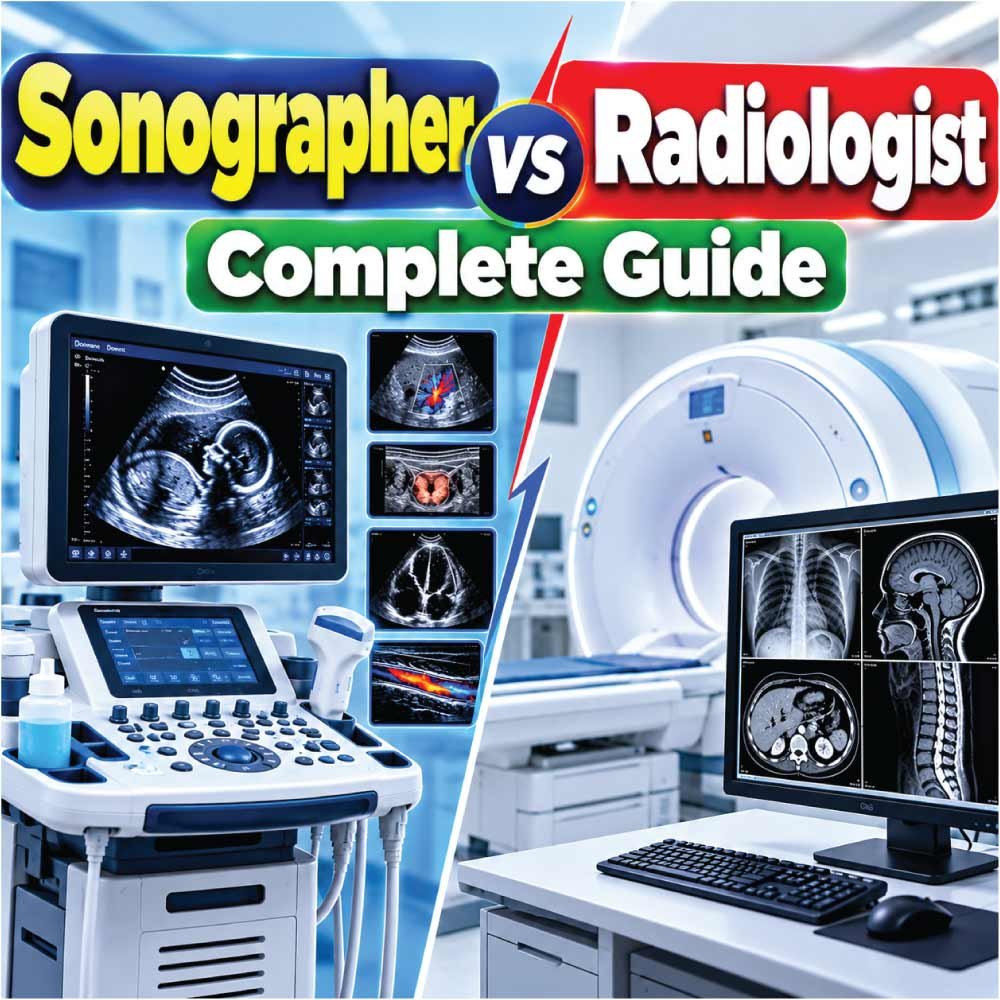
When comparing a sonographer vs radiologist, it is important to understand that these professionals work with medical imaging but have very different roles, education requirements, and responsibilities. A sonographer performs diagnostic ultrasound examinations, while a radiologist is a physician who specializes in interpreting medical images and diagnosing conditions.
The two careers often work closely together. A sonographer may perform an ultrasound examination and obtain images of a patient’s organs, tissues, blood vessels, or developing fetus. A radiologist may then review those images, depending on the healthcare setting and examination, and provide a diagnostic interpretation.
The difference becomes clearer when looking at their training and scope of practice. A sonographer is an allied health professional specializing in ultrasound technology. A radiologist first becomes a medical doctor and then completes specialized postgraduate training in radiology.
Both careers involve advanced medical technology, anatomy, patient interaction, and attention to detail, but they represent different professional paths.
What Is a Sonographer?
A sonographer is a healthcare professional trained to perform diagnostic medical ultrasound examinations. Ultrasound uses high-frequency sound waves to create images of structures inside the body.
Sonographers operate ultrasound equipment, position patients, select appropriate imaging techniques, capture diagnostic images, and evaluate the technical quality of the examination.
Depending on their specialty, sonographers may examine different parts of the body.
Common areas include:
- Abdomen and abdominal organs
- Pelvis
- Pregnancy and fetal development
- Heart and cardiovascular structures
- Blood vessels
- Musculoskeletal structures
- Breast tissue
- Pediatric anatomy
Sonography is also called diagnostic medical sonography or diagnostic ultrasound.
What Does a Sonographer Do?
The sonographer’s work is highly hands-on. Much of the examination takes place directly between the sonographer, patient, and ultrasound machine.
Typical responsibilities include:
- Reviewing the examination request
- Explaining the procedure to the patient
- Positioning the patient correctly
- Selecting appropriate ultrasound settings
- Operating the transducer
- Capturing diagnostic images
- Taking measurements when required
- Recording relevant observations
- Maintaining image quality
- Documenting the examination
- Communicating important findings according to workplace protocols
A sonographer does not simply press buttons on an ultrasound machine. They need a strong understanding of anatomy, pathology, ultrasound physics, and scanning techniques to obtain useful diagnostic images.
The quality of the examination can depend heavily on the sonographer’s technical skill and knowledge.
What Is a Radiologist?
A radiologist is a medical doctor who specializes in diagnosing and sometimes treating diseases and injuries using medical imaging.
Radiologists work with several imaging modalities, including:
- X-ray
- Computed tomography (CT)
- Magnetic resonance imaging (MRI)
- Ultrasound
- Mammography
- Fluoroscopy
- Nuclear medicine in certain practice settings
Unlike a sonographer, a radiologist follows the medical education pathway required to become a physician before specializing in radiology.
Radiologists analyze medical images in the context of the patient’s clinical history and other relevant information. They then produce diagnostic reports that help referring physicians make treatment decisions.
Some radiologists also perform image-guided procedures. These physicians may be known as interventional radiologists.
What Does a Radiologist Do?
A radiologist’s responsibilities can include:
- Interpreting diagnostic images
- Identifying abnormalities
- Comparing current and previous examinations
- Preparing radiology reports
- Communicating significant findings to other physicians
- Recommending additional imaging when appropriate
- Performing image-guided procedures in relevant specialties
- Consulting with clinical teams
- Participating in multidisciplinary patient care
The radiologist’s role is therefore broader than operating an imaging machine. It involves medical diagnosis, clinical decision-making, and communication with other healthcare professionals.
Sonographer vs Radiologist: Key Differences
Although both careers involve medical imaging, their professional roles are substantially different.
| Factor | Sonographer | Radiologist |
|---|---|---|
| Professional type | Allied health professional | Physician |
| Primary specialty | Ultrasound | Diagnostic medical imaging |
| Main technology | Ultrasound | X-ray, CT, MRI, ultrasound and others |
| Performs imaging | Yes | Usually interprets imaging |
| Interprets diagnostic studies | Provides technical observations within scope | Yes, as a physician |
| Patient interaction | Usually extensive | Variable |
| Medical school required | No | Yes |
| Diagnostic physician | No | Yes |
| Potential procedures | Generally limited to imaging examinations | Possible, depending on specialty |
| Work setting | Hospitals, clinics, imaging centers | Hospitals, clinics, imaging centers, specialty practices |
The most important distinction is that sonographers perform ultrasound examinations, while radiologists are physicians who interpret medical imaging and diagnose conditions.
Education and Training Differences
Education is one of the biggest differences between these two careers.
Sonographer Education
Aspiring sonographers generally complete an accredited education program in diagnostic medical sonography or a related specialty.
Programs may include classroom education, laboratory training, and clinical experience.
Students typically study subjects such as:
- Human anatomy
- Physiology
- Medical terminology
- Ultrasound physics
- Patient care
- Pathophysiology
- Sonographic procedures
- Image evaluation
- Professional ethics
Clinical education is particularly important because students must learn how to perform examinations on real patients.
Depending on the country and employer, professional certification or registration may also be expected or required.
Radiologist Education
The pathway to becoming a radiologist is considerably longer because radiologists are physicians.
A typical pathway includes:
- Undergraduate or pre-medical education
- Medical school
- Medical licensing
- Internship or foundational postgraduate training, depending on the system
- Radiology residency or specialist training
- Additional fellowship or subspecialty training when desired
Radiology training covers a broad range of imaging techniques and diseases.
Because radiologists are physicians, their education includes much more than imaging technology. They study medicine, disease processes, diagnosis, patient management, and clinical decision-making.
Sonographer vs Radiologist: Daily Work
The everyday experience of these careers can feel very different.
A sonographer generally spends a significant portion of the working day interacting directly with patients.
A typical ultrasound examination may involve preparing the patient, explaining what will happen, positioning the patient, performing the scan, adjusting the equipment, capturing images, and documenting the examination.
Radiologists may spend substantial portions of their day reviewing images on specialized computer workstations.
For example, a diagnostic radiologist may review:
- CT scans
- MRI examinations
- X-rays
- Ultrasound studies
- Mammograms
- Previous imaging for comparison
They then use clinical information and imaging findings to produce a report.
This means sonography tends to be more physically interactive, while many radiology roles involve considerable screen-based analytical work.
Patient Interaction and Communication
Patient contact is another major distinction.
Sonographer Patient Interaction
Sonographers commonly interact with patients throughout the examination.
They may need to:
- Explain the procedure
- Answer basic questions about the examination
- Help patients get into the correct position
- Maintain patient comfort and dignity
- Communicate with anxious or uncomfortable patients
- Follow infection-control and safety procedures
Communication skills are therefore important for sonographers.
Ultrasound examinations can sometimes require pressure from the transducer or specific positioning, so patient cooperation can directly affect image quality.
Radiologist Patient Interaction
Patient interaction varies significantly by radiology specialty.
A radiologist working primarily in diagnostic image interpretation may have less direct patient contact than a sonographer.
However, some radiologists interact directly with patients, particularly in specialties involving procedures, consultations, breast imaging, or interventional radiology.
Therefore, someone choosing between the careers should consider whether they prefer continuous patient interaction or a role that may involve more image analysis and physician-to-physician communication.
Technology Used by Sonographers and Radiologists
Both professionals rely on sophisticated technology, but the equipment they use differs.
Sonographers primarily work with ultrasound systems. They manipulate the transducer and machine controls to obtain appropriate views of the body.
Modern ultrasound systems can provide different imaging capabilities, including two-dimensional imaging, Doppler techniques, and specialized applications depending on the equipment and examination.
Radiologists may work with several imaging modalities.
| Imaging Modality | Commonly Associated Professional Role | General Purpose |
|---|---|---|
| Ultrasound | Sonographer and radiologist | Soft tissues, organs, vessels, pregnancy and other applications |
| X-ray | Radiology team | Bones, chest and other structures |
| CT | Radiology team | Cross-sectional imaging |
| MRI | Radiology team | Detailed soft-tissue and anatomical imaging |
| Mammography | Specialized imaging teams | Breast imaging |
| Fluoroscopy | Radiology team | Real-time X-ray imaging |
| Doppler ultrasound | Sonographer and radiologist | Blood flow assessment |
The exact responsibilities vary by healthcare system, workplace, and specialty.
Also Read:
Work Environment
Sonographers and radiologists can both work in hospitals and diagnostic imaging centers, but their physical work environments differ.
Sonographers often move between examination rooms and work directly with patients. Their work can require standing, positioning patients, and holding a transducer for extended periods.
Radiologists frequently work at computer workstations designed for viewing and interpreting medical images. Their work can involve long periods of sitting and concentrated visual analysis.
Potential workplaces for sonographers include:
- Hospitals
- Outpatient imaging centers
- Physician offices
- Specialty clinics
- Maternal-fetal medicine practices
- Cardiovascular departments
Radiologists may work in:
- Hospitals
- Diagnostic imaging centers
- Academic medical centers
- Private practices
- Specialty medical facilities
- Interventional departments
Some radiologists may also work remotely through teleradiology arrangements, depending on local regulations and employer practices.
Also Read:
Sonographer vs Radiologist Salary
Salary is often an important consideration when comparing these professions, but compensation varies considerably.
Factors affecting income can include:
- Country and region
- Education and credentials
- Years of experience
- Specialty
- Employer
- Work schedule
- Geographic demand
- Private versus public healthcare
- Additional responsibilities
Radiologists generally have a higher earning potential because they are physicians who undergo extensive medical education and specialist training.
Sonography can provide a healthcare career without the medical-school pathway required for physician practice.
Instead of comparing salary alone, prospective students should consider the total investment required for each career, including education, training time, licensing, and potential student debt.
Specialties Within Sonography
Sonography is not limited to one type of ultrasound examination.
A professional can develop expertise in different areas.
Diagnostic Medical Sonography
General sonographers may examine abdominal and pelvic organs, superficial structures, and other anatomical areas.
Obstetric and Gynecologic Sonography
These sonographers perform examinations related to pregnancy and the female reproductive system.
They may work with obstetric imaging and monitor fetal anatomy and development according to the examination requested.
Cardiac Sonography
Cardiac sonographers, often called echocardiographers, specialize in ultrasound examinations of the heart.
They use echocardiography equipment to acquire images and measurements used in cardiovascular assessment.
Vascular Sonography
Vascular sonographers specialize in imaging blood vessels and assessing blood flow using techniques such as Doppler ultrasound.
Musculoskeletal Sonography
Musculoskeletal ultrasound focuses on structures such as muscles, tendons, ligaments, and certain joints or soft tissues.
These specialties allow sonographers to develop focused technical expertise.
Also Read:
Radiology Subspecialties
Radiology also offers numerous paths for specialization.
Examples include:
- Diagnostic radiology
- Interventional radiology
- Neuroradiology
- Musculoskeletal radiology
- Pediatric radiology
- Breast imaging
- Emergency radiology
- Cardiothoracic radiology
- Abdominal imaging
- Nuclear medicine-related specialties in appropriate training pathways
A radiologist may therefore develop deep expertise in a particular anatomical region, disease category, imaging modality, or patient population.
This broad range of subspecialties is one reason radiology can offer many different professional directions.
Which Career Has More Patient Contact?
For people who enjoy working directly with patients, sonography generally provides more routine face-to-face interaction.
A sonographer may meet several patients during a working day and remain with each patient throughout an examination.
The role requires technical expertise combined with communication and patient-care skills.
Radiology can involve less routine patient contact, particularly in diagnostic practices where the physician spends most of the day interpreting studies.
However, this is not universal. Radiologists working in interventional or patient-facing specialties can have substantial direct interaction with patients.
The better fit therefore depends partly on whether someone prefers hands-on examinations or diagnostic image interpretation.
Which Career Requires More Medical Training?
The radiologist pathway requires substantially more formal medical education.
A radiologist must become a licensed physician before completing specialist radiology training.
A sonographer follows a different healthcare education pathway focused specifically on ultrasound and diagnostic imaging.
This distinction is important for students planning their education.
Someone who wants to become a physician and take responsibility for medical diagnosis may be interested in the radiology pathway.
Someone who wants to specialize in ultrasound technology and patient examinations without attending medical school may find sonography more aligned with that goal.
Skills Needed for Each Career
Both careers require attention to detail, but the emphasis differs.
Important Sonographer Skills
Successful sonographers commonly need:
- Strong anatomical knowledge
- Hand-eye coordination
- Ultrasound technology skills
- Patient communication
- Attention to image quality
- Physical positioning skills
- Problem-solving ability
- Professional judgment
- Patience and empathy
The ability to obtain appropriate images is especially important because ultrasound is highly operator-dependent.
Important Radiologist Skills
Radiologists need:
- Strong medical knowledge
- Detailed anatomical understanding
- Image interpretation skills
- Pattern recognition
- Clinical reasoning
- Attention to detail
- Communication skills
- Knowledge of imaging technology
- Ability to integrate clinical information
Radiologists must interpret imaging findings within the larger clinical picture rather than viewing an image in isolation.
Sonographer vs Radiologist: Career Growth
Both careers can provide opportunities for professional development.
Sonographers can pursue additional credentials or specialize in areas such as cardiac, vascular, obstetric, or musculoskeletal imaging.
Experience can also lead to roles involving education, management, quality assurance, applications support, or other healthcare-related responsibilities.
Radiologists can pursue fellowship training and specialize in specific areas of radiology.
Career development may involve:
- Subspecialty practice
- Academic medicine
- Research
- Leadership
- Teaching
- Interventional procedures
- Healthcare administration
The available opportunities depend on the healthcare system and professional qualifications.
Pros and Considerations of Sonography
Sonography may appeal to people who want a specialized healthcare career centered on diagnostic imaging and regular patient interaction.
Potential advantages include:
- Direct patient contact
- Specialized technical skills
- Variety of examinations
- Opportunities for specialization
- No medical-school pathway
- Use of advanced imaging technology
However, the profession also has physical demands. Repetitive scanning movements, awkward positions, and prolonged standing can be challenging, particularly when performed frequently over many years.
Students should therefore consider the physical nature of ultrasound work before choosing the profession.
Pros and Considerations of Radiology
Radiology may appeal to people who want to become physicians and have an interest in anatomy, diagnostic medicine, and medical technology.
Potential features include:
- Physician-level medical responsibility
- Exposure to multiple imaging modalities
- Numerous subspecialties
- Opportunities for procedures
- Diagnostic and clinical decision-making
- Research and academic opportunities
The major consideration is the extensive education and training required.
The pathway takes substantially longer than training for a sonography career, so students should understand the commitment before pursuing it.
Sonographer vs Radiologist: Which One Is Right for You?
There is no universal answer because the two professions are designed around different responsibilities.
Sonography may be worth exploring if you prefer:
- Hands-on patient care
- Ultrasound technology
- Performing examinations
- Frequent patient communication
- A focused diagnostic imaging specialty
- A shorter healthcare education pathway than becoming a physician
Radiology may be worth exploring if you prefer:
- Becoming a physician
- Diagnosing medical conditions
- Interpreting multiple imaging modalities
- Clinical decision-making
- Medical specialization
- Advanced diagnostic or procedural practice
The choice should be based on the type of work you want to perform rather than the job title alone.
Sonographer vs Radiologist: Quick Comparison
| Category | Sonographer | Radiologist |
|---|---|---|
| Main role | Performs ultrasound examinations | Interprets medical imaging and diagnoses conditions |
| Medical doctor | No | Yes |
| Main imaging technology | Ultrasound | Multiple imaging modalities |
| Patient contact | Usually frequent | Varies by specialty |
| Medical school | Not required | Required |
| Clinical training | Focused on sonography | Broad medical and radiology training |
| Specialization | Cardiac, vascular, obstetric, general and others | Many diagnostic and procedural subspecialties |
| Physical activity | Often hands-on | Often computer and workstation based |
| Diagnostic authority | Works within professional scope | Physician-level diagnostic responsibility |
| Career pathway | Allied health | Physician specialty |
Final Thoughts on Sonographer vs Radiologist
The comparison between sonographer vs radiologist is ultimately a comparison between two different healthcare careers that work within the medical imaging field.
Sonographers specialize in obtaining high-quality ultrasound examinations. Their work combines technology, anatomy, technical skill, and direct patient care.
Radiologists are physicians who use medical imaging to evaluate patients, interpret examinations, establish diagnoses, communicate findings, and, in some specialties, perform image-guided procedures.
Neither career should be viewed simply as a more advanced version of the other. They have different educational requirements, responsibilities, working environments, and professional goals.
If you enjoy hands-on imaging and regular patient interaction, sonography may align more closely with your interests. If your goal is to become a physician and specialize in medical diagnosis through imaging, radiology follows that path.
Understanding these differences before choosing an educational program can help you select a career that matches your interests, preferred working style, education goals, and long-term professional plans.

Zak is a dedicated medical and career writer specializing in sonography, healthcare education, and professional development. Through SonographerSalary.com, he shares in-depth insights on sonographer salaries, education pathways, and career tips to help readers build successful futures in medical imaging. His content combines accuracy with practical, easy-to-understand guidance, empowering students and professionals to make confident, informed career decisions.