
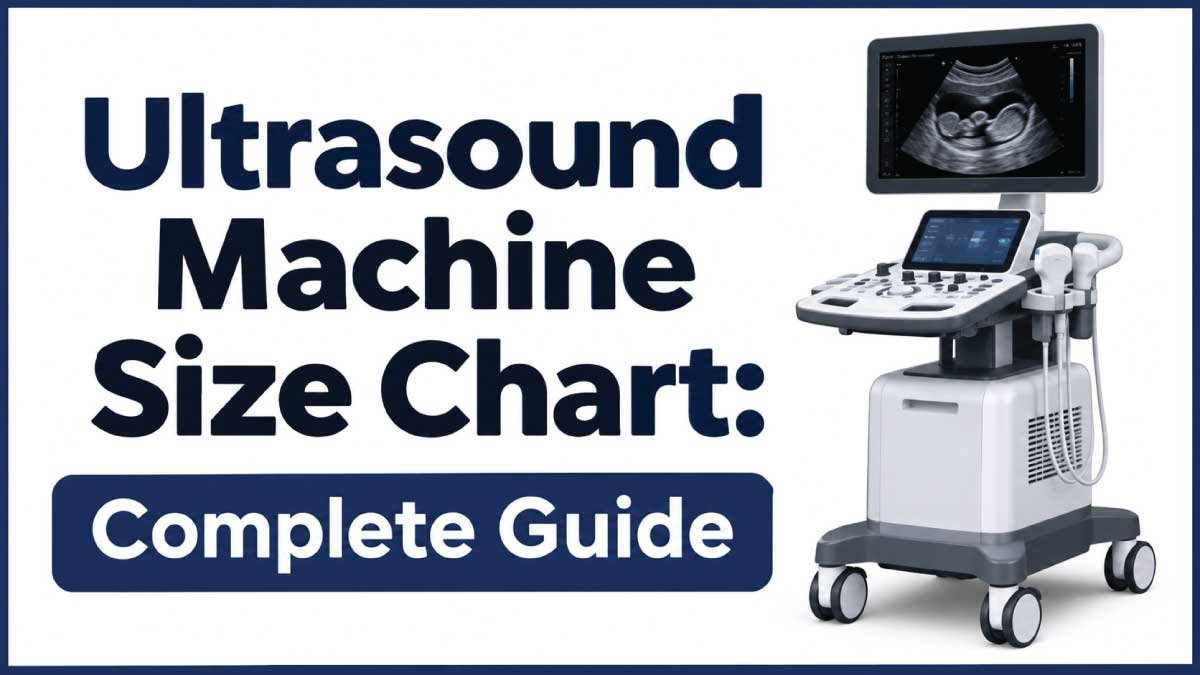
An ultrasound machine is an essential diagnostic imaging device used in hospitals, clinics, emergency departments, and specialized medical facilities. However, ultrasound systems are available in several configurations, ranging from compact handheld scanners to portable laptop systems and full-size cart-based machines. Their dimensions, weight, screen size, and storage requirements can vary considerably.
An ultrasound machine size chart helps healthcare professionals, medical equipment buyers, technicians, and facility planners understand the physical dimensions of different ultrasound systems. It also makes comparing portable and stationary equipment easier.
This guide explains common ultrasound machine types, their dimensions, typical weight considerations, monitor sizes, cart measurements, and important specifications. It also provides examples of published manufacturer dimensions to help readers understand how different systems compare.
1. What Is an Ultrasound Machine?
An ultrasound machine is a medical imaging device that uses high-frequency sound waves to create images of internal body structures. It allows healthcare professionals to examine organs, tissues, blood vessels, and developing pregnancies without using ionizing radiation.
An ultrasound system generally consists of several components:
- Main console: Contains the processing hardware and operating controls.
- Display monitor: Shows real-time ultrasound images and examination information.
- Transducer (probe): Sends and receives sound waves.
- Control panel: Provides buttons, a keyboard, touch controls, and adjustment functions.
- Power system: Supplies electricity through a mains connection or rechargeable battery.
- Cart or stand: Supports the equipment in mobile and stationary configurations.
The physical size of an ultrasound machine depends on its design, imaging capabilities, number of transducer connections, monitor configuration, and mobility requirements.
A handheld ultrasound device may fit inside a small medical bag, while a full-size diagnostic console requires a dedicated floor space.
2. Ultrasound Machine Size Chart
Ultrasound machines do not follow one universal dimensional standard. Each manufacturer develops equipment for different medical applications and working environments.
The following chart provides general equipment categories and practical size-planning guidance. These are approximate planning ranges, not standardized manufacturer specifications or guaranteed product dimensions.
| Ultrasound Machine Type | Approx. Width | Approx. Depth | Approx. Height | Typical Weight |
|---|---|---|---|---|
| Handheld scanner | 8–20 cm | 3–10 cm | 2–8 cm | 0.2–1.5 kg |
| Tablet ultrasound | 20–35 cm | 15–30 cm | 2–8 cm | 1–5 kg |
| Laptop ultrasound | 30–45 cm | 25–40 cm | 5–15 cm | 3–10 kg |
| Compact portable system | 30–45 cm | 25–45 cm | 10–30 cm | 4–15 kg |
| Portable cart-based system | 45–60 cm | 45–65 cm | 110–160 cm | 25–70 kg |
| Full-size console system | 55–80 cm | 65–100 cm | 130–180 cm | 80–200+ kg |
Important: These ranges are broad planning estimates rather than verified specifications for every model. Some products fall outside them. Always consult the manufacturer’s technical documentation before purchasing equipment or designing a clinical room.
Understanding the Dimensions
The three primary measurements used to describe an ultrasound machine are:
- Width: The horizontal measurement from the left side to the right side.
- Depth: The measurement from the front of the equipment to the back.
- Height: The vertical measurement from the bottom of the equipment to its highest point.
For cart-mounted machines, height may be adjustable. The manufacturer’s documentation should clarify whether the stated measurement includes the monitor, handle, accessories, or other attachments.
3. Ultrasound Machine Types and Their Dimensions
Different ultrasound machines are designed for specific clinical environments. Understanding their physical characteristics helps buyers select equipment that fits their workflow.
Handheld Ultrasound Machines
Handheld ultrasound machines are among the smallest available diagnostic imaging systems. They are designed for portability and point-of-care examinations.
Many handheld systems connect to compatible smartphones or tablets, while others incorporate their own display and controls.
Typical characteristics:
- Compact and lightweight construction.
- Easy transportation between examination areas.
- Battery-powered operation on compatible models.
- Limited physical footprint.
- Suitable for bedside and emergency examinations.
The exact dimensions depend on whether the equipment includes only a transducer or an integrated scanning device.
Tablet-Based Ultrasound Machines
Tablet ultrasound systems combine a touchscreen display with ultrasound processing hardware. They provide a larger viewing area than many handheld scanners while maintaining a compact design.
These systems can be used in outpatient clinics, emergency departments, and mobile medical environments.
Their physical dimensions are generally influenced by screen size, battery capacity, housing design, and probe connections.
Laptop Ultrasound Machines
Laptop-style ultrasound systems feature a folding screen and integrated control panel. Their design resembles a conventional computer, making them easier to transport than traditional console systems.
They commonly include:
- Integrated display.
- Keyboard and control interface.
- Probe connection ports.
- Rechargeable battery options.
- Internal image storage.
Their closed dimensions are important when selecting carrying cases, storage cabinets, and transportation arrangements.
Portable Cart-Based Ultrasound Machines
Portable cart-based systems combine a compact imaging console with a wheeled stand. They provide greater mobility than conventional stationary consoles while offering a more complete examination setup than handheld equipment.
These machines generally include a monitor, control panel, probe holders, storage areas, and adjustable mounting arrangements.
The cart footprint is particularly important because it determines how easily the machine can move through clinical spaces.
Full-Size Console Ultrasound Machines
Full-size ultrasound systems are designed for dedicated imaging departments and examination rooms.
They typically provide extensive controls, larger displays, multiple transducer connections, and advanced imaging capabilities.
Their dimensions and weight are usually greater than those of portable systems. Installation planning should account for equipment clearance, operator access, electrical requirements, and service access.
4. Actual Ultrasound Machine Dimensions: Manufacturer Examples
Although general size ranges are useful for planning, actual product specifications provide more reliable information.
The following examples illustrate the differences between published ultrasound machine dimensions. They are individual product specifications, not universal measurements for their respective categories.
Philips InnoSight Ultrasound Dimensions
The Philips InnoSight is a compact ultrasound system designed for mobile clinical use.
Its published physical specifications include:
| Measurement | Dimension |
|---|---|
| System length | 31.9 cm |
| System width | 22.32 cm |
| System height | 3.2 cm |
| System weight | 2.46 kg |
| Display size | 29.4 cm diagonal |
| Cart width | 48.6 cm |
| Cart depth | 56.6 cm |
| Adjustable cart height | 118.6–148.6 cm |
| Cart weight | 27.7 kg |
The tablet’s dimensions should not be confused with the dimensions of its optional mobility cart. The cart occupies substantially more space than the imaging device itself.
Siemens ACUSON P500 Dimensions
The Siemens ACUSON P500 is a portable ultrasound system designed for point-of-care applications.
Its published dimensions in working position are:
| Measurement | Dimension |
|---|---|
| Length | 40.2 cm |
| Height | 37.4 cm |
| Depth | 36 cm |
| Weight with battery | 7.2 kg |
| Monitor size | 15.4 inches |
This example demonstrates how a portable ultrasound system can provide a relatively substantial display while remaining suitable for transportation.
GE Versana Active Cart Dimensions
The GE Versana Active specification sheet provides separate measurements for its optional ergonomic trolley cart.
| Measurement | Dimension |
|---|---|
| Length | 55.5 cm |
| Depth | 51.5 cm |
| Height | 89 cm |
| Weight | 21 kg |
These measurements describe the specified trolley cart, not necessarily the complete assembled ultrasound system.
Comparison of Published Manufacturer Specifications
| Manufacturer | Model | Equipment Component | Published Weight |
|---|---|---|---|
| Philips | InnoSight | Imaging system | 2.46 kg |
| Philips | InnoSight | Mobility cart | 27.7 kg |
| Siemens | ACUSON P500 | Portable system with battery | 7.2 kg |
| GE | Versana Active | Optional trolley cart | 21 kg |
The comparison highlights an important point: an ultrasound console, tablet, and mobility cart can have completely different physical specifications even when they belong to the same imaging system.
5. Ultrasound Monitor Size Chart
The display is another important consideration when evaluating ultrasound machine dimensions.
Monitor size is generally measured diagonally from one corner of the visible screen to the opposite corner. It is not the same as the width or height of the entire monitor housing.
The following chart provides illustrative display-size categories for equipment planning.
| Display Category | Screen Size (Inches) | Approx. Diagonal (cm) |
|---|---|---|
| Small handheld display | 5–8 inches | 12.7–20.3 cm |
| Compact tablet display | 8–12 inches | 20.3–30.5 cm |
| Portable system display | 12–15 inches | 30.5–38.1 cm |
| Standard console display | 15–19 inches | 38.1–48.3 cm |
| Large console display | 19–24 inches | 48.3–61 cm |
These are descriptive display categories, not mandatory ultrasound monitor sizes.
Factors That Affect Monitor Selection
When selecting an ultrasound monitor, consider:
- Screen resolution: Higher resolution can improve image detail and interface clarity.
- Viewing angle: Important when multiple healthcare professionals need to view the examination.
- Brightness: Helps maintain visibility under different lighting conditions.
- Touchscreen functionality: Can simplify image selection and examination controls.
- Adjustability: Tilting and positioning options improve operator comfort.
- Screen protection: Important for equipment that is transported frequently.
A larger display is not automatically better for every clinical application. Screen size should match the examination environment, imaging requirements, and available workspace.
6. Ultrasound Machine Cart Size Chart
The cart is an important part of mobile ultrasound equipment. It supports the imaging console and provides space for accessories, probes, cables, and other components.
Cart dimensions vary according to the machine’s mounting system, storage configuration, and adjustment mechanism.
| Cart Measurement | What It Describes |
|---|---|
| Cart width | Overall horizontal footprint |
| Cart depth | Front-to-back floor space |
| Cart height | Floor-to-top measurement |
| Base width | Width of the wheel-supporting structure |
| Base depth | Front-to-back measurement of the base |
| Work surface height | Height of the operator’s working area |
| Wheel diameter | Size of the cart’s caster wheels |
Important Cart Features
A suitable ultrasound cart should provide:
- Stable support for the imaging console.
- Locking wheels to prevent unwanted movement.
- Adjustable monitor positioning.
- Accessible probe holders.
- Organized cable management.
- Storage for accessories and supplies.
- Sufficient clearance for operator movement.
The cart should also allow convenient access to the equipment’s power connections and service panels.
Also Read:
7. Ultrasound Transducer and Probe Sizes
Ultrasound transducers, commonly called probes, are essential components of diagnostic imaging systems.
They transmit sound waves into the body and receive returning echoes that are processed into images.
Different transducer designs are used for different examination types. Their physical shapes and dimensions vary according to the imaging application and manufacturer.
Common Ultrasound Probe Types
| Probe Type | General Shape | Common Applications |
|---|---|---|
| Linear array | Flat, rectangular head | Vascular, thyroid, superficial structures |
| Curved array | Curved scanning surface | Abdominal and obstetric imaging |
| Phased array | Small contact surface | Cardiac examinations |
| Endocavitary | Narrow, elongated design | Transvaginal and transrectal examinations |
| Microconvex | Small curved surface | Pediatric and specialized imaging |
What Determines Probe Size?
Probe dimensions depend on several design characteristics:
- Transducer frequency.
- Number and arrangement of elements.
- Contact surface shape.
- Cable and connector design.
- Intended examination.
- Ergonomic requirements.
There is no single standard probe length or width applicable to every ultrasound manufacturer.
Healthcare facilities should check the compatible probe list and physical specifications before ordering replacement transducers.
Also Read:
8. Ultrasound Machine Dimensions in Inches and Centimeters
Medical equipment documentation may use either metric or imperial measurements. Understanding both systems makes product comparisons easier, particularly when purchasing equipment internationally.
The following conversion chart provides commonly used dimensional equivalents.
| Centimeters (cm) | Inches (in) |
|---|---|
| 10 cm | 3.94 in |
| 15 cm | 5.91 in |
| 20 cm | 7.87 in |
| 25 cm | 9.84 in |
| 30 cm | 11.81 in |
| 35 cm | 13.78 in |
| 40 cm | 15.75 in |
| 45 cm | 17.72 in |
| 50 cm | 19.69 in |
| 55 cm | 21.65 in |
| 60 cm | 23.62 in |
| 70 cm | 27.56 in |
| 80 cm | 31.50 in |
| 90 cm | 35.43 in |
| 100 cm | 39.37 in |
| 120 cm | 47.24 in |
| 150 cm | 59.06 in |
How to Convert Ultrasound Machine Measurements
Use these standard mathematical relationships:
Centimeters to inches:
Inches = Centimeters ÷ 2.54
Inches to centimeters:
Centimeters = Inches × 2.54
Kilograms to pounds:
Pounds = Kilograms × 2.20462
For example, a portable ultrasound system measuring 40 cm in width is approximately 15.75 inches wide.
These conversions are useful when comparing manufacturer specification sheets that use different measurement systems.
9. How to Measure an Ultrasound Machine
Accurate measurements are necessary when purchasing equipment, arranging a medical examination room, or planning transportation.
Follow these steps to measure an ultrasound machine correctly.
Step 1: Measure the Width
Position the equipment on a stable, level surface.
Measure horizontally from the outermost point on the left side to the outermost point on the right side.
Include permanently attached components that extend beyond the main housing.
Step 2: Measure the Depth
Measure from the frontmost point of the equipment to its rearmost point.
Pay attention to handles, cable connections, rear panels, and other protruding components.
Step 3: Measure the Height
Measure vertically from the floor or supporting surface to the highest point of the equipment.
For adjustable systems, record both the minimum and maximum operating heights.
Step 4: Measure the Cart Footprint
For mobile ultrasound machines, measure the outer dimensions of the cart base.
Include the wheel assemblies if they extend beyond the main supporting structure.
Step 5: Record the Weight
Check whether the manufacturer’s weight specification includes:
- Battery.
- Transducers.
- Accessories.
- Monitor.
- Cart.
- Optional equipment.
Do not assume that the console’s weight represents the complete assembled system.
Step 6: Record the Measurements
Prepare a simple specification record containing width, depth, height, weight, monitor size, and cart dimensions.
This information makes it easier to compare equipment and verify installation requirements.
10. How to Choose the Right Ultrasound Machine Size
Selecting an ultrasound machine involves more than comparing its external dimensions. The equipment must fit the clinical environment and provide the necessary imaging functions.
Consider the Available Room Space
Measure the intended installation area before purchasing a system.
Allow sufficient space for:
- The ultrasound machine.
- Patient examination equipment.
- Operator seating.
- Movement around the cart.
- Electrical connections.
- Maintenance access.
A machine that fits physically may still be inconvenient if it restricts movement around the examination table.
Evaluate Portability Requirements
Consider how frequently the machine will be moved.
A handheld or tablet-based system may be suitable for bedside examinations and mobile healthcare services. A cart-based system may be more appropriate for clinics that need a complete workstation.
Check the Display Size
Select a display that provides suitable image visibility for the intended examinations.
Consider screen resolution, viewing distance, monitor adjustment, and available lighting.
Consider Probe Compatibility
The number and types of compatible transducers are important purchasing considerations.
A compact system may have fewer active probe connections than a larger console, depending on its configuration.
Check Weight and Transportation Requirements
Equipment weight affects transportation, storage, and installation.
For mobile systems, consider the combined weight of the console, cart, battery, and accessories.
Review Manufacturer Specifications
Always verify:
- Complete system dimensions.
- Maximum and minimum height.
- Cart footprint.
- Total assembled weight.
- Electrical requirements.
- Probe compatibility.
- Operating and storage conditions.
- Applicable safety documentation.
11. Common Applications of Different Ultrasound Machine Sizes
Different equipment configurations support different clinical environments.
| Machine Type | Typical Clinical Environment | Main Advantage |
|---|---|---|
| Handheld | Emergency and bedside care | Very compact |
| Tablet-based | Outpatient clinics | Portability and touchscreen operation |
| Laptop-based | Mobile medical services | Integrated workstation |
| Portable cart-based | Hospitals and clinics | Mobility with organized accessories |
| Full-size console | Diagnostic imaging departments | Comprehensive workstation configuration |
The appropriate size depends on the examinations being performed, the clinical workflow, and the available space.
A small device is not necessarily suitable for every examination, and a larger console is not automatically required for every clinical environment.
12. Advantages and Limitations of Different Ultrasound Machine Sizes
Understanding the benefits and limitations of each configuration helps healthcare facilities make more informed purchasing decisions.
Handheld and Compact Ultrasound Systems
Advantages:
- Easy to transport.
- Require relatively little storage space.
- Convenient for bedside examinations.
- Often support battery-powered operation.
Limitations:
- Smaller displays on some models.
- Potentially fewer physical controls.
- Capabilities vary significantly between devices.
- May require a compatible external display.
Portable Cart-Based Systems
Advantages:
- Easier movement between examination rooms.
- Organized probe and cable storage.
- Integrated display and operating controls.
- More substantial working platform.
Limitations:
- Require more floor space than handheld devices.
- Cart weight can affect transportation.
- Wheel clearance and turning space must be considered.
- Some configurations require dedicated storage areas.
Full-Size Console Systems
Advantages:
- Comprehensive workstation design.
- Larger control surfaces on many models.
- Multiple accessory and probe configurations.
- Suitable for dedicated imaging departments.
Limitations:
- Larger physical footprint.
- Greater transportation and installation requirements.
- Higher space-planning demands.
- Less convenient for frequent movement.
13. Common Mistakes When Comparing Ultrasound Machine Dimensions
Incorrect dimension comparisons can cause purchasing and installation problems.
Avoid these common mistakes:
- Comparing the console with the complete cart: These are different equipment configurations and should be measured separately.
- Ignoring adjustable height: A cart’s minimum height may differ considerably from its maximum working height.
- Forgetting attached accessories: Handles, cable holders, and external components can increase the overall footprint.
- Confusing screen size with monitor dimensions: Display size is measured diagonally, not across the monitor’s full width.
- Ignoring total weight: A portable console may be lightweight, but its complete cart assembly can be substantially heavier.
- Assuming all models share standard dimensions: Ultrasound equipment dimensions are manufacturer- and model-specific.
- Using approximate measurements for installation: Room planning should use verified product drawings and installation documentation.
These considerations are particularly important when purchasing expensive diagnostic equipment or preparing a new imaging department.
14. Frequently Asked Questions About Ultrasound Machine Sizes
1. What is the standard size of an ultrasound machine?
There is no universal standard size for ultrasound machines. Handheld systems can be very compact, while portable cart-based and full-size console systems occupy considerably more space. Dimensions depend on the manufacturer, model, and configuration.
2. How much does an ultrasound machine weigh?
Weight varies by equipment type. Small handheld devices can weigh less than 1 kg, while portable systems may weigh several kilograms. Complete cart-based and console systems can weigh considerably more.
3. What is the average width of a portable ultrasound machine?
Portable systems have different configurations. Tablet-style devices may be around 20–35 cm wide, while their supporting carts can be wider. Always check the specific model’s published dimensions.
4. How big is an ultrasound machine monitor?
Ultrasound displays come in different sizes. Compact systems may have smaller screens, while portable and full-size consoles can feature larger displays. Some systems use monitors around 12–19 inches or more.
5. What is the difference between portable and cart-based ultrasound machines?
Portable ultrasound machines are designed for transportation and may use handheld, tablet, or laptop configurations. Cart-based systems mount the imaging equipment on a wheeled stand, providing additional storage and an organized workstation.
6. Are all ultrasound machine dimensions measured in centimeters?
No. Manufacturers may publish dimensions in centimeters, millimeters, or inches. These units can be converted using the standard conversion factor of 1 inch = 2.54 centimeters.
7. How much space does an ultrasound machine require?
The required space depends on the complete system dimensions, cart configuration, examination table, operator position, and room layout. The manufacturer’s installation drawings and applicable healthcare facility requirements should determine the final space allocation.
8. Does a larger ultrasound machine provide better image quality?
Not necessarily. Image quality depends on several factors, including transducer technology, processing capabilities, imaging settings, and system configuration. Physical size alone does not determine diagnostic performance.
9. Can an ultrasound machine cart be adjusted in height?
Many modern ultrasound carts offer adjustable height or monitor positioning. However, adjustment ranges differ between manufacturers and models. Check the technical specifications before purchasing.
10. Where can I find the exact dimensions of an ultrasound machine?
The most reliable sources are the manufacturer’s product specification sheet, technical datasheet, user manual, and installation documentation. These documents provide model-specific dimensions, weight, and configuration details.
15. Conclusion
Choosing the correct ultrasound machine size requires understanding its overall dimensions, weight, display configuration, cart footprint, and intended clinical application. Handheld and tablet systems are useful where portability and compact storage are priorities, while cart-based and full-size console systems provide different workstation configurations for hospitals and diagnostic facilities.
The ultrasound machine size chart in this guide offers a starting point for comparing equipment categories and understanding important measurements. However, there is no universal dimensional standard for all ultrasound machines.
For accurate purchasing, transportation, and installation decisions, always verify the exact model specifications provided by the manufacturer. This ensures the selected equipment fits the available space and meets the practical requirements of the healthcare environment.

Zak is a dedicated medical and career writer specializing in sonography, healthcare education, and professional development. Through SonographerSalary.com, he shares in-depth insights on sonographer salaries, education pathways, and career tips to help readers build successful futures in medical imaging. His content combines accuracy with practical, easy-to-understand guidance, empowering students and professionals to make confident, informed career decisions.