
Medical imaging technologists play a vital role in modern healthcare. They are the professionals who operate imaging equipment used to visualize the internal structures of the body to diagnose illnesses, assess injuries, and guide treatment.
In this comprehensive guide, we’ll delve into what medical imaging technologists do, the education
and training required, potential specializations, salary expectations, job outlook, and tips for building a successful career.
Who Is a Medical Imaging Technologist?
A medical imaging technologist (also called a radiologic technologist or radiographer) is a highly trained healthcare professional responsible for producing diagnostic images using technologies like X‑rays, CT scans, MRI, ultrasound, and nuclear medicine.
They work closely with radiologists—the physicians who interpret the images—and other healthcare providers to help diagnose patient conditions.
These professionals are more than “button pushers.” They must understand anatomy, radiation safety, patient positioning, image optimization, and patient care.
Their work directly affects diagnosis, treatment planning, and patient outcomes.
Key Responsibilities
Key responsibilities define the essential duties and tasks expected in a role.
They outline what an individual must accomplish daily, ensuring efficiency, accountability, and alignment with organizational goals.
Understanding these responsibilities helps employees prioritize work, meet performance standards, and contribute meaningfully to team and organizational success.
-
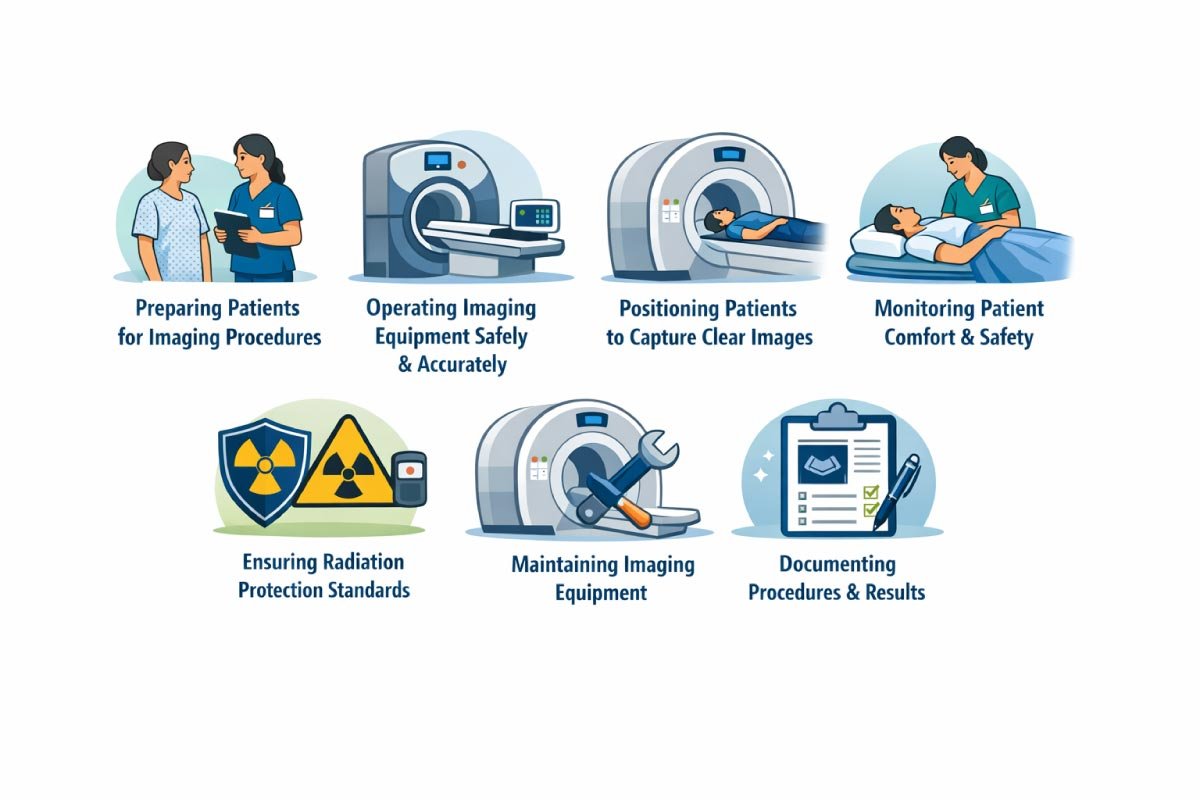
Preparing patients for imaging procedures
-
Operating imaging equipment safely and accurately
-
Positioning patients to capture clear images
-
Monitoring patient comfort and safety
-
Ensuring radiation protection standards
-
Maintaining imaging equipment
-
Documenting procedures and results
Types of Medical Imaging Technologies
Medical imaging technologies use advanced tools to visualize the inside of the body for diagnosis, treatment, and monitoring.
Common types include X-rays, CT scans, MRI, ultrasound, and nuclear medicine.
Each modality offers unique benefits, helping healthcare professionals detect conditions accurately and plan effective patient care.
| Imaging Technology | Description | Common Uses |
|---|---|---|
| X‑Ray | Uses electromagnetic radiation to capture 2D images of bones and organs | Broken bones, chest exams |
| Computed Tomography (CT) | Series of X‑ray images combined to create cross‑sectional views | Trauma, cancer diagnosis |
| Magnetic Resonance Imaging (MRI) | Uses magnetic fields and radio waves to produce detailed images | Brain, spine, soft tissue evaluation |
| Ultrasound (Sonography) | Sound waves create real‑time images | Pregnancy, abdominal organs |
| Nuclear Medicine | Radioactive tracers highlight physiological function | Bone scans, cardiac studies |
Each modality requires specific skills, safety procedures, and sometimes separate credentialing.
Education & Certification Requirements
Becoming a medical imaging technologist requires formal education, clinical training, and certification/licensure.
Requirements can vary by country and state, but the general pathway includes:
Step 1: Complete High School or Equivalent
Completing high school or obtaining an equivalent credential, such as a GED, is the foundational step for pursuing further education or entering a healthcare career.
It equips individuals with essential skills in math, science, and communication, preparing them for specialized training programs and professional certifications.
Step 2: Enroll in an Accredited Imaging Program
Enrolling in an accredited imaging program is a critical step toward a career in medical imaging.
These programs provide structured education, hands-on clinical training, and exposure to various imaging technologies.
Accreditation ensures the curriculum meets industry standards, preparing students for certification exams and professional practice.
Programs can be offered at:
-
Community colleges (Associate Degree)
-
Universities (Bachelor’s Degree)
-
Certificate programs (for those with prior healthcare education)
Most students pursue either:
-
Associate of Science in Radiologic Technology (2 years)
-
Bachelor’s Degree in Medical Imaging or Allied Health (4 years)
Step 3: Clinical Experience
Clinical experience provides hands-on training in real healthcare settings, allowing students to apply theoretical knowledge under professional supervision.
It develops practical skills, patient care abilities, and familiarity with medical imaging equipment. This experience is essential for building confidence, competence,
and readiness for certification and a successful career in medical imaging.
-
Patient interaction
-
Image acquisition
-
Equipment operation
-
Safety protocols
Step 4: Certification & Licensure
Certification and licensure validate a medical imaging professional’s knowledge, skills, and competence.
Obtaining credentials from recognized organizations ensures adherence to industry standards and legal requirements.
These credentials enhance career opportunities, credibility, and professional growth, while also demonstrating a commitment to safe, effective, and ethical patient care.
In many areas, technologists must:
-
Pass a certification exam
-
Obtain state licensure
In the U.S., the American Registry of Radiologic Technologists (ARRT) certification is widely recognized. Other countries have equivalent credentialing bodies.
Step 5: Optional Specialization
Optional specialization allows medical imaging professionals to focus on a specific area, such as MRI, CT, mammography, or interventional radiology.
Specializing enhances expertise, increases career opportunities, and often leads to higher earning potential.
It enables professionals to provide advanced, focused care and stay current with evolving technologies in their chosen field.
After entry‑level certification, technologists can specialize in areas such as:
-
CT
-
MRI
-
Mammography
-
Sonography
-
Nuclear Medicine
These often require additional exams.
Career Path & Advancement
Career path and advancement in medical imaging involve progressing from entry-level roles to specialized or leadership positions.
Opportunities may include technologist supervisor, department manager, or advanced imaging specialist. Continued education, certifications,
and experience play key roles in career growth, allowing professionals to expand responsibilities, expertise, and earning potential over time.
Medical imaging technology is a dynamic field with multiple growth opportunities.
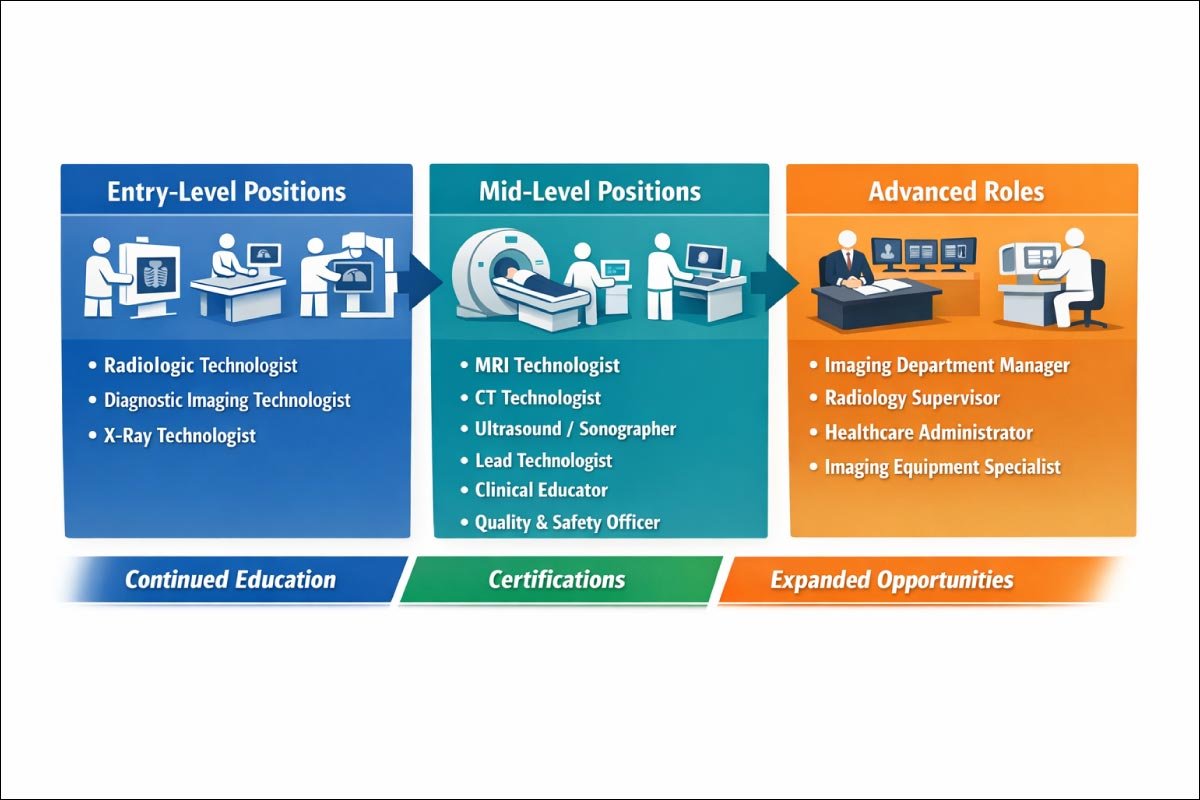
1- Entry‑Level Positions
Entry‑level positions in medical imaging provide foundational experience and exposure to clinical workflows.
Roles such as imaging assistant or junior technologist allow individuals to develop technical skills, patient interaction abilities, and familiarity with equipment.
These positions serve as a stepping stone toward specialization, certification, and long-term career growth in the field.
-
Radiologic Technologist
-
Diagnostic Imaging Technologist
-
X‑ray Technologist
2- Mid‑Level Positions
Mid‑level positions in medical imaging typically involve greater responsibility, advanced technical skills, and supervisory duties.
Roles may include certified technologist, lead imaging specialist, or modality coordinator.
Professionals at this level manage complex procedures, mentor junior staff, and contribute to departmental efficiency, positioning themselves for senior or specialized career opportunities.
As experience grows, technologists may focus on advanced modalities:
-
MRI Technologist
-
CT Technologist
-
Ultrasound/Sonographer
They may also take on:
-
Lead technologist roles
-
Educator or clinical instructor positions
-
Quality assurance or safety officer roles
3- Advanced Roles
Advanced roles in medical imaging encompass leadership, specialized expertise, and strategic responsibilities.
Positions such as imaging department manager, clinical educator, or advanced modality specialist require extensive experience, certifications, and advanced skills.
Professionals in these roles oversee operations, implement best practices, and drive innovation, shaping the future of patient care and imaging services.
With further education or experience:
-
Imaging department manager
-
Radiology supervisor
-
Healthcare administrator
-
Sales or clinical specialist for imaging equipment companies
Continuing education and certifications (e.g., ARRT advanced certifications) accelerate advancement.
Salary Overview
Salaries vary based on location, experience, specialization, setting, and credentials. Below is a general overview (approximate figures in USD for perspective—actual numbers vary by region and facility):
| Experience Level | Annual Salary (USD) |
|---|---|
| Entry‑Level | $50,000 – $65,000 |
| Mid‑Career | $65,000 – $80,000 |
| Experienced / Specialized | $80,000 – $100,000+ |
Technologists in specialized roles (e.g., MRI or CT) and those working in high‑paying regions or facilities typically earn more.
Salary by Modality
| Modality | Average Annual Salary (USD) |
|---|---|
| X‑Ray Radiologic Technologist | $55,000 – $70,000 |
| CT Technologist | $70,000 – $90,000 |
| MRI Technologist | $75,000 – $95,000 |
| Ultrasound / Sonographer | $70,000 – $90,000 |
| Nuclear Medicine Technologist | $75,000 – $100,000+ |
Note: These figures are estimates and can vary significantly across countries, regions, clinical settings, and years of experience.
Job Settings & Work Environment
Medical imaging professionals work in diverse settings, including hospitals, outpatient clinics, diagnostic centers, and mobile imaging units.
Work environments vary from fast-paced emergency departments to routine screening facilities.
Understanding these settings helps professionals adapt to different patient populations, schedules, and workflow demands while maintaining high standards of care and safety.
| Work Setting | Description |
|---|---|
| Hospitals | Most common; fast‑paced, diverse cases |
| Outpatient Imaging Centers | Scheduled exams, regular hours |
| Physician Offices / Clinics | Smaller caseloads |
| Emergency Departments | Critical trauma imaging |
| Mobile Imaging Services | On‑site imaging at different locations |
| Research Facilities | Support clinical imaging studies |
Shifts may include evenings, nights, weekends, or on‑call hours, particularly in hospitals.
Discover More:
Skills & Qualities for Success
Medical imaging technologists must combine technical expertise with strong interpersonal abilities to provide high-quality patient care.
Success in this role requires a blend of scientific knowledge, precise operational skills,
and emotional intelligence to navigate both complex imaging tasks and patient interactions effectively.
1- Technical Skills
Technologists need a solid understanding of imaging physics, including how different modalities work and how to optimize image quality for accurate diagnosis.
Mastery of equipment operation, radiation principles, and electronic health record (EHR) systems ensures safe, efficient, and precise imaging procedures.
-
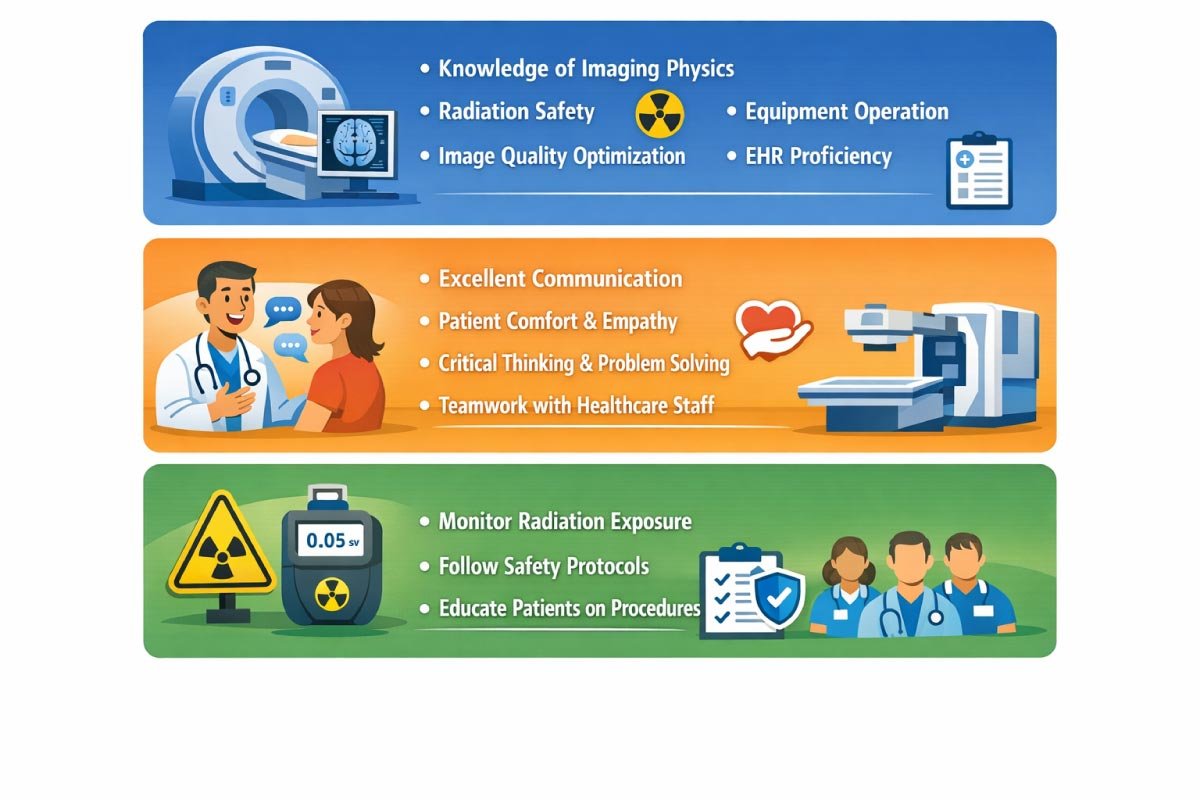
Knowledge of imaging physics
-
Radiation safety
-
Equipment operation
-
Image quality optimization
-
Electronic health record (EHR) proficiency
2- Interpersonal & Professional Skills
Strong communication is essential, both with patients and healthcare team members. Technologists must provide clear instructions, reassure patients during procedures, and demonstrate empathy.
Critical thinking allows them to adjust positioning and solve unexpected challenges while maintaining professionalism and teamwork under pressure.
-
Excellent communication
-
Patient comfort and empathy
-
Critical thinking for positioning and troubleshooting
-
Teamwork with healthcare professionals
3- Safety Awareness
Patient and staff safety is a top priority. Technologists must monitor radiation exposure carefully, adhere strictly to safety protocols, and educate patients about precautions.
Ongoing vigilance ensures compliance with regulations and protects everyone in the imaging environment from unnecessary risk.
Radiologic safety is paramount. Technologists must continuously:
-
Monitor radiation exposure
-
Follow safety protocols
-
Educate patients about procedures
Career Outlook & Future Trends
Healthcare demand continues to grow due to aging populations and increased diagnostic imaging needs.
According to labor statistics (e.g., U.S. Bureau of Labor Statistics), radiologic technologist positions are expected to grow faster than average, driven by:
- Increasing use of imaging in diagnosis
- Aging population requiring more diagnostic exams
- Technological advances expanding imaging capabilities
Future trends include:
-
AI and machine learning integration to enhance image interpretation
-
Advanced imaging modalities
-
Tele‑imaging and remote support services
-
Greater focus on radiation dose management
These trends suggest not only stability but also new opportunities for innovation and specialization.
Discover More:
How to Choose the Right Imaging Program
Choosing the right imaging program involves evaluating accreditation, curriculum quality, clinical training opportunities, and faculty expertise.
Prospective students should consider program length, cost, and career placement support.
Selecting a program that aligns with career goals ensures comprehensive education, hands-on experience, and preparation for certification and long-term success in medical imaging.
| Program Type | Duration | Typical Outcome |
|---|---|---|
| Certificate Program | 1 – 2 years | Entry into imaging field (for those with prior health background) |
| Associate Degree | 2 years | Most common route; qualifies for ARRT certification |
| Bachelor’s Degree | 4 years | More advanced clinical and leadership preparation |
| Online / Hybrid Programs | varies | Flexible for working students (must include clinical hours) |
- Tips when choosing a program:
- Ensure accreditation (e.g., JRCERT in the U.S.)
- Look at clinical rotation sites
- Ask about certification pass rates
- Consider modality specialization opportunities
Discover More:
Tips for Building a Successful Career
Growing and thriving as a medical imaging technologist requires a combination of strong technical skills, ongoing learning, and professional development.
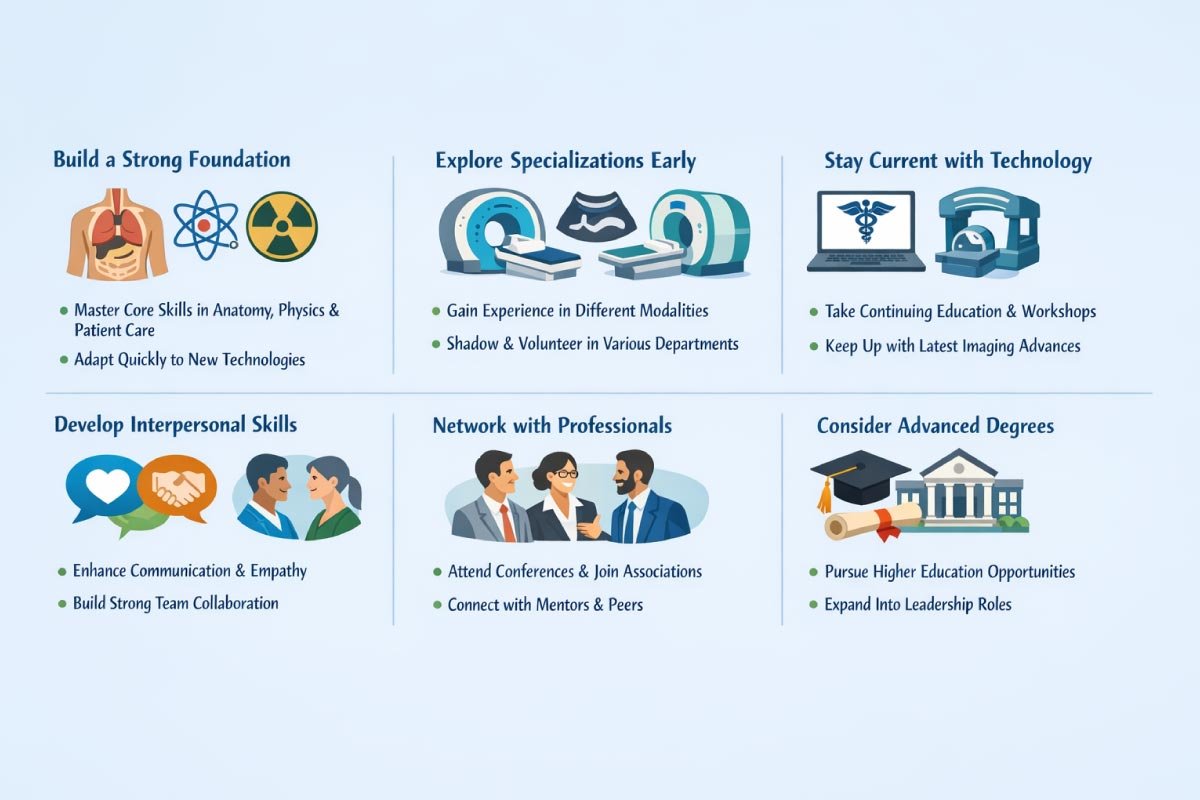
These actionable strategies can help you build a long-lasting, rewarding career in medical imaging.
1- Build a Strong Foundation
Mastering the basics of anatomy, imaging physics, radiation safety, and patient care provides the essential knowledge for accurate and safe imaging.
A solid foundation allows you to adapt quickly to new technologies and ensures confidence in performing complex procedures.
2- Explore Specializations Early
Gaining exposure to different modalities such as MRI, CT, ultrasound, or nuclear medicine can help you identify your preferred specialty.
Shadowing professionals or volunteering in various imaging departments allows you to understand workflow differences and develop skills in high-demand areas.
3- Stay Current with Technology
Medical imaging evolves rapidly with new equipment and software updates. Participating in continuing education courses, workshops,
and online training ensures you remain proficient and can provide the most accurate, cutting-edge imaging services to patients.
4- Develop Interpersonal Skills
Effective communication and empathy improve patient comfort and cooperation during procedures, leading to better image quality and outcomes.
Building trust with patients and collaborating seamlessly with colleagues enhances workplace efficiency and patient satisfaction.
5- Network with Professionals
Joining professional associations, attending conferences, and connecting with peers fosters mentorship opportunities, knowledge sharing, and career growth.
Networking can open doors to specialized positions, research opportunities, and leadership roles in medical imaging.
6- Consider Advanced Degrees
Pursuing a bachelor’s or master’s degree can expand career options into leadership, education, or management roles.
Advanced education provides deeper clinical knowledge, research skills, and strategic thinking abilities, positioning you for high-level responsibilities and increased professional influence.
Final Thoughts
Medical imaging technologists occupy a trusted and essential role in healthcare.
They blend technical expertise with patient interaction, working behind the scenes to provide life‑saving diagnostic information.
Whether you are just exploring career options or thinking about advancing in your field, medical imaging offers diversity, stability, and opportunities for growth.
Discover More:

Zak is a dedicated medical and career writer specializing in sonography, healthcare education, and professional development. Through SonographerSalary.com, he shares in-depth insights on sonographer salaries, education pathways, and career tips to help readers build successful futures in medical imaging. His content combines accuracy with practical, easy-to-understand guidance, empowering students and professionals to make confident, informed career decisions.