
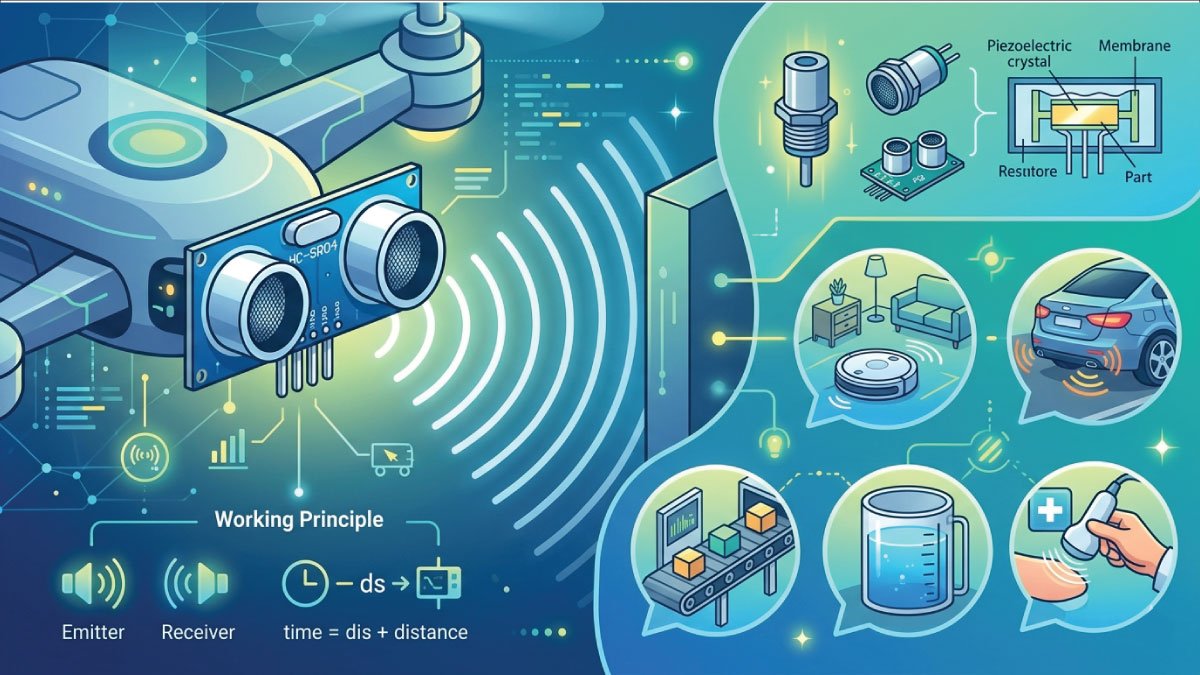
Ultrasonic sensors are one of the most widely used technologies in modern electronics, automation, and robotics. They are known for their accuracy, reliability, and ability to detect objects without physical contact.
Whether used in industrial automation, automotive systems, or smart devices, ultrasonic sensors play a vital role in distance measurement and object detection.
In this guide, you will learn everything about ultrasonic sensors, including their working principle, types, applications, advantages, and real-world uses.
What is an Ultrasonic Sensor?
An ultrasonic sensor is an electronic device that uses high-frequency sound waves to detect objects and measure distances. These sound waves are beyond the range of human hearing (typically above 20 kHz), which is why they are called “ultrasonic.”
The sensor works by emitting sound waves and measuring the time it takes for the echo to return after hitting an object. This method is commonly referred to as the time-of-flight principle.
How Does an Ultrasonic Sensor Work?
An ultrasonic sensor works by emitting high-frequency sound waves and measuring the time it takes for the echo to return after hitting an object. This process is based on reflection and is widely used for accurate, non-contact distance measurement in robotics, automation, and industrial systems.
Step-by-Step Working Principle
Step 1: Transmission of Sound Waves
The transmitter in the ultrasonic sensor generates and emits high-frequency sound waves into the surrounding environment. These waves travel through the air at the speed of sound and move in a straight path until they encounter an object.
Step 2: Travel Through Air
After emission, the ultrasonic waves propagate through the air. The distance they travel depends on the presence and position of objects. If no object is detected, the waves continue traveling without reflection.
Step 3: Reflection from Object
When the ultrasonic waves hit an object, they bounce back toward the sensor. This reflection occurs because different surfaces reflect sound waves differently depending on material, texture, and angle.
Step 4: Reception of Echo
The receiver component of the sensor detects the reflected sound waves, also known as the echo. The time between sending and receiving the signal is carefully measured by the sensor’s internal circuitry.
Step 5: Time Measurement
The sensor calculates the time taken for the sound wave to travel to the object and return. This time interval is extremely small and is measured in microseconds for precise calculations.
Step 6: Distance Calculation
Using the measured time and the known speed of sound, the sensor computes the distance between itself and the object. This is done using a simple mathematical formula based on time-of-flight.
Key Formula Explained
Distance Calculation Formula
The ultrasonic sensor uses the following equation to determine distance:
Distance = (Speed of Sound × Time) / 2
Explanation of the Formula
- The speed of sound in air is approximately 343 meters per second (at room temperature).
- The time refers to the total time taken for the sound wave to travel to the object and return.
- The division by 2 is necessary because the sound wave travels twice the distance (to the object and back).
Why This Method is Accurate
Ultrasonic sensors are highly accurate because they rely on precise time measurement. Since sound travels at a constant speed in a given environment, the sensor can calculate distance reliably as long as environmental conditions remain stable.
Practical Example
If the sensor measures a time delay of 0.01 seconds, the distance can be calculated as:
Distance = (343 × 0.01) / 2 = 1.715 meters
This means the object is approximately 1.7 meters away from the sensor.
Importance of This Working Principle
The time-of-flight principle used in ultrasonic sensors makes them extremely useful in many real-world applications. It allows machines and systems to detect objects without contact, ensuring safety, efficiency, and precision in various environments such as robotics, automotive systems, and industrial automation.
Types of Ultrasonic Sensors
Ultrasonic sensors come in different types based on their design, working method, and intended application. Each type is engineered to handle specific tasks such as detecting objects, measuring distances, or operating in complex environments. Understanding these types helps in selecting the right sensor for accurate and efficient performance in real-world systems.
1. Proximity Ultrasonic Sensors
Proximity ultrasonic sensors are designed to detect the presence or absence of objects within a limited range without measuring exact distance. They are commonly used in systems where simple detection is sufficient. These sensors are reliable, cost-effective, and widely used in automation and safety applications.
- Used in automation systems
- Ideal for obstacle detection
- Common in security systems
2. Distance Measuring Sensors
Distance measuring ultrasonic sensors are used to calculate the exact distance between the sensor and an object. They work using the time-of-flight principle and provide highly accurate readings. These sensors are essential in robotics, industrial control systems, and navigation where precise distance measurement is critical.
- Used in robotics and industrial applications
- Helps in navigation and mapping
- Provides accurate readings
3. Through-Beam Ultrasonic Sensors
Through-beam ultrasonic sensors operate with a separate transmitter and receiver placed opposite each other. When an object interrupts the ultrasonic beam, detection occurs. This design makes them highly sensitive and suitable for detecting small or fast-moving objects in dynamic environments like production lines.
- Used for detecting small or fast-moving objects
- Highly sensitive and accurate
- Used in packaging and conveyor systems
4. Retroreflective Ultrasonic Sensors
Retroreflective ultrasonic sensors use a reflector to bounce emitted sound waves back to the receiver. This configuration allows the sensor to measure distances effectively over longer ranges. These sensors are useful in complex or challenging environments where direct reflection may not be reliable or consistent.
- Used in long-distance detection
- Common in automation and logistics
- Suitable for challenging environments
Key Components of an Ultrasonic Sensor
An ultrasonic sensor consists of several important components that work together:
- Transmitter: Emits ultrasonic sound waves
- Receiver: Captures reflected sound waves
- Control Circuit: Processes signals and calculates distance
- Oscillator: Generates high-frequency signals
- Power Supply: Provides energy to the sensor
Applications of Ultrasonic Sensors
Ultrasonic sensors are widely used across multiple industries due to their accuracy, reliability, and ability to function without physical contact. Their versatility makes them suitable for detection, measurement, and automation tasks in both simple and complex systems.
1. Robotics
In robotics, ultrasonic sensors play a crucial role in helping robots interact with their environment. They allow machines to detect obstacles, navigate safely, and make real-time decisions. These sensors are essential for autonomous movement and intelligent robotic systems.
- Helps robots detect objects
- Enables path planning
- Prevents collisions
2. Automotive Industry
The automotive industry heavily relies on ultrasonic sensors for improving vehicle safety and driving convenience. These sensors assist drivers in detecting nearby objects and avoiding accidents, especially during parking and low-speed maneuvers.
- Parking assistance systems
- Obstacle detection
- Blind spot detection
- Collision avoidance
3. Industrial Automation
In industrial environments, ultrasonic sensors are used for monitoring processes and automating tasks. They help maintain efficiency, improve safety, and ensure accurate measurements in manufacturing and production systems.
- Level measurement in tanks
- Conveyor belt object detection
- Quality control
4. Medical Applications
Ultrasonic sensors are widely used in the medical field for diagnostic and imaging purposes. They provide safe, non-invasive methods for examining internal body structures without using harmful radiation.
- Ultrasound imaging
- Non-invasive procedures
- Monitoring internal organs
5. Security Systems
Security systems utilize ultrasonic sensors to detect movement and enhance safety. These sensors can identify intruders and trigger alarms, making them an important component in modern surveillance systems.
- Intruder detection
- Alarm systems
- Smart surveillance
6. Smart Devices and IoT
Ultrasonic sensors are increasingly used in smart devices and IoT applications to enable automation and touchless interactions. They improve convenience and enhance user experience in smart environments.
- Smart parking systems
- Touchless controls
- Home automation
Also Read:
Advantages of Ultrasonic Sensors
Ultrasonic sensors offer several important advantages, making them highly popular in various industries. Their ability to provide accurate measurements without contact and work in different environments makes them a preferred choice for engineers and developers.
Non-contact measurement: No physical contact required
High accuracy: Provides precise distance measurements
Versatile: Works in various environments
Safe: No harmful radiation involved
Cost-effective: Affordable compared to other sensors
Limitations of Ultrasonic Sensors
Despite their many benefits, ultrasonic sensors also have certain limitations that can affect their performance. Understanding these drawbacks helps in choosing the right sensor for specific applications.
- Affected by temperature and humidity
- Limited range compared to other sensors
- Less effective on soft or absorbent materials
- May produce errors in noisy environments
Ultrasonic Sensor vs Infrared Sensor
Ultrasonic sensors and infrared sensors are both used for detecting objects and measuring distance, but they operate using different technologies. Understanding their differences helps in selecting the right sensor for a particular application.
| Feature | Ultrasonic Sensor | Infrared Sensor |
|---|---|---|
| Technology | Sound waves | Light waves |
| Accuracy | High | Moderate |
| Range | Longer | Shorter |
| Interference | Less affected | Affected by light |
| Cost | Moderate | Lower |
Examples of Ultrasonic Sensors
Ultrasonic sensors are widely used in everyday life and industrial systems due to their reliability and precision. These real-world examples show how they improve safety, automation, and efficiency across different applications and environments.
1. Parking Sensors
Cars use ultrasonic sensors to help drivers park safely by detecting nearby objects. These sensors measure the distance between the vehicle and obstacles, providing alerts that prevent collisions and reduce the risk of damage during parking in tight spaces.
2. Liquid Level Measurement
Ultrasonic sensors are commonly used in tanks and reservoirs to measure liquid levels without physical contact. They send sound waves to the liquid surface and calculate the level based on the reflected signal, ensuring safe and accurate monitoring in industrial and storage systems.
3. Obstacle Avoidance in Robots
Robots use ultrasonic sensors to navigate their surroundings in real time. These sensors help detect objects in the path and allow the robot to adjust its movement accordingly, preventing collisions and enabling smooth and intelligent navigation in dynamic environments.
4. Automated Doors
Automatic doors use ultrasonic sensors to detect approaching individuals. When a person comes within range, the sensor triggers the door to open automatically, improving convenience, accessibility, and hygiene in places like malls, hospitals, and offices.
Future of Ultrasonic Sensor Technology
The future of ultrasonic sensor technology is highly promising as advancements continue to enhance performance, efficiency, and integration. These sensors are expected to play a major role in next-generation smart systems, automation, and intelligent devices across various industries.
- Integration with artificial intelligence
- Use in autonomous vehicles
- Enhanced precision and range
- Miniaturization for wearable devices
As technology evolves, ultrasonic sensors will become more compact, accurate, and intelligent, making them essential components in future automation and smart ecosystems.
How to Choose the Right Ultrasonic Sensor
Choosing the right ultrasonic sensor is important to ensure accurate performance and compatibility with your application. Different factors must be considered depending on the environment, purpose, and technical requirements.
Range: Choose based on required distance
Accuracy: Consider precision needs
Environment: Ensure it works in your conditions
Power Consumption: Important for portable devices
Cost: Balance performance with budget
By evaluating these factors, you can select a sensor that delivers optimal performance and meets your specific needs effectively.
Maintenance and Best Practices
Proper maintenance of ultrasonic sensors is essential to ensure long-term performance, accuracy, and reliability. Following best practices helps prevent errors, extend sensor life, and maintain consistent results in various applications.
- Keep the sensor clean
- Avoid exposure to extreme conditions
- Calibrate regularly
- Use proper mounting techniques
Regular care and correct installation significantly improve sensor efficiency and reduce the chances of malfunction or inaccurate readings.
Conclusion
Ultrasonic sensors are powerful tools that use sound waves to detect objects and measure distances with high accuracy. From robotics and automotive systems to industrial automation and smart devices, their applications are vast and growing.
Understanding how ultrasonic sensors work, their types, and their uses can help you choose the right sensor for your project or industry. With continuous technological advancements, these sensors will play an even more important role in the future of automation and intelligent systems.
Also Read:

Zak is a dedicated medical and career writer specializing in sonography, healthcare education, and professional development. Through SonographerSalary.com, he shares in-depth insights on sonographer salaries, education pathways, and career tips to help readers build successful futures in medical imaging. His content combines accuracy with practical, easy-to-understand guidance, empowering students and professionals to make confident, informed career decisions.