
It is a great choice to become a diagnostic medical sonography professional, and it might seem a little bit confusing with understanding the way online sonography courses operate. A lot of students envision it that they have to be in a hospital or a laboratory every day to study ultrasound- how are they to be online? The fact is that in the last ten years online sonography education has been increased significantly and although the training is not as rigid as in other fields, it does contain the necessities of training that are required to be successfully employed in the sector.
In case you are considering online alternatives due to work-family balance or you just want better control over your schedule, this information on how these programs work will enable you to make a decisive choice. I will take you through the format of the online courses, what you will need to do in-person and how the clinical rotation will be, as well as what to expect out of the overall experience of the learning process.
The Basic Structure of Online Sonography Programs
The online sonography programs are not entirely online. That is the first and the most important thing to know. Sonography is a practical profession. You are scanning patients, operating equipment, interpreting images, and working directly next to physicians. Due to this reason, online programs are a combination of digital learning, as well as, physical clinical education at licensed medical facilities.
Most programs follow a hybrid structure that includes:
1. Online Didactic Coursework (Theory Classes)
These are the home based academic classes. Some of them are anatomy, patient care, physics, medical terminology, and ultrasound principles. Such classes typically comprise:
Weekly modules
Recorded or live lectures
Interactive activities
Read assignments
Quizzes and discussion boards
You can study at your own free time through the online platform but you still have to meet weekly deadlines to keep you on track.
2. Virtual Labs and Simulations
Before enter a real clinical setting, the students must be taught the behavior of ultrasound images. Many online programs use:
Virtual scanning simulations
3D anatomy tools
Doppler practice modules
Physics demonstrations
These tools are not substitutes of actual scanning rather, they are intended to assist in gaining basic knowledge, thus, you will feel more ready when you begin working with real patients.
3. In-Person Clinical Training
This is what lies at the center of any accredited sonography program. Students will need to undergo hundreds (and even more than a thousand) clinical hours at a hospital, clinic, or imaging center. In your clinicals you will learn to:
Position patients
Operate ultrasound machines
Capture diagnostic images
Work with real cases
Follow safety standards
Communicate with physicians and patients
Although you do your online classes, your clinical placement is on site. The programs assist you in locating a place close to your house or in taking you through the process of getting one.
How Online Lectures and Tests Work
Online courses tend to spread out all the course content with the help of a learning platform such as Canvas, Blackboard, or Moodle. When you log in, you will see:
Weekly lessons
Lecture slides
Videos
Reading assignments
Grades
Announcements
Virtual activities
There are also live online classes where you are enrolled through the Zoom or other similar programs. There are also those that use canned lectures that you can view at any time. A combination of the two is available in many schools, which gives freedom of choice but preserves structure.
Tests may be:
Timed online exams
Open-book quizzes
Written assignments
Group projects
Examinations of a higher level particularly physics or anatomy might have to be proctored remotely, so that your webcam is active the entire time the test is taking place.
What You Learn in the Online Portion
The online is all the theoretical information that you require to have prior to handling actual ultrasound machinery. Topics usually include:
Human anatomy and physiology
This section of the show makes you nibble deep into the construction of the human body and how all the organs work daily. You learn structures, movements, blood flow, and body systems so that you can understand what is considered to be normal on ultrasound. The reason why this foundation is crucial is that it would assist you in detecting abnormalities, learn about the symptoms of patients, and create the right diagnostic images.
Medical terminology
Healthcare terms provide you with healthcare language. You can know how to decompose complicated words, how to interpret prefixes and suffixes and express yourself well with the physicians, nurses and other sonographers. This information will enable you to read charts with confidence, to comprehend clinical notes appropriately, and to write down findings professionally. However, with time, you get familiar with the terminology and find it second nature in the clinical settings.
Ultrasound physics
Physics of ultrasound can be the most difficult but it is one of the most crucial topics when it comes to coming up with good images. You get to know the behavior of sound waves within the body, the principle of transducers and the effects the various environments have on image quality. Good knowledge in physics will assist you in troubleshooting technical problems, setting the Doppler features properly, and making sure that your scans are correct, safe and clinically viable.
Patient care and safety
You are taught here how to attend to patients as soon as they get into the examination room. You get the skills of dealing with communication, body movements, infection control and safety measures that work in your favor as well as in the favor of the patient. Ethics, HIPAA and emergency response fundamentals are also discussed. The significance of good patient care is as high as technical skill, and this training will help you to feel comfortable in the real world.
Pathology
Pathology is concerned with the appearance of the diseases under ultrasound, as well as the transformation of various body organs under the influence of something. You learn typical conditions, signs, and symptoms that are subtle and show abnormalities. This information directs your mode of scanning and enhances your assurance in finding problems. Even though diagnosis is done at the end of the day, as the patient, knowledge of pathology can enable you to take the right images and report critical diagnosis.
Specialized coursework
Specialized coursework gives you an opportunity to explore the fields of sonography that are aligned with your career objectives. Training in obstetrics and gynecology, abdominal sonography, vascular imaging, or cardiac sonography (echocardiography) may be provided by the programs. Every specialty demands its methods, procedures, and picture assessment proficiencies. Such learning enables you to develop knowledge, feel more confident in the scans, and career opportunities after college.
All of these subjects can be taught effectively online because they rely heavily on reading, visuals, and lectures.
How Clinical Rotations Work in Online Programs
Although online classes are offered, clinical rotations are conducted face to face with the senior sonographers. It is in clinics that you get the art of scanning.
Here’s how it works step by step:
1. The school approves a clinical site
Programs typically have alliances with imaging centers and hospitals in numerous states. They compare you to a location nearest to the place you are. In the event that one does not have a partner site in your area, there are programs that allow you to seek approval of a clinic within your area.
2. You follow a clinical schedule
Most students attend clinicals for:
24–32 hours per week, or
Full-time, depending on the program
Schedules mimic real workplace hours, usually start early in the morning.
3. You learn from a clinical preceptor
This is a certified sonographer who:
Trains you in scanning techniques
Supervises your patient interactions
Checks your progress
Submits evaluations to your school
This one on one mentorship is a key reason clinicals are so valuable.
4. You complete required competencies
Throughout your rotations, you must demonstrate confidence in specific exams, such as:
Abdominal scans
OB/GYN scans
Vascular studies
Limited cardiac imaging
Basic Doppler procedures
Your school keeps track of your completed competencies.
Do Online Sonography Programs Lead to Certification?
Yes—as long as the program is accredited by a recognized body such as CAAHEP.
Accredited programs prepare you for ARDMS exams like:
SPI (Sonography Principles & Instrumentation)
Abdomen (AB)
OB/GYN (OB)
Vascular (RVT)
Echocardiography (RDCS)
Online coursework does not limit your eligibility. What matters is complete all academic and clinical requirements successfully.
How Long Online Sonography Programs Take
The length depends on the type of credential you’re aiming for:
Certificate Programs
Certificate programs are generally 12-20 months, and are best suited to those students who already have a degree in a healthcare related field. Their training is based on the essential sonography skills and accelerated training, which enable you to join the workforce within a shorter duration yet attain certification and clinical practice standards.
Associate Degree (AAS or AS)
Associate degree is the most popular and typically 2 year course and is offered to the students who are new to the field. It touches on the requisite course work in sonography, practical clinical practice, and general education courses which offer a well-rounded base to the entry-level sonography profession.
Bachelor’s Degree
A baccalaureate in sonography normally takes 4 years and has a more in-depth and advanced curriculum. students acquire special training, leadership, and expanded clinical experience. The career of obtaining the higher positions, research positions, or new supervisory positions is best taken this road.
Although it is online, timelines are quite similar to campus programs as there are no possibilities to hurry up with clinical hours and skill development.
What Technology You Need for Online Learning
A simple setup is enough, but you will want:
A reliable laptop or desktop
High-speed internet
Webcam and microphone
Access to digital textbooks
Ability to download simulation software (if required)
Some programs may also require:
Headphones for live sessions
External storage for coursework
Dual monitors for studying anatomy or physics more easily
Common Challenges Students Face and How to Handle Them
1. Balance life and school
Online sonography courses are very flexible, however, the coursework, assignments, and clinical demands may be daunting. Having a weekly study plan, priorities and time management can make you organize yourself, prevent burnout and have consistent progress during the program.
2. Feel nervous before clinicals
It is only normal that almost all students are nervous when they come to their first day in a clinical environment. Virtual laboratory, pre-clinical, and on the job experience assist in building confidence with stages. You slowly become more confident in working with real patients with the instruction of instructors and preceptors.
3. Keep up with physics
Ultrasound physics may be among the more difficult courses, though, regular revision is a huge difference. Video demonstrations, diagrams, and practice quizzes can be used to divide complex concepts. With time, you get to know how waves act and what settings work better with machines, and you just end up using physics in the process of scanning.
4. Build confidence with real patients
It may be otherwise overwhelming working with real patients, at least initially, when you are still learning the tricks. The build up of confidence occurs through repetition, interaction with patients and coaching of the inexperienced sonographers by the experienced sonographers. Towards the end of your clinical rotations, scanning will be more fluid, natural, as well as clinical expectations.
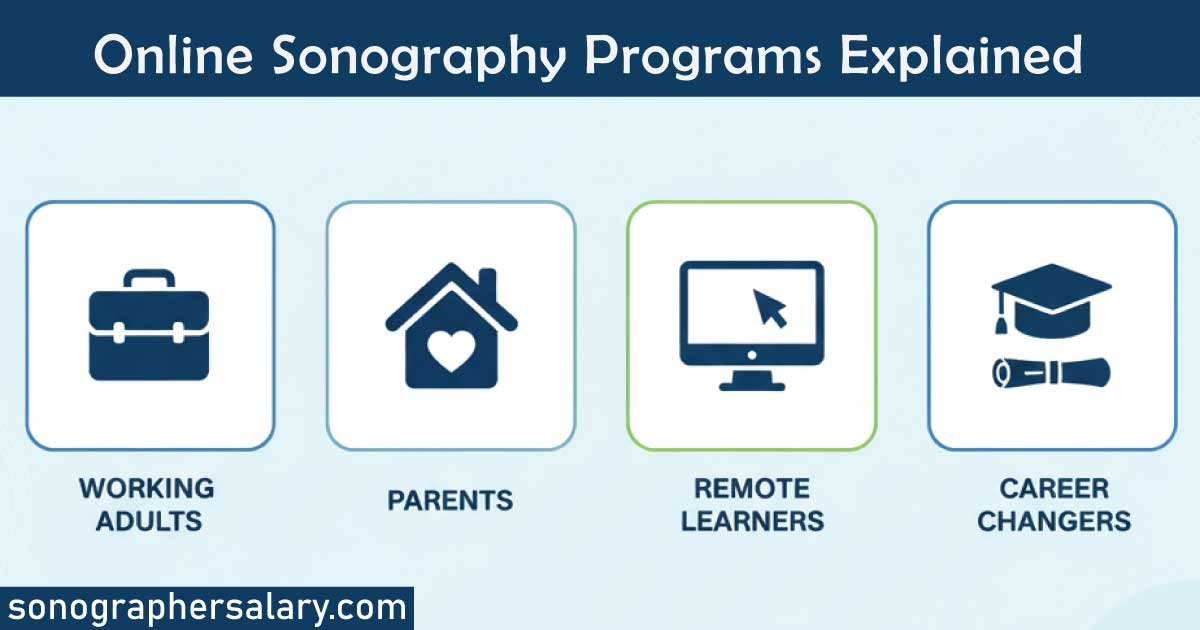
Who Online Sonography Programs Are Best For
Online programs are especially helpful for:
Working adults
Parents
Students living far from a campus
Individuals changing careers
People needed flexible study hours
Online programs can be a great choice when you are self-motivated and not put off by the idea of controll your own time.
What Makes a Good Online Sonography Program
Before enrolling, look for:
✔ Accreditation
Accreditation goes absolutely necessary in case you intend to take ARDMS certification exams upon graduating. It guarantees that the program is of national standard, offers the adequate clinical training as well as equips you with the necessary knowledge and experience to work in a comfortable and professional manner in actual healthcare environments.
✔ Strong clinical placement support
An effective online program must be proactive in assisting you in finding a clinical site as opposed to ad hoc which leaves you to resolve on your own. Placement support is organized and saves you time, lowers stress, and provides you with a supervised and hands-on experience at a nearby accredited hospital or imaging center.
✔ Experienced instructors
The most effective programs are presented by the instructors who have years of actual clinical scanning experience. They know what students go through, they do not just give general tips that only an expert can handle but take you through complicated issues in a simple way. The mentorship enhances your competencies and enhances your confidence.
✔ Updated technology
Sonography programs in the modern age must also provide a current learning technology such as simulation, image library, recorded examples, and interactive courses. Modern technology keeps you up to date on the current procedures, learning how the machines work and get ready to be in the practical application of the equipment and processes in the actual clinical settings.
✔ Clear competency requirements
Strong programs map all the skills and scan that you have to finish in clinicals. Clarity about competency expectations can also keep you focused, keep you on track, and see just what it takes to graduate and be certified. This openness can help training to become easier and enhance your professional practice preparedness.
Final Thoughts: Is an Online Sonography Program Worth It?
Online sonography programs provide opening to many students which would be closed. The combination of theory education online and practical training in the clinic provides you with flexibility without losing competencies. You still will get practical experience, actual patient care, and professional guidance but only with a more flexible schedule.
An online pathway can be an intelligent and efficient option to a sonographer, especially when you are serious about becoming one and you just want a program that does not interfere with your life, instead of changing it. You will be able to graduate with all the certifications and be sure that you will be able to be part of the ultrasound profession as long as the program is accredited, organized and allows students to succeed.
👉 Practical Training for Cardiac Sonographers is essential for anyone aiming to master real-world scanning skills and patient care. This post explains how hands-on experience, clinical rotations, and echo techniques shape your confidence and accuracy. Keep reading to discover exactly what training looks like and how it prepares you for a successful career in cardiac sonography.

Zak is a dedicated medical and career writer specializing in sonography, healthcare education, and professional development. Through SonographerSalary.com, he shares in-depth insights on sonographer salaries, education pathways, and career tips to help readers build successful futures in medical imaging. His content combines accuracy with practical, easy-to-understand guidance, empowering students and professionals to make confident, informed career decisions.