
Diagnostic medical sonography is one of the best career choices anyone can ever make nowadays. The career has stability, meaningfulness and defined growth. However, there is the question that keeps on reoccurring; Does your education level influence your sonographer salary? The simple answer is yes, albeit differently, as the case is with other healthcare professions. Education is a gateway in sonography, but the education levels, and rates of earnings, are also based upon certification, specialization, experience, and place.
In this guide, I will break everything down in a simple way that you can understand exactly how education shapes earning potential for sonographers in the United States. Whether you are a high school student exploring options, a medical assistant wanting to upgrade, or a working adult planning a career switch, this article will give you clear direction.
Why Education Matters in Sonography
Sonography is unique because it is a profession where your skill is your power. Your ability to read images, understand anatomy, use equipment, and communicate with physicians depends heavily on training. And training, of course, depends on your education path.
But here is the important thing:
You do not need a four-year degree to earn great money as a sonographer in the USA.
However…Higher education can unlock higher salaries, leadership positions, and better career mobility.
Let’s look at the different education levels and how they influence income step-by-step.
High School Diploma + Sonography Certificate Program
Many people are surprised to learn that some sonography programs accept students directly after high school. These are usually certificate or diploma programs, often offered by hospitals or technical schools.
Salary Impact
This route gives you entry-level access to the field if the program is accredited (especially by CAAHEP). With a certificate, you can still earn:
Around $55,000 to $70,000 per year in most states
Higher in cities with strong demand (California, New York, Washington)
The earning potential is good, but it is less likely to grow, and employers might choose those candidates who have an associate degree.
Pros
- Fastest way to enter the career
- Cost-effective
- Little to no student debt
- Good earning potential for a short-term program
Cons
- Limited advancement
- May restrict specialization options
- Some hospitals prefer degree holders
This path is ideal for someone who wants to start working quickly and build up from there.
Associate Degree in Diagnostic Medical Sonography (Most Common)
Diagnostic Medical Sonography- The most popular one in the USA is the Associate of Applied Science (AAS). In fact, most employers like this level which is a balance between in-depth study and practical training.
Salary Impact
Associate degree graduates often start at:
$65,000 to $85,000 per year, depending on state
With experience, they can make $90,000+
This degree level qualifies you for certifications through ARDMS, which is the real key to higher pay.
Why Employers Prefer Associate Degrees
Stronger clinical experience
Accredited curriculum
Well-rounded training (abdomen, OB/GYN, vascular basics)
Better communication and anatomy knowledge
Pros
- Balanced route: not too long, not too short
- Allows specialization
- Higher salary ceiling
- Widely accepted nationwide
Cons
- Takes 2 years
- More competitive admissions
This is when you want to receive a comfortable regular salary and maintain your educational schedule.
Bachelor’s Degree in Diagnostic Medical Sonography (Highest Education Level)
Bachelor’s degrees are not as common, but they are gradually becoming more popular, especially in large medical centers.
Salary Impact
With a bachelor’s degree, you can earn:
$80,000 to $105,000+ per year
Faster promotions
Higher pay when moving into leadership or specialized roles
Many hospitals give automatic pay bumps for bachelor’s degree holders.
Where Bachelor’s Graduates Shine
Teaching positions
Supervisory roles
Research positions
Specializations like fetal echo, vascular, or cardiac sonography
Work at major hospitals and top-tier imaging centers
Pros
- Strongest career growth
- Highest salary potential in clinical settings
- Flexibility to move into management
- Attractive to academic and research institutions
Cons
- More expensive
- Longer duration
- Not required for most entry-level jobs
If you are looking long-term, management, leadership, or specialized diagnostic roles, this path offers the strongest salary leverage.
Master’s Degree (Rare but Growing)
Master’s degrees in imaging sciences or related fields are not required for general sonography. But they matter if you plan to move into:
Education
Research
Administration
Department management
Healthcare policy roles
Salary Impact
While a master’s degree may not boost clinical sonographer pay much, it does boost leadership salaries, which often range from:
$95,000 to $130,000 per year
Some directors earn $140,000+
This path is less about scanning and more about leading sonography teams or teaching future healthcare students.
How Education Affects Salary in Real Life
Education has an impact on sonographer salary other than having a diploma. It influences the positions you can be eligible at, the licenses you can receive and how competitive you will be in the labor market. College education may open up, expand income potential and carry long term career development.
1. Education Determines the Roles You Qualify For
The level of your education predetermines the kinds of sonography jobs that you can get. The education level increases access to more professional roles, specialized fields, and leadership roles directly affecting the earning capacity and career progression.
Certificate holders typically enter entry-level diagnostic roles.
Associate graduates qualify for standard hospital and clinic positions.
Bachelor’s and master’s degree holders access senior, specialized, or administrative roles.
2. Education Impacts the Certifications You Can Earn
Certifications are significant in sonography and can readily increase remuneration. The type of education you follow also influences what qualifications you are able to undertake, meaning how well you can specialize as well as having a higher chance of securing a better paying job.
Certificate holders may qualify for limited specialty certifications.
Associate degree graduates can pursue most mainstream sonography certifications.
Bachelor’s graduates can access advanced and leadership-level certification pathways.
3. Education Affects How Competitive You Are
Education, experience and skills are what employers commonly put into consideration. Higher education indicates the preparedness to handle complicated situations and leadership thereby providing the candidates with a competitive advantage in employment as well as promotions and even positions in departments that are specialized.
Higher-educated candidates often receive better starting pay.
Education can accelerate promotions and career advancement.
Employers prefer highly educated sonographers for specialized or leadership roles.
Education Determines Specialization (The Real Salary Multiplier)
Education is significant in the type of specialty of sonography you can take, and specialization can be the greatest salary-enhancing factor. Sophisticated disciplines demand more training and tougher clinical expertise, specialized knowledge, and have a greater potential of earning a lot more and have the ability to secure high-strength and high-paying jobs.
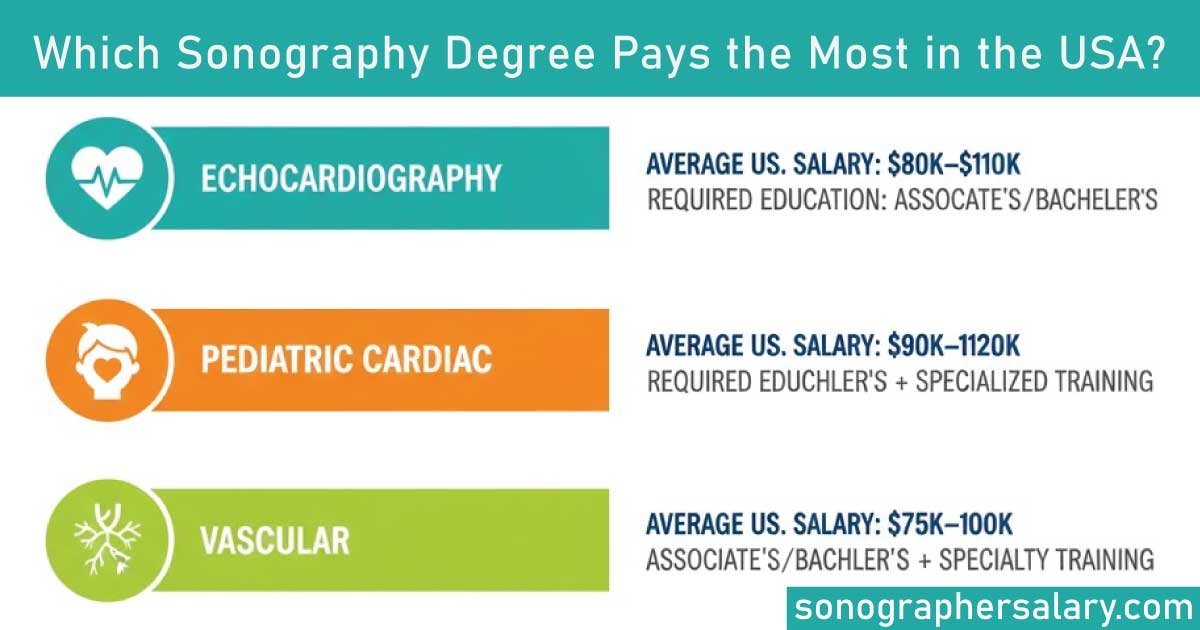
1. Echocardiography
Echocardiography is the examination of the heart in great detail, which needs advanced education and practical training. Since cardiac imaging is complicated and a core requirement in detecting heart diseases, echocardiographers are highly demanded and they receive a better pay compared to other general sonographers in hospitals, cardiology clinics, and specialty health facilities.
2. Pediatric Cardiac Sonography
Pediatric cardiac sonographers deal with children and babies and make specific images of the developing heart. This is a specialized field which requires a high level of training, accuracy and sensitivity. Due to a limited number of professionals in this field, wage is increased and the specialists are very profitable in the children hospitals and in the mature departments of cardiology in hospitals.
3. Vascular Sonography
Vascular sonographers observe the blood flow, the arteries and veins to detect obstructions and diseases of the veins. This specialty needs extra training and good technical precision. Vascular sonography is a well-paying career with good long-term career growth and development with soaring demand in hospitals and diagnostic centers.
4. High-Risk OB Sonography
The high-risk OB sonographers are the ones who are monitoring the pregnancy that has complications and therefore they need to have special training in fetal development and advanced clinical evaluation. They assist maternal-fetal medicine staff by bringing defects to light. The responsibility is high and salaries are high and the demand is escalating in the major medical centers.
Education level affects your ability to specialize. Specialization, in return, boosts your salary dramatically sometimes by $15,000 to $30,000 more per year.
Does More Education Always Mean Higher Salary?
Not always. Here’s the truth that most students don’t hear:
👉 Experience + Certifications + Location often outweigh education level.
As an illustration, an associate degree sonographer having 10 years of experience and a vascular certification would earn higher income compared to a bachelor’s degree sonographer who is still fresh.
But education still plays a key role in unlocking:
Better job opportunities
Higher starting salaries
Easier specialization
Long-term growth
Administrative roles
Think of education as your foundation. Experience builds the house. Specialization adds more rooms. Location determines the neighborhood.
State-by-State: Education and Salary Gaps
Education is playing a significant role in the salaries of sonographers, although the effects differ across locations. In some states, bigger pay is given to higher degrees, whereas experience and certifications are more important in other states. These differences can be understood to help you plan your career in a strategic manner.
1. High-Paying States
In such states as California, Washington, New York, Oregon, Massachusetts, and New Jersey, employers give preference to candidates whose degrees are either associate or bachelor. These are competitive markets of healthcare with big hospital systems. Advanced degree sonographers usually earn more, get quicker promotions, and are assigned to special imaging departments.
2. Mid-Range States
Texas, Florida, Ohio, Georgia, and North Carolina are the states that have good salaries of sonographers, but the disparity between the degree levels is not very clear. Associate degrees are highly acceptable and experience and certifications usually prevail in the recruitment process.
3. Rural Areas
There is a great need in the rural regions of the qualified sonographers, and when the workforce is understaffed, even the certificate holders have the opportunity to receive good wages. In this situation, there is more emphasis on clinical competence and availability among the employers than formal degrees and hence the rural jobs are open and rewarding to early career sonographers in terms of finances.
Which Education Level Should YOU Choose? (Simple Guide)
Selecting the appropriate level in sonography education is not only about the speed at which you can be out to work, it is all about the degree and career objectives, the amount of money you are going to make and the extent of your growth. Education will provide a starting point, but it is your certifications and clinical experience as well as your specialty that will ultimately dictate how soon you can get your salary to the top. This is an easy 10-step guide that can assist you in choosing the right route to take according to your schedule, desire, and aspirations.
Education Paths and Career Goals
| Goal | Recommended Education | Why It Works | Salary Potential |
|---|---|---|---|
| Start earning fast | Certificate or Associate Degree | Quick entry into the workforce; ideal for working adults or career changers | $55,000–$75,000 |
| Long-term growth & specialization | Associate or Bachelor’s Degree | Opens doors to specialized fields and career advancement | $70,000–$95,000+ |
| Leadership or teaching roles | Bachelor’s or Master’s Degree | Prepares for supervisory, administrative, or academic positions | $90,000–$130,000+ |
| Maximize salary | Combine education + certifications + experience | Advanced skills, multiple certifications, and experience allow highest earnings | $100,000+ |
Detailed Guidance by Goal
Start Earning Fast
Choose a certificate or associate degree program for the fastest entry.
Ideal for adults switching careers or those who need income quickly.
Can still earn competitive pay, especially with in-demand certifications.
Long-Term Growth & Specialization
Associate or bachelor’s degrees are best for students planning career growth.
Opens opportunities in high-demand specialties like vascular or cardiac sonography.
Supports higher starting salaries and faster promotion potential.
Leadership or Teaching Roles
Bachelor’s or master’s degrees prepare you for supervisory, management, or educational positions.
Employers value advanced education when promoting staff or leading departments.
Higher salaries and opportunities to influence clinical practice or training programs.
Maximize Salary
Combine education with multiple certifications and hands-on experience.
Specialize in high-paying areas such as echocardiography, pediatric cardiac, or high-risk OB.
Experience plus credentials create the strongest earning potential across states and institutions.

Zak is a dedicated medical and career writer specializing in sonography, healthcare education, and professional development. Through SonographerSalary.com, he shares in-depth insights on sonographer salaries, education pathways, and career tips to help readers build successful futures in medical imaging. His content combines accuracy with practical, easy-to-understand guidance, empowering students and professionals to make confident, informed career decisions.