
If you are considering a career as an ultrasound technician or medical sonographer, choosing the right sonography program can make all the difference between a smooth journey into a rewarding healthcare career and a frustrating detour full of wasted time, money, or confusion. With ever‑evolving medical technology, increasing demand for diagnostic imaging, and strict accreditation requirements, not all “sonography programs” are created equal. In this guide, we walk you through everything you need to know to pick a high‑quality, effective program that sets you up for success. Think of this as your roadmap to becoming a certified ultrasound professional from your first information session to your first job offer, or even your enrollment in a bachelor’s‑level program.
Throughout this article, you will learn the different types of sonography degrees, how to assess accreditation and clinical training, typical costs and time frames, and how to compare or eliminate programs based on real‑world criteria. By the end, you will be equipped with the confidence and knowledge needed to choose a program that matches your career goals and financial situation.
What Are the Main Types of Sonography Programs?
Before diving into quality comparisons, it’s important to understand the different types of sonography credentials available because your choice determines not only how long you’ll be in school, but also your job prospects and eventual earning potential.
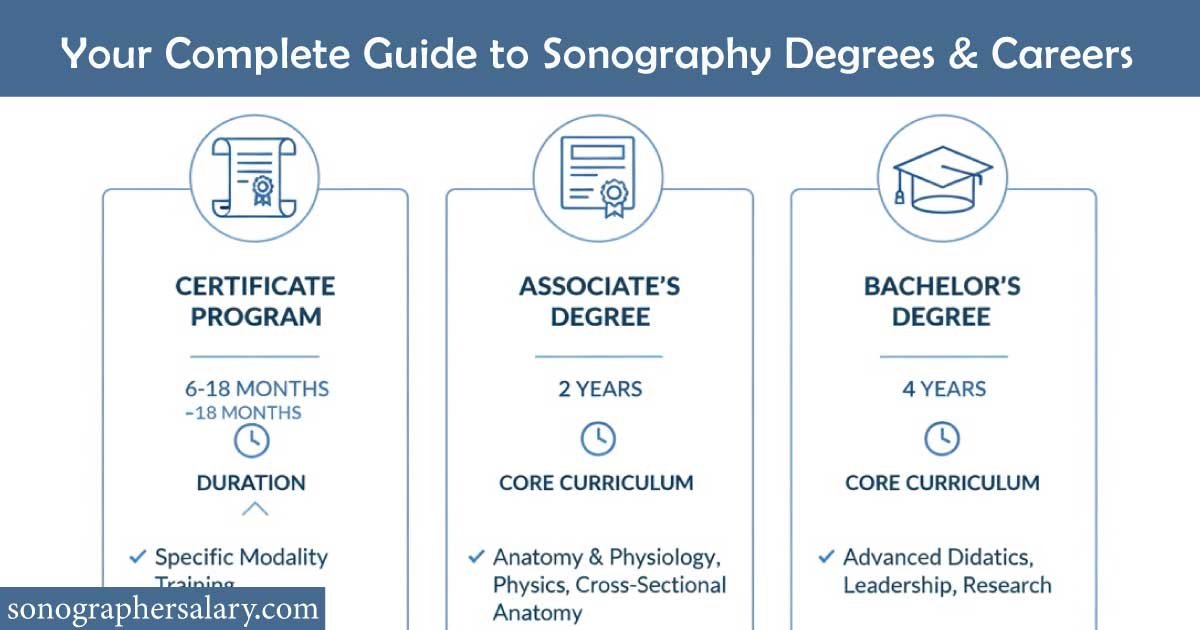
1. Certificate and Diploma Programs
These are often the quickest route to entering the sonography field, taking around 12 to 18 months. Certificate programs usually build on existing healthcare credentials (like an LPN or radiologic technologist background) or prior general education, so they don’t always start from scratch. They’re ideal for people looking for a fast track into ultrasound imaging.
2. Associate Degree Programs
Associate degrees are more common for first-time students. Typically two years long, often offered by community colleges or technical schools, these programs combine general education (e.g., English, math) with core sonography training. Graduates become eligible for certification exams such as those offered by credentialing bodies.
3. Bachelor’s Degree Programs
A bachelor’s program gives greater depth and broader training often combining sonography with related health sciences courses, additional clinical rotations, and sometimes specialization (e.g., cardiac sonography, vascular imaging). These degrees generally take four years and appeal to those seeking maximum job flexibility, leadership roles, or eventual specialization.
Here’s a quick table summarizing typical program types:
| Program Type | Typical Duration | Best For | Credential Outcome |
|---|---|---|---|
| Certificate/Diploma | 12–18 months | Fast entry, already in healthcare | Sonography Fundamentals Certificate |
| Associate Degree | ~2 years | First-time students seeking entry-level roles | AAS in Diagnostic Medical Sonography |
| Bachelor’s Degree | ~4 years | Those seeking specialization or leadership | BS in Diagnostic Medical Sonography |
📌 Sonography vs Ultrasound explains the key differences, uses, and career paths in medical imaging. This post clarifies terms, techniques, and professional roles to help you make informed decisions. Read the full guide to fully understand both fields and choose the right path for your healthcare career.
Accreditation: The Foundation of Quality and Credentialing
A critical factor that often gets overlooked by prospective students is accreditation. Accreditation ensures that the program meets minimum quality standards for curriculum, faculty, equipment, and clinical training. Attending an accredited program is often required for certification, financial aid eligibility, and many employers’ hiring standards.
In the United States, typical accrediting and credentialing bodies include national organizations recognized by major medical associations. One of the most important is the body that evaluates programs to ensure they provide adequate clinical hours, competent instruction, and a curriculum aligned with current sonography practices. Always verify a program’s accreditation status before enrolling.
An unattributed or unaccredited program may seem cheaper or faster but that can jeopardize your ability to become certified, get a good job, or even qualify for licensure, depending on your state or employer.
What Does a Typical Sonography Curriculum Include?
Most quality sonography programs whether certificate, associate, or bachelor’s, follow a core structure that balances theoretical knowledge with hands‑on clinical training. You should expect coursework in human anatomy, physiology, pathology, ultrasound physics, patient care, medical ethics, and imaging protocols.
Clinical rotations are especially critical: these allow you to gain real-world experience scanning patients under supervision, mastering imaging protocols, learning to position patients, operate ultrasound machines, and sometimes specialize (e.g., abdominal, obstetric, cardiac, vascular).
Here’s a simplified representation of a typical associate-level curriculum over two years:
| Semester | Didactic Courses (Theory) | Clinical / Lab Rotations |
|---|---|---|
| Semester 1 | Anatomy & Physiology I, Medical Terminology, Intro to Ultrasound Physics | Lab ultrasound fundamentals |
| Semester 2 | Anatomy & Physiology II, Patient Care & Ethics, Ultrasound Physics II | Basic organ system imaging lab |
| Semester 3 | Pathology, Obstetric & Gynecologic Ultrasound, Vascular Imaging | Clinical rotation: OB/GYN clinic |
| Semester 4 | Cardiac Sonography, Abdominal Imaging, Sonography clinic management | Hospital clinical rotation |
Programs often build on earlier semesters: foundational courses lay the groundwork before specialized imaging instruction begins. Understanding this standard layout helps you compare programs more meaningfully.
📌 What Is Sonography? The Expert Complete Guide explores the science, techniques, and career opportunities in medical imaging. This post explains how sonography works, its applications, and the skills you need. Read the full guide to gain expert insights and start or advance your career in this growing healthcare field.
How to Evaluate Clinical Training Opportunities
Clinical experience is arguably the most important part of any sonography program after all, ultrasound is a hands-on skill. When evaluating a program, consider:
Number of clinical hours required. A program that offers only minimal lab time may not sufficiently prepare you for the real world. Many accredited programs require hundreds of clinical hours.
Diversity of clinical settings. Exposure to hospitals, outpatient imaging centers, OB‑GYN clinics, vascular labs, or cardiac units gives you a broad base of skills.
Supervision and mentorship quality. Experienced instructors and sonographers guiding your training can dramatically improve your competence and confidence.
Student-to-instructor ratio. A lower ratio ensures you get personalized training rather than being lost in a crowd.
If possible, try to visit the facilities or attend an open house. Ask to see the ultrasound machines, ask about typical patient types, and talk to current students about their experience. A good clinical training setup will feel professional, well-equipped, and supportive of student learning.
Program Length, Degree Outcomes, and What They Mean for Your Career
Your career path and timeline depend heavily on the program length and the resulting credential. Below is an illustrative comparison:
| Credential Type | Typical Total Time Commitment | Approximate Entry-Level Roles You Might Get | Potential Long-Term Benefits |
|---|---|---|---|
| Certificate/Diploma | 1–1.5 years | Junior Sonographer, Imaging Assistant | Fast entry; may need further credentials for advancement |
| Associate Degree | 2 years | Diagnostic Medical Sonographer (entry-level) | Qualifies for certification; good for stable employment |
| Bachelor’s Degree | 3.5–4 years | Sonographer with specializations, lead technologist roles | Broader training, leadership potential, higher pay |
Keep in mind, some bachelor’s programs may also combine general sciences or health‑care administration courses, which can help if you plan to later pursue advanced roles such as sonography educator, department manager, or specialized ultrasound technologist (e.g., cardiovascular sonography).
📌 High-Paying Medical Jobs highlight lucrative career options in healthcare, from nursing to specialized technician roles. This post explores salaries, required skills, and growth opportunities. Read the full guide to discover which high-paying medical career fits your goals and how to start earning in this rewarding field.
Cost, Financial Aid, and ROI: What to Know
The cost of a sonography program varies widely depending on type (certificate vs degree), institution (community college vs private university), and residency (in-state vs out-of-state). Below is a simplified cost comparison for typical U.S.-based programs (figures approximate and for illustration):
| Program Type | Public In-State Tuition | Public Out-of-State Tuition | Private/For-Profit Tuition |
|---|---|---|---|
| Certificate | $5,000 – $8,000 | $10,000 – $14,000 | $12,000 – $18,000 |
| Associate Degree | $10,000 – $15,000 | $18,000 – $25,000 | $20,000 – $30,000 |
| Bachelor’s Degree | $20,000 – $30,000 | $30,000 – $45,000 | $35,000 – $50,000+ |
Financial aid including federal student loans, grants, and scholarships, often depends on accreditation status or whether the program qualifies under eligible federal aid criteria. It’s worth asking the school’s financial aid office whether their sonography program is “Title IV eligible” (in the U.S.), which determines whether you can use federal funds.
When considering return on investment (ROI), you might also factor in time to completion, living expenses during schooling, and likely starting salary. For many graduates, the cost is offset quickly given the demand for qualified sonographers and decent entry-level pay.
Admission Requirements and Prerequisites You Should Know
Admission requirements vary among programs, but common prerequisites include high-school level math, biology, and English, sometimes along with background in allied health. For certificate programs, some prior medical credentials or experience may be required. Programs may also ask for a minimum GPA (often 2.5 – 3.0), standardized test scores, immunizations, and criminal background checks due to clinical rotations.
It’s wise to prepare early: if your high school or prior education didn’t include strong science courses, consider taking anatomy, physiology, or biology classes first even if they are community college or online. Deficiencies in foundational knowledge can lead to struggles with ultrasound physics or anatomy-heavy coursework.
Also, consider soft‑skills prerequisites: good communication, manual dexterity, and patient‑care aptitude — because sonographers often interact with patients, explain procedures, and help put nervous or vulnerable patients at ease.
Online vs On-Campus Sonography Programs: What Works and What Doesn’t
In recent years, some education providers have begun offering online or hybrid sonography programs. These often combine online coursework (anatomy, medical terminology, ethics) with required in-person lab work or clinical rotations nearby.
Online programs can be convenient especially if you live far from a campus or need to balance work/family responsibilities. But they also come with trade‑offs and considerations:
First, ensure the online program still meets accreditation and clinical requirements. If the program does not provide or coordinate in-person clinical rotations, you may end up needing to find them yourself, which can be tricky and delay graduation.
Second, consider the value of on-campus labs: in-person instruction with instructors and clinical equipment can lead to stronger foundational skills than self-paced online learning. For many students, the hands-on experience, peer interaction, and structured schedule make on-campus or hybrid programs more effective.
If you choose online, lean on programs that offer robust clinical placement support and documented success placing students. Treat those placement resources as part of the “program quality” evaluation alongside accreditation, curriculum, and cost.
A Comparison of Some Well-Known Sonography Programs (Illustrative Examples)
Below is a simplified comparison among several well-known sonography programs across the U.S. This table is for illustration, always double-check current program details directly with the institution.
| Institution (State) | Degree Type | Program Length | Typical Clinical Hours | Approximate Tuition (In-State) | Unique Strength |
|---|---|---|---|---|---|
| University A – Large University | Bachelor’s | 4 years | ~900 hrs | $25,000 | Broad specialization options |
| Community College B | Associate | 2 years | ~600 hrs | $12,000 | Affordable, strong hospital ties |
| Technical School C (Private) | Certificate | 15 months | ~450 hrs | $16,000 | Fast entry, short-term commitment |
| Hybrid School D (Online + Local) | Associate/Certificate | 2 years | variable (placement needed) | $14,000 – $18,000 | Flexible schedule, ideal for working adults |
This comparison gives you a sense of what’s out there — but your choice should depend on your personal goals, availability, financial situation, and career aspirations.
Realistic Timeline: From Enrollment to Certification (Typical Journey)
Here’s an example timeline of a student starting in a 2‑year associate sonography program and ending up as a certified ultrasound technologist working full-time:
| Phase | Duration | What Happens |
|---|---|---|
| Application & Admission | 1–3 months | Submit transcripts, prerequisites, background check |
| Coursework + Lab Training | 4–5 semesters (~2 years) | Didactic courses, labs, anatomy, ultrasound physics |
| Final Clinical Rotations | Last 1–2 semesters | Hospital/clinic training under supervision |
| Graduation & Paperwork | ~1 month | Diploma, transcripts, certification eligibility |
| Certification Exam Prep | 1–2 months | Review, practice tests, register for exam |
| Certification Exam & Results | 1–2 months (incl. results) | Written and practical exam |
| Job Search / Employment | 0–3 months | Resume submission, interviews, hire |
From start to finish, for an associate program, the journey typically spans around 2.5 years, including exam preparation and job search. For a bachelor’s program, add another 2 years; for a certificate, subtract perhaps six months.
Practical Tips for Choosing the Right Sonography Program
Now that you know what to look for, here are some practical tips (sprinkled throughout in conversations with past students) that can make your decision much easier:
Before applying, create a “wish list” of non-negotiables — e.g., accredited program; enough clinical hours; manageable cost; location or commute; specialization availability.
Visit campuses or attend info sessions — seeing the ultrasound machines, talking to instructors, and meeting current students gives insights you won’t get from a website.
Ask about job placement rates for graduates — a high placement rate often indicates good reputation and employer trust.
If you need to work or manage family obligations during schooling, consider part-time, evening, or hybrid programs — but also check how that impacts clinical rotations’ scheduling.
Go beyond tuition: factor in other costs such as textbooks, uniform, liability insurance, certification exam fees, commuting or housing if relocating.
One former student advised: “Don’t just chase the lowest cost, choose the program that gives you the clinical exposure and support you’ll need when things get real.” That simple advice can save you from frustration later.
Common Mistakes People Make When Picking a Sonography Program
Even well‑intentioned students sometimes make avoidable mistakes when selecting a sonography program. A few of the most common pitfalls:
Choosing a non-accredited or poorly accredited program just because it’s cheaper or faster, this often leads to ineligibility for certification or difficulty finding a decent job.
Underestimating the importance of clinical hours and hands-on experience; classroom learning alone doesn’t fully prepare you for workplace responsibilities.
Ignoring long-term career goals (e.g., leadership, specialization, continuing education), which can limit mobility or pay growth when entering the workforce.
Failing to factor in hidden costs — like textbooks, exam fees, travel for clinical rotations and ending up underfunded or dropping out mid-way.
Overcommitting to work or family while studying without checking schedule flexibility, which can lead to burnout or poor grades.
Avoiding these mistakes means taking the time to research thoroughly, ask clear questions, and think long-term rather than just short-term convenience.
What to Do After Graduation: Certification, Licensure, and Job Search
Graduating from a program is just the beginning. In many states and for many employers, you will need to pass a certification exam (offered by recognized credentialing bodies) to be credentialed as a sonographer. Certification makes you more competitive and often required for higher pay.
After certification, many graduates apply for positions in hospitals, imaging centers, OB‑GYN clinics, vascular labs, cardiac departments, or mobile imaging services. Some choose to specialize further (e.g., fetal echocardiography, vascular Doppler, pediatric ultrasound), which may require additional training or hours.
If you completed a bachelor’s program, you may also be in a good position to pursue leadership or educational roles, such as lead ultrasound technologist, sonography instructor, or imaging department coordinator.
Example: How to Compare Your Top 2–3 Program Choices (Mini List in Text)
Let’s say you narrowed down your choices to two or three promising programs. In that case, create an informal “comparison snapshot” by considering factors like accreditation status, clinical hour requirement, total cost (tuition + extras), length, flexibility (full-time vs part-time), and specialization options. By weighing those criteria, accreditation, cost, exposure, flexibility, you will often find one program stands out as the best fit for your needs.
Bonus Table: Specialization Options and Typical Additional Training
Here’s a breakdown of common ultrasound specializations and what extra training or coursework might involve:
| Specialization Area | Typical Additional Training or Courses | Typical Additional Clinical Hours / Requirements |
|---|---|---|
| Obstetric & Gynecologic | Fetal development, maternal imaging protocols | ~100–150 hours |
| Abdominal Imaging | Liver, kidney, abdominal organs, gallbladder, pancreas | ~80–120 hours |
| Vascular Doppler | Blood flow studies, venous/arterial Doppler ultrasound | ~60–100 hours |
| Cardiac (Echocardiography) | Cardiac anatomy, Doppler, patient positioning, echo views | ~120–160 hours |
| Pediatric Sonography | Child anatomy, pediatric protocols, child patient care | May require pediatric clinic rotation |
Opting for specialization can lengthen your training slightly but often results in stronger employment prospects and higher starting salaries.
Evaluating Return on Investment (ROI): Basic Salary vs Program Cost
Understanding long-term gains is important before committing, so here’s a rough ROI scenario for someone who just completed an associate’s program and becomes certified:
| Metric/Item | Value (U.S. Example) |
|---|---|
| Total Cost of Associate Program | ~$15,000 (tuition + extras) |
| Time to Complete & Certify | ~2.5 years |
| Entry-Level Median Salary | ~$55,000–$65,000 per year |
| Expected Time to Recoup Costs | ~4–6 months (assuming full-time work) |
| 5-Year Earning Potential (approx) | ~$275,000–$325,000 |
With demand for diagnostic imaging technicians projected to grow, many graduates find their investment pays off rapidly. The ability to specialize, pursue advanced certifications, or move into leadership roles can further improve long-term returns.
Final Thoughts: Making a Smart, Informed Decision
Choosing the right sonography program isn’t just about picking the one with the shortest time or lowest cost. It’s about selecting the program that gives you quality education, proper clinical exposure, accreditation, and a clear pathway to certification and employment. By focusing on accreditation, clinical hours, curriculum quality, cost vs benefit, and future specialization opportunities, you set yourself up for long-term career success.
Remember, this is a career-defining step. Your time, energy, and resources invested now will shape your opportunities for years. Approach the decision like you would for any major life move: ask questions, compare carefully, visit campuses if possible, and think long-term.
If you do this right, your journey from student to skilled sonographer can be smooth, efficient, and rewarding. Best of luck and I hope you find a program that leads to a fulfilling and stable career in sonography.
FAQs:
What is the best field of sonography?
The best field of sonography depends on interest and career goals. Cardiac sonography and vascular sonography are highly regarded due to high demand and specialized skills. Obstetric sonography is popular for pregnancy care. Choosing a field combines personal preference, growth opportunities, and potential earnings for a successful career.
What type of sonographer earns the most money?
Cardiac sonographers and vascular sonographers typically earn the most money. Their specialized skills in imaging the heart and blood vessels require advanced training. Hospitals and cardiovascular centers offer higher salaries due to the complexity and critical nature of their work, making these types the top-paying sonography careers.
What degree is best for sonography?
The best degree for sonography is an Associate’s or Bachelor’s degree in Diagnostic Medical Sonography. A bachelor’s degree can offer more opportunities for specialized fields, leadership roles, and higher salaries. Certification and clinical training are essential to gain practical experience and become a licensed, professional sonographer.
Does sonography have a future?
Yes, sonography has a promising future. Medical imaging is expanding, and the demand for non-invasive, safe diagnostic tools continues to grow. Advancements in technology, like 3D/4D imaging and portable devices, create new opportunities for sonographers, ensuring long-term career stability and growth in hospitals, clinics, and private practices.
Does sonography pay well?
Yes, sonography pays well, especially in specialized fields like cardiac, vascular, or obstetric imaging. Entry-level sonographers earn competitive salaries, while experienced professionals in high-demand areas can earn six figures. The field offers benefits, overtime opportunities, and steady employment, making it financially rewarding and career-sustainable.
How many types of sonography are there?
There are several types of sonography, including abdominal, obstetric, gynecologic, cardiac, vascular, musculoskeletal, and pediatric sonography. Each type focuses on specific organs or patient groups. Specialization determines the skills required, job demand, and salary potential, giving sonographers diverse career paths within medical imaging.
What is the hardest class in sonography?
The hardest class in sonography is often advanced sonographic physics or cardiovascular sonography, which requires understanding sound waves, imaging principles, and complex anatomy. Clinical practicums can also be challenging as students must apply theory to real patients, mastering accurate imaging, patient care, and technical precision simultaneously.

Zak is a dedicated medical and career writer specializing in sonography, healthcare education, and professional development. Through SonographerSalary.com, he shares in-depth insights on sonographer salaries, education pathways, and career tips to help readers build successful futures in medical imaging. His content combines accuracy with practical, easy-to-understand guidance, empowering students and professionals to make confident, informed career decisions.