
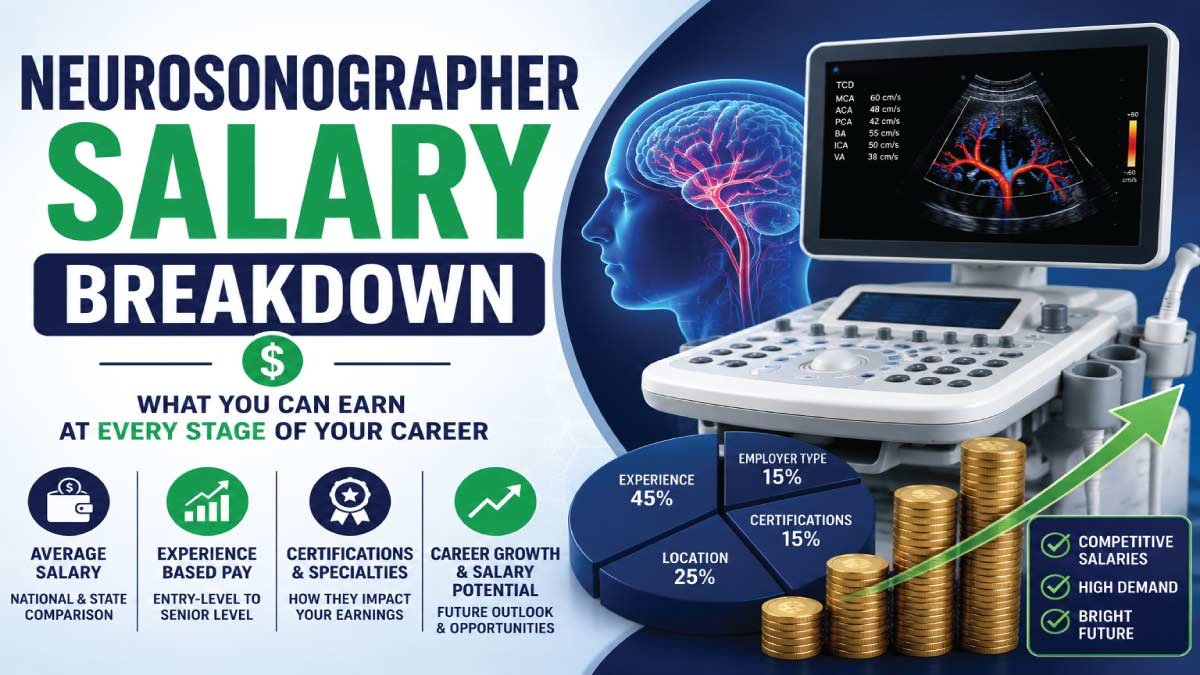
Neurosonography is one of the most specialized branches of diagnostic medical imaging. It focuses on ultrasound studies involving the brain, nervous system, and cerebral blood flow. Because this specialty requires advanced technical precision and deeper clinical understanding, many people considering the field naturally want to know: how much does a neurosonographer earn in 2026?
In 2026, neurosonography remains a smaller specialty compared with general ultrasound, cardiac imaging, or vascular sonography. That smaller talent pool often makes trained professionals valuable in hospitals, neurological centers, neonatal intensive care units, and advanced specialty departments.
Recent 2026 salary reporting places the average U.S. neurosonographer salary at about $91,749 per year, or approximately $7,646 per month. The typical national range falls between about $82,990 and $101,696 depending on experience, location, and employer setting.
This guide explains how neurosonographer salary works, what affects pay, and how career growth usually develops over time.
What Is a Neurosonographer?
A neurosonographer performs ultrasound studies related to the nervous system and cerebral circulation. Depending on the employer and patient population, this may include:
- transcranial Doppler studies
- cerebral blood flow assessment
- neonatal brain imaging
- intracranial vascular evaluation
- neurovascular monitoring support
In neonatal care, neurosonographers may image the infant brain through the fontanelle. In adults, neurovascular ultrasound often focuses more on cerebral circulation and vascular assessment.
Unlike routine ultrasound exams, neurosonography often requires strong knowledge of:
- neurological anatomy
- blood flow dynamics
- cerebral circulation pathways
- pathology affecting the brain and nervous system
Because these studies can influence diagnosis in critical situations, accuracy matters greatly.
Average Neurosonographer Salary in 2026
In 2026, neurosonographers in the United States earn competitive salaries compared with many diagnostic imaging roles.
National average salary
- Annual: about $91,700
- Monthly: about $7,600
- Hourly: about $44
Typical salary range
- 25th percentile: about $82,990
- 75th percentile: about $101,696
Recent 2026 salary data reflects this general national range. These numbers are broad national estimates. Actual income depends heavily on experience level, region, and employer type.
Why Neurosonography Pays Well
Neurosonography tends to offer higher compensation because it is a highly specialized field that requires advanced technical skill, precision, and strong clinical understanding. Since it focuses on brain and nervous system imaging, the responsibility level is often higher compared to general ultrasound roles, which directly influences earning potential.
1. Specialized Expertise
Neurosonographers are less common than general diagnostic sonographers, which increases their professional value in the job market. This smaller pool of trained specialists means hospitals often compete for experienced professionals. As a result, individuals with neurosonography skills may have access to stronger salary packages and more advanced job opportunities.
2. Complex Imaging
Imaging the brain and cerebral vascular system requires a high level of accuracy and technical precision. These studies often involve delicate anatomy and detailed scanning techniques that demand strong training and focus. Because of this complexity, neurosonography is considered an advanced specialty that is rewarded with higher compensation.
3. Clinical Impact
Neurosonography findings can play a critical role in urgent medical decisions, especially in neonatal intensive care units and neurovascular cases. Early and accurate detection of abnormalities can directly influence patient treatment outcomes. This level of responsibility increases the importance of the role and contributes to higher salary expectations.
4. Limited Specialist Availability
Not all hospitals have dedicated neurosonography departments or trained specialists in this field. This limited availability increases demand for qualified professionals. When expertise is scarce, experienced neurosonographers become highly valuable to healthcare facilities, often resulting in better pay and stronger career opportunities.
Also Read:
Neurosonographer Salary by Experience Level
Experience remains one of the biggest drivers of salary growth. As neurosonographers become more efficient, more confident, and better able to handle technically challenging cases, compensation often improves.
1. Entry-Level Neurosonographer (0–2 Years)
A new neurosonographer usually enters the field after formal sonography education plus specialty clinical exposure.
At this stage, many professionals are still strengthening:
- imaging confidence
- workflow efficiency
- pathology recognition
- independent decision-making
Typical salary
- Annual: $84,000 to $89,000
- Monthly: $7,000 to $7,400
Recent salary reporting places entry-level neurosonographers near the upper-$80,000 range nationally.
What matters early?
At the beginning of a career, pay often depends on:
- clinical training quality
- hospital versus outpatient environment
- specialty department demand
- geographic market conditions
The first years are usually focused on skill building rather than maximizing income.
2. Early Career Neurosonographer (2–4 Years)
After a few years, many neurosonographers become more independent and more technically consistent.
They often become better at:
- obtaining reliable Doppler signals
- adjusting imaging technique under difficult conditions
- recognizing abnormal cerebral flow patterns
- working more efficiently in hospital environments
Typical salary
- Annual: $88,000 to $93,000
- Monthly: $7,300 to $7,750
At this stage, employers often place more value on reduced supervision needs and stronger clinical reliability.
3. Mid-Level Neurosonographer (4–7 Years)
By mid-career, many neurosonographers become highly dependable members of specialty teams.
They often have broader exposure to:
- neonatal neurological cases
- critical care patients
- technically challenging studies
- complex vascular findings
Typical salary
- Annual: $92,000 to $98,000
- Monthly: $7,650 to $8,150
Common responsibilities
Mid-level neurosonographers may:
- handle more difficult studies independently
- support urgent inpatient imaging
- assist newer staff members
- contribute to departmental workflow efficiency
This stage often marks noticeable salary growth.
4. Experienced Neurosonographer (7+ Years)
Highly experienced neurosonographers often combine technical precision with strong clinical judgment.
Typical salary
- Annual: $98,000 to $110,000+
- Monthly: $8,150 to $9,100+
Recent 2026 salary reporting shows expert-level professionals can move into the mid-$90,000 range nationally, with higher earnings possible depending on setting and location.
Why experienced professionals earn more
They usually bring:
- advanced image optimization
- better pathology recognition
- faster workflow integration
- lower supervision needs
- stronger mentoring ability
That combination often creates real salary value.
Also Read:
Neurosonographer Salary by Workplace
Where you work can affect salary as much as experience. Two neurosonographers with similar years in the field may earn very different incomes depending on employer type.
1. Hospitals
Hospitals often provide the broadest clinical exposure.
Common hospital work may include:
- acute neurological imaging
- inpatient studies
- neonatal intensive care support
- urgent cerebral vascular evaluation
Typical salary
Hospital-based neurosonographers often fall in the $88,000 to $105,000+ range.
Hospitals may also provide:
- shift differential
- weekend pay
- overtime opportunities
- call coverage premiums
These extras can meaningfully increase total earnings.
2. Specialty neurological centers
Neurology-focused or neurovascular specialty centers may place particularly high value on technical expertise. In these environments, strong cerebral vascular knowledge can improve compensation.
4. Pediatric and neonatal hospitals
Neonatal neurosonography often requires special patient handling and specialized anatomical knowledge. Children’s hospitals and neonatal centers may therefore offer attractive opportunities for experienced professionals.
Neurosonographer Salary by Location
Geographic location can create major pay differences. Recent 2026 salary reporting shows several higher-paying regions include:
- District of Columbia
- California
- Massachusetts
- Washington
- New Jersey
- Alaska
- Connecticut
- New York
Higher-paying regions often reflect:
- larger specialty hospital systems
- higher cost of living
- stronger demand for advanced imaging professionals
Recent salary data identifies these states among the stronger-paying neurosonography markets in 2026. However, a higher salary does not always mean stronger real purchasing power. Living costs matter too.
Example of Monthly Salary Breakdown
A simple example makes the numbers easier to understand. Suppose a neurosonographer earns $92,400 per year.
Monthly salary
$92,400 ÷ 12 = $7,700
Weekly salary
$92,400 ÷ 52 = about $1,777
Hourly estimate
At 40 hours per week:
$92,400 ÷ 2,080 = about $44.40 per hour
This does not include overtime, shift premiums, or call pay.
Also Read:
Why Neurosonography Has Strong Career Growth
Neurosonography remains a promising long-term specialty because neurological imaging continues to play an important role in modern medicine.
Demand is supported by:
- aging populations
- stroke evaluation needs
- neonatal neurological care
- greater emphasis on noninvasive vascular assessment
- growing use of ultrasound-based monitoring techniques
Because the specialty remains relatively small, experienced neurosonographers often maintain strong long-term professional value.
Career Growth Paths in Neurosonography
Neurosonography offers strong and flexible career development options because it combines advanced imaging skills with critical clinical decision-making. As experience increases, professionals can move into more specialized roles, expand into related imaging fields, or focus on high-demand patient populations.
1. Advanced Clinical Specialization
With experience, neurosonographers often progress into more advanced neurovascular imaging roles. This includes detailed cerebral blood flow assessments and complex brain studies that require higher precision and stronger diagnostic judgment. As skill levels increase, professionals become more trusted in handling difficult cases, which can improve both responsibility and earning potential.
2. Cross-Training into Vascular Imaging
Many neurosonographers expand their skills into vascular sonography because both fields rely heavily on Doppler techniques and blood flow analysis. This cross-training increases versatility and makes professionals more valuable in hospital settings. Being skilled in both neuro and vascular imaging can improve job opportunities and strengthen long-term salary potential.
3. Neonatal Specialization
Neonatal neurosonography is a highly specialized area focused on imaging the brains of newborns, especially in intensive care units. This work requires precision, patience, and strong technical ability. Sonographers with neonatal expertise are often in high demand in pediatric hospitals, where their skills can have a direct impact on early diagnosis and treatment.
4. Expanded Career Flexibility
Neurosonography allows professionals to move between related specialties and clinical environments over time. This flexibility helps improve job security and creates more opportunities for advancement. As sonographers gain broader expertise, they become more adaptable, which can lead to stronger career stability and increased earning potential in specialized healthcare settings.
Leadership roles
Experienced neurosonographers may move into roles involving:
- staff support
- workflow coordination
- quality review
- clinical training
Leadership often improves compensation.
Teaching and mentoring
Many experienced specialists contribute to:
- student clinical education
- department onboarding
- mentoring newer staff members
These responsibilities can strengthen long-term career value.
Example of Salary Growth Over Time
Salary progression in neurosonography usually happens gradually as experience, confidence, and clinical expertise build over time. While exact figures vary by hospital, region, and specialization, this example shows a realistic pathway of how earnings can increase with career development.
Year One
A new neurosonographer typically starts at around $86,000 per year. At this stage, the focus is on learning scanning protocols, improving image quality, and gaining confidence in basic neuroimaging procedures under supervision.
Year Three
By the third year, increased independence and improved workflow efficiency often lead to a salary rise. At this point, a neurosonographer may earn around $90,000 annually. They can handle more cases with less guidance and demonstrate stronger technical consistency.
Year Six
After several years of exposure to more complex neurological and cerebral vascular cases, income may increase to approximately $96,000. Professionals at this stage usually have stronger diagnostic accuracy and are trusted with more advanced imaging responsibilities.
Year Ten
By the tenth year, an experienced hospital-based neurosonographer may reach or exceed $104,000 annually. At this level, professionals often take on leadership duties, contribute to training junior staff, and handle highly complex neuroimaging cases independently.
Career Growth Insight
This example shows that salary growth in neurosonography is typically steady rather than sudden. Long-term income improvement comes from accumulated experience, stronger technical ability, and increased responsibility within advanced clinical environments.
How to Increase Neurosonographer Salary
Neurosonographer salary growth is closely tied to technical skill, clinical exposure, and professional responsibility. Professionals who actively develop expertise and seek higher-acuity environments often see stronger long-term earning potential compared to those who remain in routine roles.
1. Build Strong Doppler Technique
Doppler ultrasound skills are essential in neurosonography, especially for evaluating cerebral blood flow. High accuracy in waveform interpretation and vessel assessment improves diagnostic reliability. Sonographers who master these techniques are more trusted with advanced studies, which can lead to better job opportunities and increased compensation.
2. Gain Hospital-Based Experience
Working in hospital or acute care settings exposes neurosonographers to more complex and urgent cases. This environment strengthens clinical judgment, speed, and adaptability. Over time, this type of experience increases professional value and often results in stronger salary growth compared to outpatient-only experience.
3. Develop Comfort with Complex Cases
Exposure to a wide range of neurological and vascular conditions builds confidence and technical strength. Handling complex cases independently shows advanced capability and reliability. Employers value professionals who can manage challenging studies, and this often translates into higher pay and expanded clinical responsibilities.
4. Stay Flexible Geographically
Geographic flexibility can significantly impact salary levels in neurosonography. Some regions and healthcare systems offer higher compensation due to demand or staffing shortages. Being open to relocation allows professionals to access better-paying markets and take advantage of more competitive job opportunities.
5. Take Leadership Opportunities
Leadership roles such as training new staff, supporting workflow management, or assisting with department coordination can increase both responsibility and compensation. These positions demonstrate professionalism and initiative, and employers often reward them with higher salaries and stronger career advancement paths.
Is Neurosonography a Good Career?
For many healthcare professionals, yes.
It offers:
- specialized clinical work
- meaningful patient impact
- strong long-term demand
- good earning potential
- professional growth opportunities
It is especially attractive for people who enjoy advanced imaging, neurological medicine, and technically detailed diagnostic work.
Final Thoughts
Neurosonographer salary in 2026 remains strong because the specialty combines advanced imaging skill with important clinical responsibility.
Recent U.S. salary reporting places average neurosonographer earnings at about $91,749 annually, or roughly $7,646 per month, with experienced professionals often earning above that range.
In simple terms:
- entry-level neurosonographers usually focus on building technical confidence
- mid-level professionals often gain stronger independence and salary growth
- experienced specialists usually reach the strongest earning levels
For professionals interested in diagnostic imaging, neurosonography remains one of the more specialized and promising long-term career paths in 2026.

Zak is a dedicated medical and career writer specializing in sonography, healthcare education, and professional development. Through SonographerSalary.com, he shares in-depth insights on sonographer salaries, education pathways, and career tips to help readers build successful futures in medical imaging. His content combines accuracy with practical, easy-to-understand guidance, empowering students and professionals to make confident, informed career decisions.