

Choosing a healthcare career can feel overwhelming, especially when two paths look very different in role, education, salary, and future growth. Sonography (Diagnostic Medical Sonographer) and Medical Assisting are both respected healthcare professions, but they serve very different purposes in patient care.
If you are trying to decide between these two careers, this detailed guide will help you understand everything clearly—from job duties and education to salary, skills, and long-term opportunities.
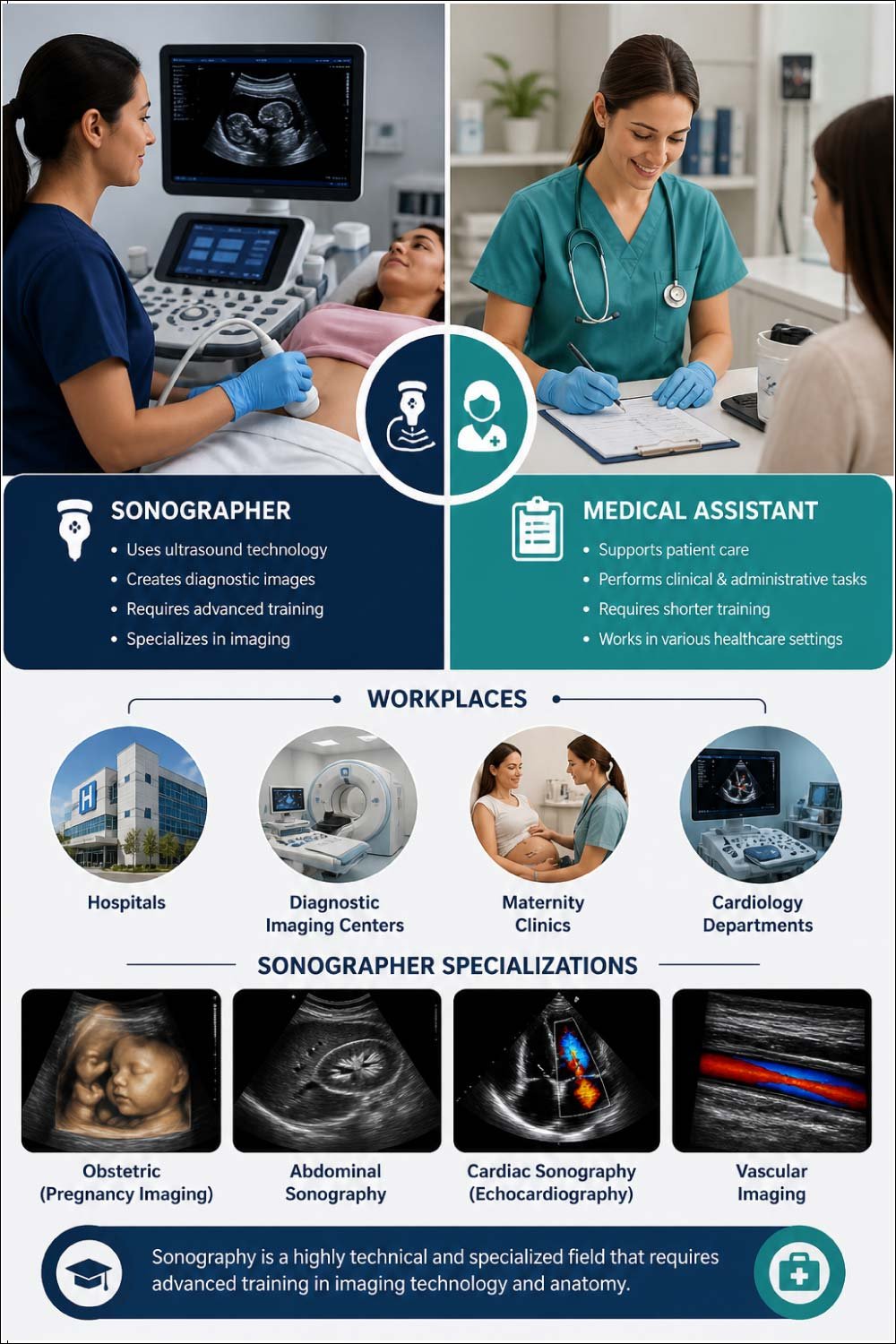

3. Job Responsibilities Comparison (continued)
Both careers involve patient care, but the level of responsibility is very different. Sonographers focus on diagnostic imaging that helps doctors detect diseases, while medical assistants ensure smooth daily operations in clinics by supporting both patients and medical staff in multiple ways.
Medical Assistant Responsibilities
Medical assistants perform a mix of clinical and administrative tasks, making them versatile members of the healthcare team. Their duties ensure that clinics and hospitals run efficiently while also supporting patient care and doctor workflows.
Clinical tasks:
- Taking vital signs
- Drawing blood (in some cases)
- Administering basic medications (varies by region)
- Assisting physicians during exams
Administrative tasks:
- Scheduling appointments
- Managing patient records
- Insurance documentation
- Handling phone calls and front desk duties
Their role supports the smooth operation of a healthcare facility.
4. Salary Comparison
Salary is one of the biggest differences between sonographers and medical assistants. Sonography is a highly specialized field with advanced technical skills, which generally leads to higher income levels compared to medical assisting, which is considered an entry-level healthcare role.
Sonographer Salary
Sonographers are well-compensated due to their technical expertise and the critical role they play in medical diagnosis. Their salary increases with experience, specialization, and additional certifications.
Earning levels:
- Entry-level: Moderate to high income
- Experienced sonographers: High earning potential
- Specialized fields (cardiac, vascular): Even higher salaries
Sonographers often earn significantly more than medical assistants because of their technical expertise.
Medical Assistant Salary
Medical assistants earn a more modest income compared to sonographers. While the salary is stable and reliable, it reflects the entry-level nature of the role in the healthcare system.
Earning levels:
- Entry-level: Lower compared to sonographers
- Experienced MAs: Slight increase with time and certification
- Specialized clinics may offer better pay
While stable, it is considered an entry-level healthcare salary.
Also Read:
5. Work Environment

Work environments for sonographers and medical assistants are quite different. Sonographers usually work in quiet, focused diagnostic settings, while medical assistants work in busy, fast-paced clinics where multitasking is required throughout the day.
Sonographer Work Environment
Sonographers work in controlled medical imaging environments where accuracy and focus are essential. Their work is usually patient-by-patient, allowing more time per case.
- Mostly hospital or diagnostic lab settings
- Quiet, focused imaging rooms
- Long periods of standing or holding scanning positions
- Less administrative work
- Strong focus on patient interaction during imaging
Sonographers often work with one patient at a time in a controlled environment.
Medical Assistant Work Environment
Medical assistants work in dynamic healthcare settings where multiple tasks must be handled simultaneously. Their role requires flexibility and the ability to manage both clinical and office duties.
- Busy clinics and outpatient offices
- Fast-paced multitasking environment
- Frequent interaction with multiple patients daily
- Combination of front desk and clinical work
- Higher administrative workload
Medical assistants often juggle several tasks at once.
Also Read:
6. Skills Required
Both careers require strong healthcare knowledge, but the skill sets differ based on job responsibilities. Sonographers need technical imaging skills, while medical assistants require strong communication and multitasking abilities.
Skills for Sonographers
Sonographers must be highly skilled in imaging technology and anatomy to ensure accurate diagnostic results. Precision and attention to detail are essential.
- Strong understanding of human anatomy
- Technical ability with imaging equipment
- Attention to detail
- Physical stamina (standing and positioning patients)
- Communication skills
- Analytical thinking
Precision is critical in this career.
Skills for Medical Assistants
Medical assistants require a balance of clinical knowledge and administrative ability. They must be organized, friendly, and able to handle multiple responsibilities at once.
- Communication and interpersonal skills
- Organization and multitasking
- Basic clinical knowledge
- Administrative and computer skills
- Empathy and patience
- Teamwork
Medical assistants act as the “bridge” between patients and medical staff.
Also Read:
7. Career Growth Opportunities
Career growth in both fields depends on education, experience, and specialization. Sonography offers more technical advancement, while medical assisting provides broader pathways into different healthcare professions.
Sonographer Career Growth
Sonographers can advance by gaining specialization and experience in advanced imaging fields. However, growth is mostly within the imaging department rather than outside it.
- Senior sonographer
- Specialized fields (cardiac, vascular, neurosonography)
- Lead imaging technologist
- Instructor or educator
- Department supervisor
Growth is more technical than managerial.
Medical Assistant Career Growth
Medical assisting offers more flexible career pathways, especially for those who continue their education in healthcare fields. It can serve as a stepping stone to higher-level medical professions.
- Registered Nurse (RN) through further education
- Medical office manager
- Healthcare administrator
- Specialized clinical assistant roles
- Phlebotomist or lab technician transition
This career can act as a stepping stone to higher medical roles.
8. Job Demand and Stability

Both sonography and medical assisting are growing careers in the healthcare industry, but the reasons for demand differ. Sonography is driven by advanced medical imaging needs, while medical assistants are needed to support expanding healthcare facilities and increasing patient loads.
Sonographer Demand
Sonography is in high demand globally due to its importance in safe, non-invasive medical diagnosis. Hospitals and diagnostic centers increasingly rely on ultrasound technology as a primary imaging tool.
Reasons for high demand:
- Increasing use of non-invasive diagnostics
- Aging population requiring more medical imaging
- Growth in maternity and cardiac care
- Preference for ultrasound over radiation-based imaging
Job stability is strong and growing.
Medical Assistant Demand
Medical assistants are also highly needed in modern healthcare systems because clinics and hospitals require efficient support staff to manage increasing patient flow and administrative workload.
Reasons for demand:
- Healthcare clinics are expanding
- Administrative workload in hospitals is increasing
- Affordable support staff is needed
However, competition is higher due to easy entry.
9. Pros and Cons Comparison
Both careers offer valuable opportunities, but they differ in salary potential, training time, workload, and career flexibility. Understanding the advantages and disadvantages helps in making a realistic career decision.
Sonographer Pros
- Higher salary potential
- Specialized and respected profession
- Strong job stability
- Minimal administrative work
- Advanced medical role
Sonographer Cons
- Longer education and training
- Physically demanding scanning positions
- Limited career diversification
- High responsibility for diagnostic accuracy
Medical Assistant Pros
- Quick entry into healthcare field
- Flexible job opportunities
- Variety of clinical and office tasks
- Good starting point for medical careers
- Less educational requirement
Medical Assistant Cons
- Lower salary range
- High workload and multitasking stress
- Less specialization
- Limited clinical authority
10. Which Career Should You Choose?

Choosing between sonography and medical assisting depends on your career goals, education willingness, and interest in technical vs general healthcare roles. Both are valuable paths, but they suit different personalities and long-term plans.
Choose Sonography If You:
- Want a high-paying medical career
- Are interested in diagnostic imaging
- Prefer technical and specialized work
- Are comfortable with longer education
- Enjoy focused, patient-based procedures
Sonography is ideal for those who want a deep clinical role with strong technical expertise.
Choose Medical Assisting If You:
- Want a quick entry into healthcare
- Prefer variety in daily tasks
- Enjoy administrative + clinical balance
- Plan to advance into nursing or other fields
- Like working in fast-paced clinic environments
Medical assisting is perfect as a starting point in healthcare.
Final Verdict
Both sonographer and medical assistant careers play important roles in healthcare, but they are very different in scope and responsibility.
- Sonography is a specialized, higher-paying diagnostic career requiring advanced training and technical skill.
- Medical assisting is an entry-level, versatile healthcare role offering quick employment and broader career flexibility.
If your goal is higher salary and technical specialization, sonography is the stronger choice.
If you want quick entry and career flexibility, medical assisting is the better starting point.
Ultimately, the right choice depends on your time, interest, and long-term career goals in healthcare.

Zak is a dedicated medical and career writer specializing in sonography, healthcare education, and professional development. Through SonographerSalary.com, he shares in-depth insights on sonographer salaries, education pathways, and career tips to help readers build successful futures in medical imaging. His content combines accuracy with practical, easy-to-understand guidance, empowering students and professionals to make confident, informed career decisions.