
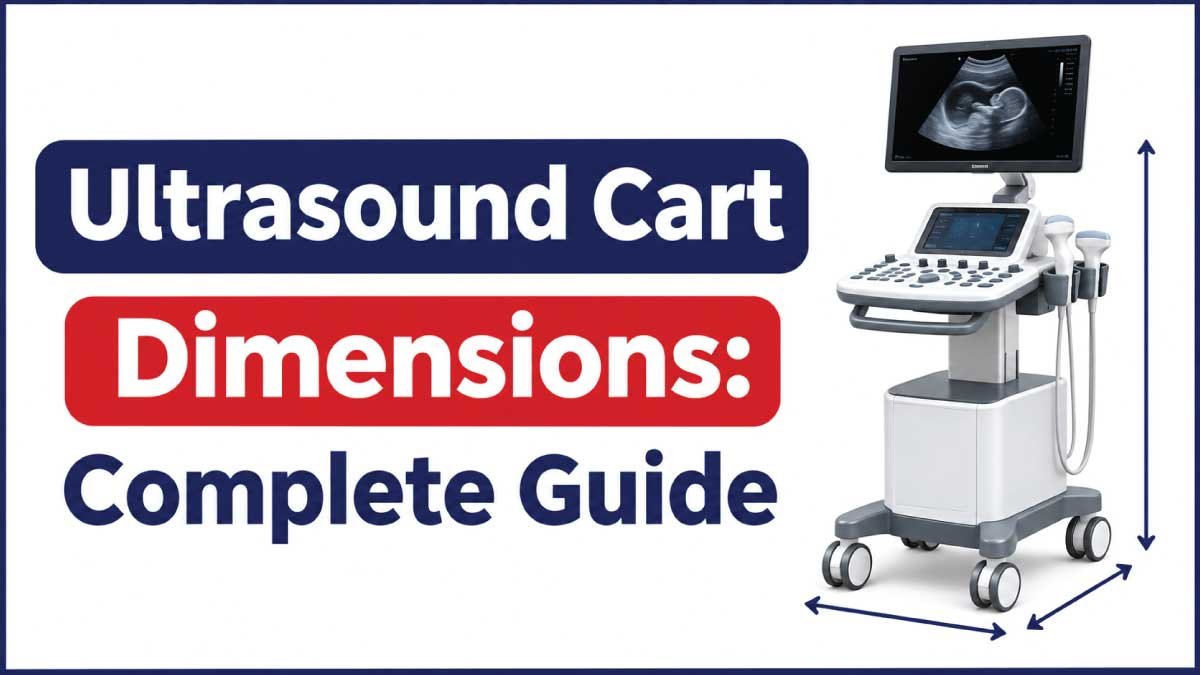
Ultrasound cart dimensions are important considerations when selecting, installing, or arranging diagnostic imaging equipment in hospitals, clinics, and medical examination rooms. An ultrasound cart supports the imaging console, monitor, control panel, transducers, and accessories while allowing healthcare professionals to move the equipment between examination areas.
However, ultrasound carts are available in different designs, including compact portable trolleys, adjustable-height carts, mobile workstations, and dedicated console systems. Their width, depth, height, weight capacity, and wheelbase can vary depending on the manufacturer and equipment configuration.
An ultrasound cart dimensions chart helps healthcare professionals, medical equipment buyers, technicians, and facility planners compare different cart measurements and determine how much space a system requires.
This guide covers common ultrasound cart dimensions, measurement methods, cart components, weight considerations, mobility requirements, and practical selection tips. It also explains how to measure an ultrasound cart accurately and avoid common purchasing mistakes.
1. What Is an Ultrasound Cart?
An ultrasound cart is a wheeled support structure designed to hold and transport ultrasound imaging equipment. It provides a stable platform for the monitor, control panel, imaging console, and other accessories.
Most cart-based ultrasound systems are designed to make diagnostic examinations more convenient by keeping essential equipment organized and accessible.
A typical ultrasound cart includes:
- Base: The lower supporting structure that provides stability.
- Wheels or casters: Allow the cart to move between examination rooms.
- Monitor mount: Supports the ultrasound display.
- Console platform: Holds the imaging system and operating controls.
- Probe holders: Provide designated storage for transducers.
- Cable management: Keeps electrical and probe cables organized.
- Storage compartments: Hold accessories and other medical supplies.
- Handle: Allows the operator to move the cart.
The overall dimensions depend on the cart design, mounting arrangement, monitor size, and ultrasound system installed on it.
2. Ultrasound Cart Dimensions Chart
Ultrasound carts are available in different sizes to accommodate compact portable systems and full-size diagnostic consoles.
The following chart provides approximate planning ranges for common cart categories. These values are general estimates, not standardized dimensions or guaranteed specifications for every manufacturer.
| Ultrasound Cart Type | Approx. Width | Approx. Depth | Approx. Height |
|---|---|---|---|
| Compact portable cart | 40–50 cm | 40–55 cm | 80–110 cm |
| Small ultrasound trolley | 40–55 cm | 45–60 cm | 90–120 cm |
| Standard mobile cart | 45–65 cm | 45–70 cm | 100–150 cm |
| Adjustable-height cart | 45–65 cm | 45–70 cm | 90–150 cm |
| Large console cart | 55–80 cm | 60–100 cm | 120–180 cm |
| Specialized imaging workstation | 50–80 cm | 55–100 cm | Model-specific |
Important: These dimensions are approximate equipment-planning references. Actual cart dimensions depend on the manufacturer, model, accessories, and monitor configuration. Always check the product datasheet before purchasing or planning installation space.
Understanding Ultrasound Cart Measurements
Three primary dimensions are used to describe an ultrasound cart:
- Width: The horizontal measurement from the left side to the right side.
- Depth: The measurement from the front of the cart to the back.
- Height: The vertical distance from the floor to the highest point.
For adjustable carts, manufacturers may provide minimum and maximum height measurements.
The overall height may include the monitor, mounting arm, handle, or other components, so it is important to understand exactly how the manufacturer defines each measurement.
3. Ultrasound Cart Width Dimensions
Cart width determines how much horizontal space the equipment occupies. It also affects how easily the cart moves through doorways, corridors, and examination areas.
Compact carts generally require less space than large console workstations.
Typical Cart Width Categories
| Cart Category | Approximate Width |
|---|---|
| Compact cart | 40–50 cm |
| Small mobile cart | 40–55 cm |
| Standard ultrasound cart | 45–65 cm |
| Large console cart | 55–80 cm |
| Specialized workstation | 50–80 cm |
These ranges are intended for general comparison.
Factors Affecting Cart Width
Several components can influence the overall width:
- Monitor mounting structure.
- Side handles.
- Probe holders.
- Storage compartments.
- Console housing.
- Wheel assemblies.
- Cable management accessories.
When measuring the cart, include any permanent components that extend beyond its main body.
Why Cart Width Matters
Cart width is particularly important in healthcare facilities with limited room space.
A narrower cart may be easier to move through restricted areas, while a wider base may provide a different stability and support configuration.
Before selecting a cart, measure the narrowest doorway and passage through which the equipment must travel.
4. Ultrasound Cart Depth Dimensions
Cart depth measures the distance from the frontmost point to the rearmost point of the equipment.
It determines how much floor space the cart occupies when positioned beside an examination table or against a wall.
| Cart Category | Approximate Depth |
|---|---|
| Compact portable cart | 40–55 cm |
| Small mobile cart | 45–60 cm |
| Standard ultrasound cart | 45–70 cm |
| Large console cart | 60–100 cm |
| Specialized workstation | 55–100 cm |
Important Depth Considerations
When evaluating cart depth, consider:
- Rear cable connections.
- Power supply arrangements.
- Monitor support structures.
- Console overhang.
- Wheelbase dimensions.
- Service and maintenance access.
A cart may have a relatively compact base but a larger overall depth because of its rear-mounted equipment or supporting structures.
For accurate room planning, use the complete equipment footprint rather than measuring only the lower base.
5. Ultrasound Cart Height Dimensions
Cart height affects operator comfort, display positioning, and accessibility.
Some ultrasound carts have fixed-height structures, while others allow the monitor or working surface to be adjusted.
Typical Ultrasound Cart Height Chart
| Cart Type | Approximate Height |
|---|---|
| Compact portable cart | 80–110 cm |
| Small ultrasound trolley | 90–120 cm |
| Standard mobile cart | 100–150 cm |
| Adjustable-height cart | 90–150 cm |
| Large console cart | 120–180 cm |
These are broad planning ranges and should not replace model-specific specifications.
Fixed-Height Ultrasound Carts
Fixed-height carts have a predetermined working height.
Their design is generally simpler, but the operator cannot adjust the entire cart height to the same extent as an adjustable workstation.
Adjustable-Height Ultrasound Carts
Adjustable carts allow users to change the position of the working surface or monitor.
Depending on the design, adjustment may be manual, mechanical, or powered.
Common benefits include:
- Better ergonomic positioning.
- Greater flexibility for different operators.
- Improved monitor visibility.
- More adaptable examination arrangements.
Always check the manufacturer’s specified adjustment range.
6. Ultrasound Cart Base and Wheel Dimensions
The base and wheels are essential parts of an ultrasound cart because they influence stability, movement, and floor clearance.
The wheel arrangement varies between manufacturers and equipment categories.
Common Cart Base Measurements
| Component | Measurement Consideration |
|---|---|
| Base width | Overall horizontal support width |
| Base depth | Front-to-back support dimension |
| Wheel diameter | Outside diameter of each caster |
| Wheel spacing | Distance between wheel centers |
| Ground clearance | Space between the floor and lower structure |
| Wheelbase | Distance between the supporting wheel positions |
There is no universal wheel diameter or base measurement for ultrasound carts.
Important Wheel Features
A suitable ultrasound cart may include:
- Locking casters.
- Swivel wheels.
- Stable wheel positioning.
- Smooth rolling performance.
- Suitable floor clearance.
- Secure wheel attachment.
Locking mechanisms help prevent unwanted movement during examinations.
For heavy equipment, the cart’s specified load capacity and stability requirements should be checked before installation.
7. Actual Ultrasound Cart Dimensions: Manufacturer Example
Generic dimensions are useful for initial planning, but published manufacturer specifications provide more reliable information for individual models.
One example is the Philips InnoSight mobility cart.
Philips InnoSight Cart Dimensions
The published cart specifications include:
| Measurement | Published Dimension |
|---|---|
| Cart width | 48.6 cm |
| Cart depth | 56.6 cm |
| Adjustable cart height | 118.6–148.6 cm |
| Cart weight | 27.7 kg |
These specifications describe the mobility cart, not the complete imaging system.
The Philips InnoSight imaging device has separate dimensions and weight specifications.
This distinction is important because the dimensions of an ultrasound console or tablet should not be confused with the dimensions of its supporting cart.
How to Interpret Manufacturer Cart Specifications
When comparing product datasheets, check whether the listed measurements refer to:
- The cart alone.
- The cart with the ultrasound console.
- The complete system with monitor.
- The equipment in its minimum-height position.
- The equipment in its maximum-height position.
- The cart with optional accessories installed.
This helps prevent inaccurate comparisons between different manufacturers.
Also Read:
8. Ultrasound Cart Size Comparison Chart
Different cart designs serve different clinical environments.
The following comparison summarizes their general characteristics.
| Cart Type | Space Requirement | Mobility | Common Environment |
|---|---|---|---|
| Compact portable cart | Low | High | Small clinics |
| Small ultrasound trolley | Low to moderate | High | Outpatient departments |
| Standard mobile cart | Moderate | High | Hospitals |
| Adjustable-height cart | Moderate | High | Examination rooms |
| Large console cart | High | Moderate | Imaging departments |
| Specialized workstation | Model-specific | Model-specific | Specialized clinical areas |
Compact Ultrasound Carts
Compact carts are useful when available floor space is limited.
They may support smaller portable imaging systems and provide basic storage for probes and accessories.
Standard Mobile Ultrasound Carts
Standard mobile carts provide a larger platform for the ultrasound console and monitor.
They are commonly suitable for facilities that move equipment between different examination rooms.
Large Console Carts
Large console carts are designed for more substantial imaging systems.
Their larger footprints may accommodate additional controls, storage, and equipment components.
Also Read:
9. Ultrasound Cart Dimensions in Inches and Centimeters
Manufacturer specifications may use either metric or imperial measurements.
The following conversion chart helps compare cart dimensions between different product documents.
| Centimeters (cm) | Inches (in) |
|---|---|
| 40 cm | 15.75 in |
| 45 cm | 17.72 in |
| 50 cm | 19.69 in |
| 55 cm | 21.65 in |
| 60 cm | 23.62 in |
| 65 cm | 25.59 in |
| 70 cm | 27.56 in |
| 75 cm | 29.53 in |
| 80 cm | 31.50 in |
| 90 cm | 35.43 in |
| 100 cm | 39.37 in |
| 110 cm | 43.31 in |
| 120 cm | 47.24 in |
| 130 cm | 51.18 in |
| 140 cm | 55.12 in |
| 150 cm | 59.06 in |
| 160 cm | 62.99 in |
| 180 cm | 70.87 in |
How to Convert Cart Dimensions
Use these formulas:
Centimeters to inches:
Inches = Centimeters ÷ 2.54
Inches to centimeters:
Centimeters = Inches × 2.54
Kilograms to pounds:
Pounds = Kilograms × 2.20462
For example, a cart measuring 48.6 cm in width is approximately 19.13 inches wide.
10. How to Measure an Ultrasound Cart
Measuring an ultrasound cart correctly helps determine whether it fits through doorways, corridors, and examination spaces.
Follow these steps to record its dimensions.
Step 1: Measure the Overall Width
Measure from the outermost point on the left side to the outermost point on the right side.
Include handles, wheel assemblies, and other permanent components that extend beyond the cart body.
Step 2: Measure the Overall Depth
Measure from the frontmost point to the rearmost point.
Consider cable connections, rear supports, and other protruding components.
Step 3: Measure the Overall Height
Measure vertically from the floor to the highest point of the assembled cart.
For adjustable carts, record both the minimum and maximum heights.
Step 4: Measure the Base Dimensions
Record the width and depth of the lower supporting structure.
These measurements help determine the cart’s floor footprint and stability configuration.
Step 5: Measure the Wheels
Record the wheel diameter and relevant wheelbase measurements when required.
Also check the caster locking mechanism and ground clearance.
Step 6: Record the Total Weight
Check whether the manufacturer’s weight includes the console, monitor, battery, accessories, and other components.
The weight of the empty cart may be substantially different from that of the fully assembled system.
11. How to Choose the Right Ultrasound Cart Size
Selecting an ultrasound cart requires considering the available space, imaging equipment, operator requirements, and movement between clinical areas.
Evaluate Available Floor Space
Measure the examination room before purchasing the cart.
Consider:
- Available floor area.
- Examination table position.
- Doorway width.
- Corridor clearance.
- Operator movement.
- Electrical connections.
- Equipment maintenance access.
A cart should fit comfortably without restricting patient care or operator movement.
Check Equipment Compatibility
Not every cart supports every ultrasound system.
Verify:
- Console mounting compatibility.
- Monitor mounting arrangement.
- Weight capacity.
- Probe holder configuration.
- Cable management.
- Electrical and power arrangements.
Manufacturer-approved carts are generally preferable when the equipment requires specific mounting or electrical connections.
Consider Ergonomic Requirements
The working surface and monitor should be positioned for comfortable operation.
Adjustable monitor arms and height-adjustable platforms may help accommodate different operators.
Evaluate Mobility
If the ultrasound system must move frequently, consider the cart’s wheel design, locking mechanisms, steering, and total assembled weight.
The cart should be suitable for the flooring and movement requirements of the healthcare facility.
Check Load Capacity
The cart’s load capacity must accommodate the complete supported equipment configuration.
Consider the weight of the imaging console, display, probes, accessories, and other mounted components.
Do not exceed the manufacturer’s specified load limits.
12. Common Mistakes When Comparing Ultrasound Cart Dimensions
Incorrect measurements can create installation difficulties and purchasing problems.
Avoid these common mistakes:
- Measuring only the base: The complete cart may extend beyond the lower supporting structure.
- Ignoring the monitor: Display mounts can increase the overall height and footprint.
- Confusing cart and console dimensions: These are separate measurements.
- Ignoring adjustable height: Minimum and maximum operating heights can differ considerably.
- Forgetting the wheels: Caster assemblies may extend beyond the cart housing.
- Ignoring cable connections: Rear connections may require additional clearance.
- Overlooking load capacity: A cart must safely support its complete equipment configuration.
- Using generic measurements for purchasing: Always verify the manufacturer’s exact specifications.
These considerations are particularly important when arranging multiple ultrasound systems in a limited clinical space.
13. Frequently Asked Questions About Ultrasound Cart Dimensions
1. What are the standard dimensions of an ultrasound cart?
There are no universal standard dimensions for all ultrasound carts. Compact carts may be relatively narrow, while larger diagnostic workstations require more width, depth, and height. Actual dimensions depend on the manufacturer and model.
2. How wide is a typical ultrasound cart?
General ultrasound cart width ranges may be approximately 40–65 cm for compact and standard mobile configurations. Larger systems can be wider. Always verify the exact model specifications.
3. How deep is an ultrasound cart?
Cart depth varies according to its design. Compact carts may have a depth of approximately 40–55 cm, while larger console carts may require substantially more space.
4. Are ultrasound cart heights adjustable?
Many modern ultrasound carts provide adjustable monitor or working-surface positions. However, adjustment mechanisms and height ranges vary between manufacturers.
5. How much does an ultrasound cart weigh?
Cart weight depends on its frame, wheels, storage arrangement, and mounting structure. A cart’s empty weight should be distinguished from the total weight of the assembled ultrasound system.
6. What is the difference between an ultrasound cart and an ultrasound console?
An ultrasound cart is the supporting mobile structure, while the console contains the imaging system’s processing hardware and operating controls. Some products combine these components into one integrated configuration.
7. How much space is needed for an ultrasound cart?
The required space depends on the complete cart footprint, examination table, operator position, and movement requirements. Manufacturer installation drawings and applicable healthcare facility requirements should guide room planning.
8. Can an ultrasound cart fit through a standard doorway?
It depends on the cart’s overall width, protruding components, and the actual clear doorway opening. Measure the narrowest passage and compare it with the fully assembled cart dimensions.
9. What type of wheels should an ultrasound cart have?
Many mobile ultrasound carts use swivel casters, with locking mechanisms to help keep the equipment stationary during examinations. The appropriate wheel configuration depends on the cart design and load requirements.
10. Where can I find exact ultrasound cart dimensions?
The manufacturer’s product datasheet, technical specifications, installation manual, and equipment drawings provide the most reliable dimensions for an individual ultrasound cart.
14. Conclusion
Ultrasound cart dimensions are important when purchasing diagnostic imaging equipment, planning examination rooms, and arranging mobile medical workstations. Width, depth, height, wheelbase, and total weight all influence how conveniently a cart can be installed and moved.
The ultrasound cart dimensions chart in this guide provides a practical overview of common cart configurations and their approximate measurements. Compact carts are suitable for space-conscious environments, while larger mobile workstations support more substantial imaging equipment.
However, ultrasound carts do not follow one universal dimensional standard. Exact measurements depend on the manufacturer, model, and installed accessories.
Before purchasing a cart, verify its complete dimensions, height adjustment range, load capacity, wheel configuration, and compatibility with the ultrasound system. These checks help ensure that the selected cart meets the practical requirements of the healthcare facility.

Zak is a dedicated medical and career writer specializing in sonography, healthcare education, and professional development. Through SonographerSalary.com, he shares in-depth insights on sonographer salaries, education pathways, and career tips to help readers build successful futures in medical imaging. His content combines accuracy with practical, easy-to-understand guidance, empowering students and professionals to make confident, informed career decisions.