
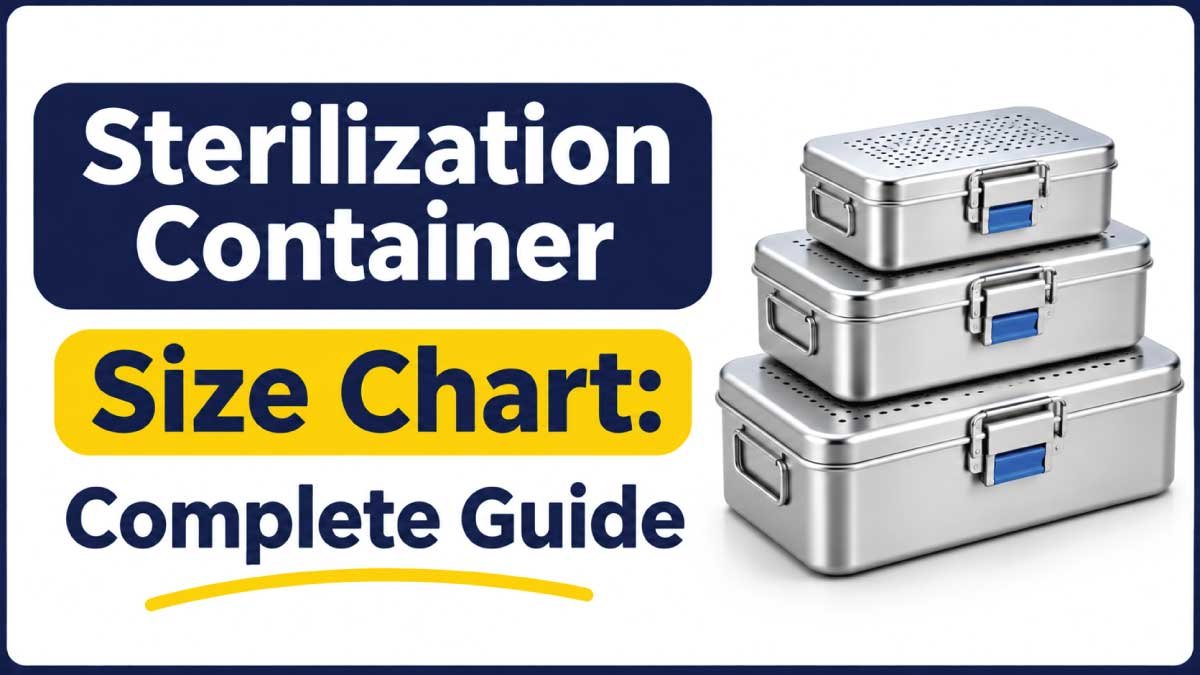
Sterilization containers are essential medical devices used in hospitals, surgical centers, dental clinics, and other healthcare facilities to protect surgical instruments during sterilization, storage, and transportation. Selecting the correct sterilization container size is important because the container must accommodate the instruments, support the appropriate sterilization process, and maintain a sterile barrier until the contents are needed.
Sterilization containers are available in different lengths, widths, heights, and configurations. Small containers are commonly used for individual instrument sets, while larger models accommodate multiple surgical instruments and specialized equipment. Their dimensions also depend on the manufacturer, container system, sterilization method, and type of instruments being processed.
A sterilization container size chart helps healthcare professionals compare standard configurations and select suitable equipment for their surgical departments. However, there is no single universal size standard covering every manufacturer or sterilization system.
This guide explains sterilization container dimensions, common sizes, standard configurations, instrument capacity, material options, and important considerations for choosing the correct container.
Standard Sterilization Container Size Chart
Sterilization containers are generally classified by their external dimensions and internal usable capacity. Manufacturers offer different configurations to accommodate instrument trays, surgical sets, and specialized medical equipment.
The following chart provides approximate planning categories. These are illustrative dimensional ranges rather than universal manufacturer specifications.
Sterilization Container Dimensions in Inches
| Container Size | Length (in) | Width (in) | Height (in) |
|---|---|---|---|
| Small | 10–12 | 6–8 | 2–4 |
| Medium | 16–18 | 10–12 | 3–5 |
| Large | 20–24 | 12–16 | 4–6 |
| Extra Large | 24–26 | 16–20 | 5–7 |
| Deep Container | 16–24 | 10–16 | 6–8 |
| Specialized Container | 20–26 | 12–20 | 6–10 |
These categories are intended to explain common container configurations. Actual product dimensions may differ, and the manufacturer’s approved specifications should always take priority.
Sterilization Container Dimensions in Centimeters
The following table provides approximate metric equivalents for healthcare facilities that use centimeters.
| Container Size | Length (cm) | Width (cm) | Height (cm) |
|---|---|---|---|
| Small | 25–30 | 15–20 | 5–10 |
| Medium | 41–46 | 25–30 | 8–13 |
| Large | 51–61 | 30–41 | 10–15 |
| Extra Large | 61–66 | 41–51 | 13–18 |
| Deep Container | 41–61 | 25–41 | 15–20 |
| Specialized Container | 51–66 | 30–51 | 15–25 |
Metric values are rounded planning conversions. Always distinguish external dimensions from internal dimensions when comparing products.
Main Dimensions of Sterilization Containers
Understanding the three main dimensions helps healthcare facilities determine whether a container will accommodate a specific instrument set and fit within their sterilization workflow.
Sterilization Container Length
Length measures the longest horizontal dimension of the container.
It is particularly important when storing longer surgical instruments, instrument trays, and specialized medical equipment.
Consider the following factors:
- Length of the longest instrument.
- Dimensions of the instrument basket.
- Internal clearance around the instruments.
- Space required for instrument positioning.
- Compatibility with the sterilization equipment.
A container should provide adequate room for the instruments without requiring them to be forced into position.
Sterilization Container Width
Width measures the distance across the shorter horizontal side of the container.
It affects how many instruments or instrument trays can be arranged inside the system. Wider containers may accommodate larger instrument sets, but they also require more shelf and storage space.
Sterilization Container Height
Height measures the vertical distance from the bottom of the container to the top of its lid.
Container height is especially important for bulky surgical instruments and equipment with larger profiles.
Available height must accommodate the instruments, baskets, and approved internal accessories without interfering with the lid or filtration system.
Internal and External Dimensions
One important consideration is the difference between internal and external measurements.
External dimensions determine the physical footprint of the container, while internal dimensions indicate the usable space available for instrument storage.
Wall thickness, handles, lid construction, and internal support structures can reduce usable space.
Always check both measurements before purchasing a sterilization container.
Types of Sterilization Containers and Their Sizes
Different sterilization container systems are designed for different surgical applications. Their dimensions, construction, and internal configurations vary according to the instruments they accommodate.
Standard Rigid Sterilization Containers
Standard rigid sterilization containers are reusable systems designed to hold surgical instruments during an approved sterilization cycle.
They generally consist of a container base, lid, filtration or valve system, and locking mechanisms.
Common features include:
- Rigid metal construction.
- Reusable container bases and lids.
- Integrated or replaceable filtration components.
- Secure locking mechanisms.
- Instrument basket compatibility.
- Identification and tracking features.
These systems are available in several footprint and height configurations.
Perforated Sterilization Containers
Perforated containers have openings designed to support sterilant circulation and drying under the conditions specified by the manufacturer.
Their construction and perforation patterns depend on the sterilization system.
They may be available in shallow, standard, and deep configurations for different instrument sets.
Non-Perforated Sterilization Containers
Non-perforated containers have a different construction from conventional perforated systems. Their suitability depends on the specific sterilization technology and the manufacturer’s validated instructions.
They should never be assumed to be interchangeable with perforated containers.
Dental Sterilization Containers
Dental sterilization containers are generally designed for smaller instrument sets used in dental clinics and treatment rooms.
They may accommodate:
- Dental examination instruments.
- Periodontal instruments.
- Dental hand instruments.
- Small surgical instruments.
- Specialized dental instrument trays.
Compact dimensions can help dental practices organize multiple instrument sets while making efficient use of sterilization equipment.
Surgical Instrument Containers
Surgical instrument containers are designed for larger and more specialized instrument sets used in operating rooms.
Depending on the application, they may accommodate general surgical instruments, orthopedic instruments, and other reusable medical devices.
Their dimensions should match the instrument basket and the validated sterilization configuration.
Sterilization Container Size by Application
The correct container size depends largely on the type and number of instruments being processed.
Small Instrument Containers
Small containers are useful for individual instrument sets and compact medical equipment.
Common applications include:
- Dental instrument sets.
- Minor surgical instruments.
- Small examination instruments.
- Individual procedure kits.
They require less storage space and can be useful in clinics that process smaller instrument loads.
Medium Instrument Containers
Medium-sized containers can accommodate more extensive instrument arrangements.
They are commonly considered for general surgical instrument sets and reusable instruments used in different clinical departments.
Large Instrument Containers
Large containers provide additional space for bigger instrument baskets and more extensive surgical sets.
They may be suitable for operating room applications where multiple instruments are required for a procedure.
Extra-Large Instrument Containers
Extra-large containers are intended for specialized instrument configurations that require additional length, width, or depth.
Before selecting these models, confirm that the container is compatible with the sterilizer chamber, loading equipment, storage shelves, and manufacturer’s validated cycle instructions.
Manufacturer Sterilization Container Size Examples
Actual manufacturer specifications provide a more reliable reference than general size categories. Aesculap, for example, offers sterilization containers in full-size, three-quarter-size, and half-size configurations, with different heights.
Aesculap SterilContainer S Dimensions
The following dimensions are published for the Aesculap SterilContainer S product family. Measurements are external dimensions, including the lid.
| Container Configuration | Length (in) | Width (in) | Height (in) |
|---|---|---|---|
| Full Size | 23.25 | 11.25 | 4.25 |
| Full Size | 23.25 | 11.25 | 5.5 |
| Full Size | 23.25 | 11.25 | 6 |
| Three-Quarter Size | 18.5 | 11.25 | 4.25 |
| Three-Quarter Size | 18.5 | 11.25 | 5.5 |
| Three-Quarter Size | 18.5 | 11.25 | 6 |
| Half Size | 11.75 | 11.25 | 4.25 |
| Half Size | 11.75 | 11.25 | 5.5 |
| Half Size | 11.75 | 11.25 | 6 |
<Cite refs={[“turn727278search22”]}/>
These examples demonstrate how container length and height can change while the width remains the same.
Aesculap Standard 1/1 Container Dimensions
Another example is the Aesculap standard 1/1 container system. Its published specifications distinguish external and internal dimensions.
| Container Model | External Length (mm) | External Width (mm) | External Height (mm) |
|---|---|---|---|
| JK440 | 592 | 274 | 90 |
| JK441 | 592 | 274 | 120 |
| JK442 | 592 | 274 | 135 |
| JK444 | 592 | 274 | 187 |
| JK446 | 592 | 274 | 247 |
The corresponding internal dimensions for the first three configurations are approximately 544 mm in length and 258 mm in width. Internal height varies according to the model. <Cite refs={[“turn727278search2″,”turn727278search3″,”turn727278search5″,”turn727278search6”]}/>
These examples should not be mixed with the SterilContainer S measurements as though they belong to one universal sizing system. Always identify the exact product family before comparing dimensions.
Sterilization Container Materials and Construction
The material used in a sterilization container affects its durability, weight, cleaning requirements, and compatibility with the intended sterilization process.
Aluminum Sterilization Containers
Aluminum is commonly used in reusable rigid sterilization container systems.
Its characteristics include:
- Relatively lightweight construction.
- Good durability when properly maintained.
- Corrosion resistance depending on the alloy and surface treatment.
- Suitability for specific validated sterilization systems.
- Availability in multiple container configurations.
The aluminum alloy, finish, and construction should be approved by the manufacturer for the intended application.
Stainless Steel Sterilization Containers
Stainless steel is used in some reusable medical instrument containers and sterilization accessories.
Common characteristics include:
- High structural strength.
- Resistance to corrosion when properly maintained.
- Durability under appropriate reprocessing conditions.
- Compatibility with selected instrument storage systems.
Stainless steel containers may be heavier than comparable aluminum products.
Plastic Sterilization Containers
Some sterilization systems use specialized medical-grade polymers or plastic components.
These materials may be used for particular container designs, trays, lids, and accessories.
Not every plastic container is suitable for every sterilization method. Temperature tolerance, chemical compatibility, and manufacturer validation must be checked carefully.
Related Guide:
Sterilization Container Accessories and Internal Dimensions
The container itself is only one part of a complete sterilization system. Internal accessories help organize instruments and support appropriate processing.
Instrument Baskets
Instrument baskets hold surgical instruments in an organized arrangement.
Their dimensions should match the container’s internal length, width, and height.
Before selecting a basket, verify:
- Internal container measurements.
- Basket external dimensions.
- Instrument arrangement.
- Required clearance.
- Compatibility with the container and sterilizer.
Silicone Mats
Silicone mats may be used in approved configurations to help organize and protect instruments.
Their dimensions should match the intended tray or container system. However, compatibility with the sterilization method must be confirmed.
Instrument Holders and Dividers
Instrument holders, brackets, and dividers keep individual instruments positioned during handling and processing.
They can be particularly useful for organizing delicate or specialized surgical instruments.
Filters and Valves
Some rigid container systems use filters, while others use alternative validated mechanisms to permit sterilant entry and maintain the sterile barrier.
These components are not interchangeable across all container systems. Only manufacturer-approved components should be used.
Related Guide:
How to Choose the Correct Sterilization Container Size
Selecting the right sterilization container requires considering the instruments, sterilization equipment, storage requirements, and intended clinical application.
Consider Instrument Dimensions
Measure the longest, widest, and tallest instruments in the set.
The container should provide sufficient internal space without forcing instruments against the walls, lid, or other components.
Consider:
- Length of the longest instrument.
- Overall instrument set dimensions.
- Instrument basket dimensions.
- Required internal clearance.
- Approved instrument positioning.
Check Sterilizer Chamber Compatibility
A container must fit inside the sterilizer chamber with adequate space for the validated loading configuration.
Before purchasing, check:
- Chamber length, width, and height.
- Available loading space.
- Approved container configurations.
- Maximum permitted load weight.
- Sterilization cycle compatibility.
A container that physically fits inside a chamber is not necessarily approved for every sterilization cycle.
Consider the Type of Surgical Procedure
Different surgical specialties require different instrument sets.
For example:
- Dental procedures: Smaller containers may accommodate compact dental instrument sets.
- General surgery: Medium and full-size configurations may accommodate standard surgical instrument baskets.
- Orthopedic surgery: Larger or deeper containers may be needed for specialized instruments.
- Minor procedures: Compact containers may be sufficient for smaller instrument arrangements.
The final selection should be based on the actual instrument set rather than the procedure name alone.
Evaluate Storage and Transportation
Consider where sterilization containers will be stored and how they will move through the facility.
Check the dimensions of:
- Sterilization racks.
- Storage shelves.
- Transport carts.
- Operating room storage areas.
- Loading and unloading equipment.
The container should be easy to handle without compromising its closure or sterile barrier.
Related Guide:
Sterilization Container Safety and Maintenance
Proper inspection and maintenance help preserve container performance and support safe instrument reprocessing.
Inspect the Lid and Base
Check the container before each use for:
- Dents and structural damage.
- Distorted sealing surfaces.
- Damaged locking mechanisms.
- Loose handles.
- Corrosion or excessive wear.
Damaged components may affect the container’s ability to function as intended.
Check Filters and Valves
For systems that use filters or valves, inspect these components according to the manufacturer’s instructions.
Use only approved replacement parts and follow the specified replacement schedule.
Follow Manufacturer Cleaning Instructions
Reusable sterilization containers require appropriate cleaning and preparation before each sterilization cycle.
Follow the manufacturer’s instructions for:
- Disassembly.
- Cleaning.
- Rinsing.
- Drying.
- Inspection.
- Reassembly.
Maintain Container Identification
Identification labels and tracking systems help healthcare facilities distinguish instrument sets and monitor their movement through the reprocessing workflow.
Use labels and indicators approved for the specific sterilization system.
Common Sterilization Container Sizing Mistakes
Confusing External and Internal Dimensions
External measurements determine the container’s footprint, while internal measurements determine usable instrument space. Always check both.
Choosing Excessive Container Height
A deeper container is not always necessary. Excessive space may increase the overall load size and weight without providing useful additional capacity.
Ignoring Instrument Basket Compatibility
A basket that does not fit correctly may interfere with container closure or instrument arrangement.
Ignoring Sterilizer Compatibility
Different container systems may be validated for different sterilization technologies. Never assume that a container approved for one process is automatically suitable for another.
Overloading the Container
Exceeding manufacturer weight limits or placing instruments incorrectly can compromise the validated processing configuration. Follow the approved loading instructions.
Frequently Asked Questions About Sterilization Container Sizes
1. What are the standard sizes of sterilization containers?
Sterilization containers are available in half-size, three-quarter-size, full-size, and other manufacturer-specific configurations. Their dimensions vary according to the product system and intended application.
2. What is a full-size sterilization container?
A full-size container is a larger standardized configuration within a particular manufacturer’s product family. For example, the Aesculap SterilContainer S full-size bottom measures approximately 23.25 inches long and 11.25 inches wide, with different available heights.
3. What is the difference between half-size and full-size sterilization containers?
The main difference is their external footprint and available instrument space. Half-size configurations are generally shorter, while full-size models accommodate larger instrument arrangements.
4. How tall is a sterilization container?
Container height depends on the model. Some Aesculap SterilContainer S configurations have heights of 4.25, 5.5, and 6 inches. Other systems offer substantially deeper configurations.
5. What material is best for sterilization containers?
Aluminum is commonly used in reusable rigid sterilization systems because of its relatively low weight and durability. Stainless steel and specialized polymers are also used in different applications. Material suitability depends on the validated sterilization process.
6. Can sterilization containers be used in autoclaves?
Some rigid sterilization containers are specifically designed and validated for steam sterilization. However, not every container is compatible with every autoclave cycle. Always consult the manufacturer’s instructions.
7. What is the difference between perforated and non-perforated sterilization containers?
Perforated containers have openings designed to support sterilant circulation in approved systems. Non-perforated containers use different construction and may rely on specific validated mechanisms. Their suitability depends on the sterilization technology.
8. How do I measure a sterilization container?
Measure its external length, width, and height, including the lid. Then check the internal measurements to determine the available instrument space. Record dimensions in inches or millimeters for accurate comparisons.
9. Are sterilization container lids interchangeable?
Not necessarily. Lids are generally designed for specific container bases and product configurations. Use only compatible components approved by the manufacturer.
10. How often should sterilization containers be inspected?
Reusable containers should be inspected before each use according to the manufacturer’s instructions. Check the base, lid, locking mechanisms, sealing surfaces, filters, and valves where applicable.
Conclusion
Sterilization container dimensions vary according to the manufacturer, container configuration, instrument requirements, and sterilization method. Half-size, three-quarter-size, and full-size configurations provide different storage options for surgical and medical instruments.
When comparing sterilization container sizes, consider external dimensions, internal capacity, height, material, basket compatibility, and sterilizer chamber requirements. Manufacturer specifications are especially important because containers that look similar may have different validated applications.
Choosing the correct sterilization container helps healthcare facilities organize surgical instruments, maintain appropriate processing conditions, and support reliable sterile storage. Always follow the manufacturer’s instructions and applicable sterilization standards before selecting or using a container.

Zak is a dedicated medical and career writer specializing in sonography, healthcare education, and professional development. Through SonographerSalary.com, he shares in-depth insights on sonographer salaries, education pathways, and career tips to help readers build successful futures in medical imaging. His content combines accuracy with practical, easy-to-understand guidance, empowering students and professionals to make confident, informed career decisions.