
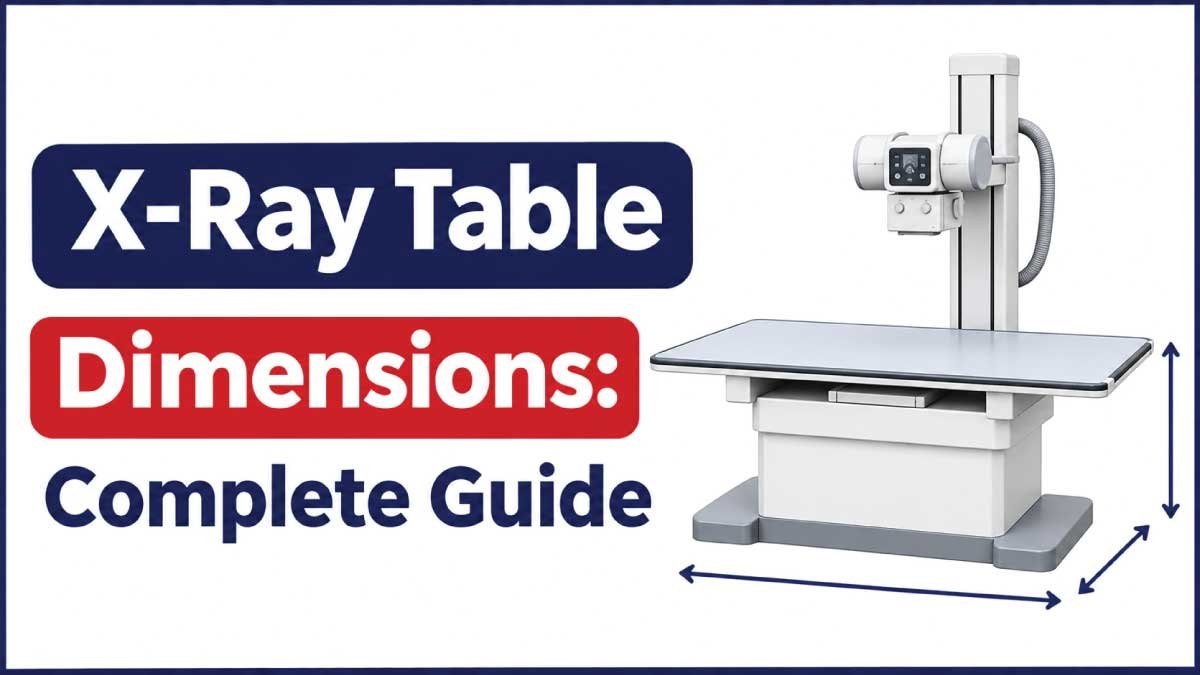
X-ray table dimensions are important when selecting radiography equipment, designing an imaging room, replacing an existing examination table, or comparing different medical imaging systems. The table must provide sufficient space for patient positioning while supporting accurate imaging, comfortable access, and compatibility with the X-ray detector and tube assembly.
An X-Ray Table Dimensions Chart helps radiology professionals, hospital administrators, biomedical technicians, medical equipment purchasers, and healthcare facility planners understand the measurements used in different radiography systems.
However, X-ray tables do not have one universal standard size. Their dimensions depend on the manufacturer, equipment configuration, clinical application, patient weight capacity, and whether the table uses a fixed or floating tabletop.
Many conventional radiography tables have tabletops approximately 200–235 cm long and 65–85 cm wide. Height also varies, with fixed-height and adjustable-height configurations available.
This guide covers standard X-ray table measurements, manufacturer-specific examples, tabletop dimensions, height specifications, different table types, measurement methods, and important selection factors.
What Are X-Ray Table Dimensions?
X-ray table dimensions describe the physical measurements of a patient-supporting table used during radiographic examinations. These measurements determine how much space is available for patient positioning and how the table fits within an imaging room.
An X-ray table is generally designed to support patients in a horizontal or angled position while allowing the imaging system to capture radiographs of different body regions.
Its dimensions are particularly important because the table must work together with the X-ray tube, detector, bucky assembly, and positioning equipment.
Main Dimensions of an X-Ray Table
The most important measurements include:
- Tabletop length: The distance from the head end to the foot end of the tabletop.
- Tabletop width: The measurement across the patient-supporting surface.
- Table height: The vertical distance between the floor and the upper tabletop surface.
- Overall length: The total length of the complete table structure.
- Overall width: The maximum width of the table, including its supporting structure where applicable.
- Tabletop travel: The distance the tabletop can move longitudinally or laterally.
- X-ray transparent area: The usable imaging area designed to minimize interference with the X-ray beam.
These measurements should be recorded separately because tabletop dimensions and overall equipment dimensions are not necessarily identical.
Why Accurate Measurements Matter
Correct X-ray table dimensions are important for several reasons:
- Provide sufficient patient support during examinations.
- Allow appropriate positioning for different radiographic procedures.
- Ensure compatibility with the detector and bucky assembly.
- Help determine the required imaging-room space.
- Support safe patient transfers.
- Allow technicians to position the X-ray tube correctly.
- Help facilities compare equipment specifications before purchasing.
A table that is too narrow, too short, or incorrectly positioned may create difficulties during certain examinations.
X-Ray Table Dimensions Chart
The following chart provides a general reference for understanding the dimensions found in different X-ray table configurations.
These are representative dimensional categories, not mandatory industry standards. Actual dimensions must be verified against the specific manufacturer’s product documentation.
| Dimension | Common Reference Range | Measurement Unit |
|---|---|---|
| Tabletop length | 160–260 | cm |
| Tabletop width | 65–85 | cm |
| Table height | 65–90 | cm |
| Overall table length | Model dependent | cm |
| Overall table width | Model dependent | cm |
| Adjustable table height | Model dependent | cm |
| Longitudinal tabletop movement | Model dependent | cm |
| Lateral tabletop movement | Model dependent | cm |
| Patient weight capacity | Model dependent | kg |
Typical X-Ray Tabletop Size Examples
The following examples show actual published dimensions from different radiography equipment manufacturers and suppliers.
| Manufacturer or Model | Tabletop Length | Tabletop Width | Table Height |
|---|---|---|---|
| Siemens Multix Select DR | 235 cm | 80 cm | 75 cm |
| Philips DigitalDiagnost TH | 240 cm | 75 cm | Model dependent |
| Philips DigitalDiagnost TH | 240 cm | 85 cm | Model dependent |
| Philips DigitalDiagnost TH | 220 cm | 67 cm | Model dependent |
| RADspeed Pro BK-120MK | 235 cm | 81 cm | 53.5–85 cm |
| RADspeed Pro BK-200 | 235 cm | 81 cm | 53.5–85 cm |
| DLC AVT001 | 160 cm | 65 cm | 76 cm |
| TXR SM-1103R3 | 220 cm | 82.5 cm | 77 cm |
Important: The values above describe different equipment configurations. They should not be interpreted as interchangeable specifications. In particular, height-adjustment ranges and fixed tabletop heights are different measurements.
Standard X-Ray Table Dimensions by Type
Different radiography tables are designed for specific imaging requirements. Their dimensions, movement mechanisms, and patient-support features vary considerably.
1. Fixed-Height X-Ray Table
A fixed-height X-ray table has a tabletop positioned at a predetermined height.
It is commonly used in facilities where the same basic examination arrangement is maintained throughout the working day.
Main characteristics:
- Stationary tabletop height.
- Relatively simple mechanical construction.
- Fixed patient-supporting surface.
- Compatibility with selected X-ray tube and detector arrangements.
- Generally fewer height-adjustment mechanisms.
Some fixed-height radiology tables are available with custom heights, depending on the manufacturer.
For example, IMA-X offers fixed-height X-ray tables in configurations with specified heights of 650, 700, 750, and 800 mm.
2. Height-Adjustable X-Ray Table
Height-adjustable tables allow operators to raise or lower the tabletop.
This feature helps accommodate different patient-transfer requirements and examination positions.
Important specifications include:
- Minimum tabletop height.
- Maximum tabletop height.
- Total vertical adjustment range.
- Manual or motorized adjustment.
- Patient weight capacity.
- Available locking mechanisms.
For example, the Siemens radiographic table range includes height-adjustable configurations with a published table-height range of 54–93 cm.
3. Floating X-Ray Table
A floating X-ray table allows the tabletop to move horizontally while the supporting base remains stationary.
This movement helps technicians position the patient relative to the detector without repeatedly repositioning the patient.
The two main movement directions are:
- Longitudinal movement: Forward and backward movement along the length of the table.
- Lateral movement: Side-to-side movement across the tabletop.
Some floating tables also include electromagnetic locking systems to secure the tabletop during exposure.
A published RADspeed Pro BK-120MK specification, for example, identifies a tabletop measuring 810 × 2,350 mm, with 1,100 mm longitudinal movement and ±125 mm lateral movement.
4. Radiography and Fluoroscopy Table
Radiography and fluoroscopy tables are designed to support imaging procedures that may involve dynamic X-ray imaging.
Depending on the system, these tables may include:
- Adjustable tabletop positioning.
- Specialized detector arrangements.
- Tilt mechanisms.
- Patient restraints.
- Motorized movement.
- Integrated imaging controls.
Their dimensions vary according to the clinical application and imaging system configuration.
5. Portable X-Ray Table
Portable X-ray tables are designed for facilities that require flexible equipment placement.
They may be used in smaller clinics, veterinary facilities, and selected imaging environments.
Common features include:
- Compact supporting structures.
- Lightweight construction.
- Optional wheels.
- Fixed or adjustable height.
- Compatible detector or cassette holders.
Portable table dimensions should be considered together with the space needed for the X-ray generator and positioning equipment.
X-Ray Table Length and Width Measurements
Tabletop length and width are two of the most important dimensions when comparing radiography equipment.
They determine the available patient-supporting surface and help establish whether a table is suitable for the intended examination.
X-Ray Table Length
Table length is measured from one end of the tabletop to the other.
Different manufacturers offer different lengths depending on their equipment design.
For example:
| Tabletop Length | Equivalent in Inches | Equivalent in Feet |
|---|---|---|
| 140 cm | 55.12 in | 4.59 ft |
| 160 cm | 62.99 in | 5.25 ft |
| 180 cm | 70.87 in | 5.91 ft |
| 200 cm | 78.74 in | 6.56 ft |
| 210 cm | 82.68 in | 6.89 ft |
| 220 cm | 86.61 in | 7.22 ft |
| 235 cm | 92.52 in | 7.71 ft |
| 240 cm | 94.49 in | 7.87 ft |
| 260 cm | 102.36 in | 8.53 ft |
Longer tabletops can provide additional positioning space, but the appropriate size depends on the imaging application and room arrangement.
X-Ray Table Width
Table width is measured across the tabletop from one side to the other.
| Tabletop Width | Equivalent in Inches | Equivalent in Feet |
|---|---|---|
| 60 cm | 23.62 in | 1.97 ft |
| 65 cm | 25.59 in | 2.13 ft |
| 67 cm | 26.38 in | 2.20 ft |
| 70 cm | 27.56 in | 2.30 ft |
| 75 cm | 29.53 in | 2.46 ft |
| 80 cm | 31.50 in | 2.62 ft |
| 81 cm | 31.89 in | 2.66 ft |
| 82.5 cm | 32.48 in | 2.71 ft |
| 85 cm | 33.46 in | 2.79 ft |
A wider tabletop may provide additional support space, but width must also be considered in relation to detector coverage, X-ray transparency, and operator access.
X-Ray Table Height Chart
Table height affects patient transfers, operator positioning, and examination-room workflow.
Different table designs offer fixed heights or adjustable vertical movement.
The following chart provides unit conversions for commonly encountered height specifications.
| Height (cm) | Height (mm) | Height (Inches) |
|---|---|---|
| 50 cm | 500 mm | 19.69 in |
| 54 cm | 540 mm | 21.26 in |
| 60 cm | 600 mm | 23.62 in |
| 65 cm | 650 mm | 25.59 in |
| 70 cm | 700 mm | 27.56 in |
| 75 cm | 750 mm | 29.53 in |
| 76 cm | 760 mm | 29.92 in |
| 80 cm | 800 mm | 31.50 in |
| 85 cm | 850 mm | 33.46 in |
| 90 cm | 900 mm | 35.43 in |
| 93 cm | 930 mm | 36.61 in |
Fixed Height vs. Adjustable Height
A fixed-height table remains at one specified operating height.
An adjustable-height table can move within a manufacturer-defined vertical range.
For example, a table with an adjustment range of 54–93 cm has:
- Minimum height: 54 cm.
- Maximum height: 93 cm.
- Total vertical travel: 39 cm.
This calculation is useful when comparing different height-adjustable models.
X-Ray Table Weight Capacity and Movement Specifications
Physical dimensions alone are not sufficient when selecting radiography equipment.
Weight capacity and movement specifications are equally important because they determine how the table can be used during examinations.
Patient Weight Capacity
The maximum allowable patient weight is the manufacturer’s specified loading limit.
Some published examples include:
| Manufacturer or Model | Maximum Patient Weight |
|---|---|
| Siemens Multix Select DR | 200 kg |
| Philips DigitalDiagnost TH | 225 kg |
| Siemens Radiographic Table Range | Up to 280 kg |
| RADspeed Pro BK-120MK | 200 kgf |
The RADspeed value is expressed in kilogram-force in the product specification. It should not automatically be treated as identical to a manufacturer’s rated patient mass.
Always distinguish between patient weight capacity, uniformly distributed load, and other mechanical loading limits.
Tabletop Movement
Floating tables may provide horizontal movement to improve patient positioning.
| Movement Type | Description |
|---|---|
| Longitudinal | Movement along the table length |
| Lateral | Movement across the table width |
| Vertical | Raising or lowering the tabletop |
| Tilt | Changing the tabletop angle |
| Rotation | Rotational movement where supported |
Not every X-ray table includes all these features.
For example, the RADspeed Pro BK-200 specifies 1,150 mm longitudinal movement and ±125 mm lateral movement.
These specifications should be checked before comparing tables with different mechanical configurations.
Also Read:
How to Measure X-Ray Table Dimensions
Accurate measurement is necessary when replacing an existing table, planning an imaging room, or comparing equipment specifications.
The following method helps identify the main physical dimensions.
Step 1: Measure the Tabletop Length
Use a measuring tape to measure from the head end to the foot end of the tabletop.
Record the measurement in millimeters or centimeters.
Do not include external accessories unless the manufacturer’s specification defines them as part of the tabletop.
Step 2: Measure the Tabletop Width
Measure horizontally across the patient-supporting surface.
Take the measurement at the widest relevant part of the tabletop.
For irregularly shaped tabletops, record additional measurements where necessary.
Step 3: Measure the Table Height
Measure vertically from the floor to the upper surface of the tabletop.
For adjustable tables, record both the minimum and maximum operating heights.
Make sure the table is positioned on a level floor.
Step 4: Measure Overall Dimensions
Overall dimensions include the complete equipment structure rather than only the patient-supporting surface.
Depending on the model, these measurements may include:
- Supporting base.
- Table frame.
- Column assembly.
- Integrated mechanical components.
- Fixed accessories.
Use the manufacturer’s dimensional drawing when determining installation requirements.
Step 5: Record Movement Specifications
If the table has a floating tabletop, measure its available longitudinal and lateral travel using the manufacturer’s specified reference points.
Do not confuse total movement with the physical tabletop length or width.
Step 6: Document the Measurements
Prepare a specification record containing:
- Manufacturer and model number.
- Tabletop length.
- Tabletop width.
- Minimum and maximum height.
- Overall equipment dimensions.
- Patient weight capacity.
- Longitudinal movement.
- Lateral movement.
- Detector compatibility.
This information makes future equipment comparisons and replacement decisions easier.
Also Read:
How to Choose the Right X-Ray Table Dimensions
Selecting the correct table requires consideration of clinical requirements, patient characteristics, equipment compatibility, and room dimensions.
1. Consider the Intended Imaging Application
General radiography, fluoroscopy, veterinary imaging, and specialized examinations may require different table configurations.
Identify the procedures that will be performed before choosing a table.
2. Check the Available Room Space
Measure the imaging room before purchasing equipment.
Consider the space required for:
- The complete X-ray table.
- X-ray tube and supporting assembly.
- Wall-mounted detector stand.
- Operator movement.
- Patient transfer.
- Wheelchair and stretcher access.
- Service and maintenance access.
Do not use tabletop dimensions alone to determine the required room size.
3. Verify Detector Compatibility
The tabletop must work with the intended detector, cassette, or bucky arrangement.
Check the usable imaging area, detector dimensions, and manufacturer-approved configuration.
4. Evaluate Patient Weight Capacity
Choose a model with an appropriate manufacturer-rated patient capacity.
Also check whether the stated capacity applies to static loading, distributed loading, or particular tabletop positions.
5. Consider Height Adjustment
Height-adjustable equipment may be useful where patients have different mobility requirements.
However, the minimum height, maximum height, and adjustment mechanism should all be evaluated.
6. Check Tabletop Material
Radiographic tabletops are designed to permit X-ray imaging while providing mechanical support.
Common construction materials include specialized composites, wood-based structures, and carbon-fiber options.
For example, the RADspeed Pro BK-120MK specifies wood as its standard tabletop material and offers carbon-fiber-reinforced plastic as an option.
Material selection should consider radiographic attenuation, durability, cleaning requirements, and manufacturer specifications.
Common X-Ray Table Dimension Mistakes
Incorrect measurements can lead to equipment incompatibility, installation difficulties, and unnecessary purchasing costs.
Avoid these common mistakes:
- Confusing tabletop and overall dimensions: The patient-supporting surface may be smaller than the complete equipment structure.
- Ignoring table height: A table may have suitable length and width but an unsuitable operating height.
- Overlooking movement ranges: Floating tabletop movement is a separate specification from physical tabletop dimensions.
- Ignoring patient capacity: Always verify the rated loading limit.
- Assuming universal dimensions: Different manufacturers use different table designs and configurations.
- Ignoring detector compatibility: A table must support the intended imaging system.
- Measuring without reference points: Always establish where the measurement begins and ends.
- Forgetting room clearance: Equipment must fit safely within the complete imaging environment.
Frequently Asked Questions About X-Ray Table Dimensions
1. What are the standard dimensions of an X-ray table?
There is no single universal standard. Many conventional radiography tables have tabletops approximately 200–235 cm long and 65–85 cm wide. Actual dimensions depend on the manufacturer and model.
2. How long is a typical X-ray table?
Many general-purpose radiography tables have tabletops around 200–235 cm long. Specialized and portable models may have shorter or longer surfaces.
3. What is the standard width of an X-ray table?
Tabletop widths vary by equipment configuration. Published examples include 67, 75, 80, 81, and 85 cm. The correct width depends on the imaging application and detector arrangement.
4. What is the normal height of an X-ray table?
X-ray table height varies between fixed and adjustable models. Published examples include 75–76 cm fixed-height configurations and adjustable tables with ranges such as 54–93 cm.
5. What is a floating X-ray table?
A floating X-ray table has a movable tabletop that can travel horizontally in longitudinal and lateral directions. This allows technicians to position patients relative to the detector more conveniently.
6. What is the maximum weight capacity of an X-ray table?
Weight capacity varies by manufacturer and model. Published examples include 200 kg, 225 kg, and up to 280 kg. Always verify the exact rated capacity in the equipment documentation.
7. What is the difference between tabletop dimensions and overall dimensions?
Tabletop dimensions describe the patient-supporting surface. Overall dimensions describe the complete equipment structure, which may include the base, frame, and supporting components.
8. Does tabletop material affect X-ray imaging?
Yes. The material and construction influence X-ray attenuation and imaging performance. Manufacturers specify suitable tabletop materials and attenuation characteristics for their equipment.
9. How do I measure an X-ray table?
Measure tabletop length, width, and height separately. For adjustable tables, record the minimum and maximum heights. Also document overall dimensions and available tabletop movement.
10. How much space is needed for an X-ray table?
The required room space depends on the complete radiography system, including the table, tube stand, detector stand, patient-transfer area, operator access, and service clearances. Follow the manufacturer’s installation and room-planning documentation.
Conclusion
Understanding X-ray table dimensions is essential when selecting radiography equipment, planning imaging facilities, or comparing medical table specifications.
Although many conventional models have tabletops approximately 200–235 cm long and 65–85 cm wide, actual measurements vary according to the manufacturer, equipment type, and clinical application.
Before purchasing an X-ray table, verify its tabletop dimensions, overall size, operating height, weight capacity, movement range, detector compatibility, and installation requirements.
Using accurate manufacturer specifications rather than assuming universal dimensions helps healthcare facilities select appropriate equipment and maintain a practical, safe imaging environment.

Zak is a dedicated medical and career writer specializing in sonography, healthcare education, and professional development. Through SonographerSalary.com, he shares in-depth insights on sonographer salaries, education pathways, and career tips to help readers build successful futures in medical imaging. His content combines accuracy with practical, easy-to-understand guidance, empowering students and professionals to make confident, informed career decisions.