
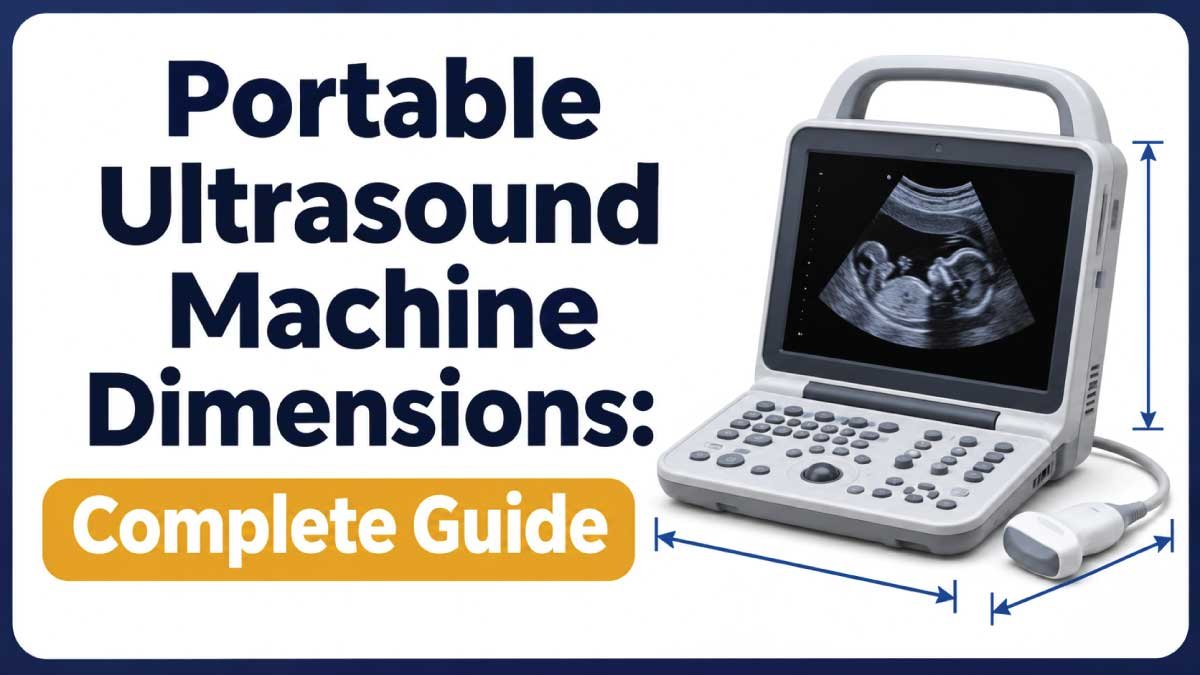
Portable ultrasound machines are designed to provide diagnostic imaging capabilities in a compact, mobile format. Unlike traditional cart-based ultrasound systems, portable models are easier to transport, require less storage space, and can be used in different clinical environments. Their dimensions vary depending on the equipment design, display size, battery configuration, and imaging capabilities.
Understanding portable ultrasound machine dimensions is important when selecting equipment for hospitals, clinics, emergency departments, mobile healthcare services, and bedside examinations. The physical size affects transportation, storage, workspace requirements, and overall usability.
This guide explains portable ultrasound machine dimensions, including typical height, width, depth, screen sizes, different equipment types, and practical measurement considerations. It also covers how to choose the right portable ultrasound system based on available space and clinical requirements.
What Are Portable Ultrasound Machine Dimensions?
Portable ultrasound machine dimensions refer to the physical measurements of an ultrasound imaging system designed for convenient transportation and flexible clinical use.
These measurements generally include:
- Height: The vertical measurement from the bottom to the highest point of the equipment.
- Width: The horizontal measurement across the widest part of the machine.
- Depth: The distance from the front to the rear of the equipment.
- Footprint: The amount of floor or surface area occupied by the equipment.
- Display size: The diagonal measurement of the integrated monitor or touchscreen.
Portable ultrasound machines are available in several configurations. Some resemble laptops, others use compact console designs, and smaller handheld systems connect to smartphones or tablets.
Consequently, there is no single standard dimension that applies to every portable ultrasound machine.
When comparing models, it is important to distinguish between the dimensions of the main equipment and the total dimensions of the complete operating setup.
Portable Ultrasound Machine Dimensions Chart
Portable ultrasound machines are manufactured in different sizes to accommodate various medical applications and transportation requirements.
The following chart provides approximate planning ranges for common portable ultrasound configurations. These measurements are illustrative estimates, not universal manufacturer specifications.
| Portable Ultrasound Type | Height (inches) | Width (inches) | Depth (inches) |
|---|---|---|---|
| Handheld Ultrasound | 5–10 | 2–5 | 1–3 |
| Compact Portable Ultrasound | 8–16 | 10–16 | 5–12 |
| Laptop-Style Ultrasound | 10–16 | 12–17 | 8–13 |
| Tablet-Based Ultrasound | 7–12 | 10–16 | 1–4 |
| Compact Console Ultrasound | 12–22 | 14–20 | 10–16 |
| Portable Ultrasound with Cart | 40–60 | 18–25 | 20–30 |
Actual dimensions depend on the manufacturer, model, monitor configuration, and included accessories.
The handheld and tablet-based measurements describe the imaging device itself, not necessarily the complete setup with its connected display.
For purchasing decisions, always consult the official technical specifications for the exact equipment model.
Portable Ultrasound Machine Dimensions by Type
Different portable ultrasound systems have different physical characteristics. Understanding these categories makes it easier to compare equipment and identify the most appropriate design.
1. Handheld Portable Ultrasound Machine Dimensions
Handheld ultrasound machines are among the smallest imaging devices available. They are designed for healthcare professionals who need immediate access to ultrasound imaging without transporting a larger console.
Many handheld systems connect wirelessly or through a cable to a smartphone or tablet.
Their compact design makes them particularly useful for bedside examinations and point-of-care ultrasound.
Typical approximate dimensions include:
| Measurement | Approximate Range |
|---|---|
| Length | 5–10 inches |
| Width | 2–5 inches |
| Thickness | 1–3 inches |
| Weight | Model-dependent |
These measurements describe the handheld scanner rather than the connected mobile device.
Common applications include:
- Emergency medical examinations.
- Bedside patient assessments.
- Vascular access guidance.
- Point-of-care cardiac imaging.
- Abdominal examinations.
- Mobile medical services.
The main advantage of handheld ultrasound equipment is its small physical size. However, imaging capabilities, display options, and available examination modes vary between models.
2. Laptop-Style Portable Ultrasound Machine Dimensions
Laptop-style ultrasound systems combine a dedicated display and control interface in a compact, foldable design.
They resemble conventional laptops but contain specialized ultrasound processing hardware and transducer connections.
Typical planning dimensions are:
| Measurement | Approximate Range |
|---|---|
| Height | 10–16 inches |
| Width | 12–17 inches |
| Depth | 8–13 inches |
| Display Size | 12–17 inches |
The screen is generally mounted to a foldable housing that protects the display during transportation.
Laptop-style systems are suitable for medical professionals who need more functionality than a handheld device while maintaining portability.
Common applications include:
- General diagnostic examinations.
- Emergency departments.
- Small medical clinics.
- Obstetric examinations.
- Musculoskeletal imaging.
- Mobile healthcare services.
3. Tablet-Based Portable Ultrasound Machine Dimensions
Tablet-based ultrasound systems use a tablet-style display with an integrated or connected ultrasound imaging interface.
Some models use dedicated imaging tablets, while others connect an external ultrasound probe to a compatible mobile device.
Their compact structure reduces storage requirements and makes them convenient for mobile examinations.
Approximate planning dimensions include:
| Measurement | Approximate Range |
|---|---|
| Height | 7–12 inches |
| Width | 10–16 inches |
| Depth | 1–4 inches |
| Display Size | 10–16 inches |
These dimensions depend on the tablet, protective housing, and integrated hardware configuration.
Tablet-based systems are particularly useful when a lightweight and compact imaging solution is required.
4. Compact Console Portable Ultrasound Machine Dimensions
Compact console systems offer more substantial imaging hardware while maintaining a smaller form factor than traditional cart-based machines.
They generally include a dedicated monitor, control panel, transducer ports, internal electronics, and sometimes an integrated battery.
Approximate planning dimensions may include:
- Height: 12–22 inches.
- Width: 14–20 inches.
- Depth: 10–16 inches.
Some compact consoles are designed for placement on medical carts or examination tables.
These systems provide a practical balance between portability and operational functionality.
5. Portable Ultrasound Machine with Cart Dimensions
Some portable ultrasound machines are supplied with dedicated mobile carts.
These systems provide convenient transportation while offering additional storage and adjustable equipment positioning.
A typical compact portable ultrasound cart may have approximate dimensions of:
| Measurement | Approximate Range |
|---|---|
| Height | 40–60 inches |
| Width | 18–25 inches |
| Depth | 20–30 inches |
| Display Size | 15–21 inches |
The actual dimensions depend on the cart structure, monitor mounting system, and equipment configuration.
Cart-mounted portable systems are useful when an ultrasound machine needs to move between examination rooms but requires more functionality than a handheld or laptop-style device.
Portable Ultrasound Machine Height, Width, and Depth Explained
Understanding individual measurements helps when comparing portable ultrasound equipment, planning storage, or preparing a medical workspace.
Portable Ultrasound Machine Height
Height measures the vertical distance between the lowest and highest points of the equipment.
For handheld and laptop-style systems, the height or thickness may refer to the main body when placed on a flat surface.
For cart-mounted portable systems, the measurement generally includes the base and monitor in the specified configuration.
Height is important when:
- Storing equipment inside cabinets.
- Transporting machines in medical vehicles.
- Positioning equipment on shelves.
- Checking clearance beneath work surfaces.
- Adjusting display positions.
If the monitor is adjustable or foldable, record the dimensions in both transportation and operating configurations.
Portable Ultrasound Machine Width
Width measures the horizontal distance across the equipment.
This measurement is especially important when carrying a portable ultrasound system in a medical bag or placing it on a small examination table.
Consider additional components such as:
- Side handles.
- Probe connectors.
- Protective housings.
- Monitor attachments.
- Cable connections.
Always measure the widest part of the complete equipment configuration.
Portable Ultrasound Machine Depth
Depth refers to the distance from the front of the equipment to its rear.
For laptop-style ultrasound systems, this measurement may change depending on the screen position.
For handheld devices, thickness is often more relevant than traditional equipment depth.
Depth matters when selecting storage compartments, transport cases, and work surfaces.
Portable Ultrasound Machine Footprint
The footprint represents the surface area occupied by the equipment.
For a rectangular portable system, it can be calculated using:
Footprint = Width × Depth
For example, consider a compact ultrasound machine measuring 14 inches wide and 10 inches deep.
14 × 10 = 140 square inches.
To convert the result into square feet:
140 ÷ 144 = 0.97 square feet.
Therefore, its approximate footprint is 0.97 square feet.
This calculation describes the equipment’s static footprint and does not include additional space needed for cables, probes, or medical staff.
Portable Ultrasound Monitor Dimensions and Screen Sizes
The display is an important part of a portable ultrasound machine because it allows healthcare professionals to view ultrasound images, adjust imaging settings, and review examination information.
Portable ultrasound systems use different display sizes depending on their design.
| Portable Ultrasound Type | Typical Display Size |
|---|---|
| Handheld Ultrasound | Smartphone-dependent |
| Compact Portable System | 10–15 inches |
| Laptop-Style System | 12–17 inches |
| Tablet-Based System | 10–16 inches |
| Compact Console System | 12–21 inches |
| Portable Cart System | 15–21 inches |
Screen sizes are measured diagonally from one corner to the opposite corner.
A larger display can improve image visibility and make it easier to review measurements. However, it may increase the equipment’s overall dimensions and transportation requirements.
When evaluating a portable ultrasound monitor, consider:
- Screen resolution.
- Display brightness.
- Touchscreen functionality.
- Viewing angle.
- Image visibility in different lighting conditions.
- Monitor protection during transportation.
The display size should match the clinical application without compromising portability.
Related Guide:
Space Requirements for Portable Ultrasound Machines
Portable ultrasound equipment generally requires less space than full-size diagnostic systems. However, proper workspace planning remains important.
The required space depends on the equipment configuration and the examination being performed.
Examination Table Space
Compact ultrasound machines are frequently placed on medical work surfaces or equipment carts.
Ensure that the available surface can safely support the machine’s weight and accommodate its accessories.
The equipment should be positioned so that the operator can access the controls and view the display comfortably.
Storage Space
Portable systems may be stored in medical cabinets, equipment cases, or dedicated storage areas.
Before selecting a storage location, check:
- Overall height.
- Maximum width.
- Total depth.
- Charging requirements.
- Accessory storage requirements.
- Manufacturer-recommended environmental conditions.
Protective cases should provide sufficient clearance without putting pressure on the display or transducer.
Transportation Clearance
Portable ultrasound machines are often moved between departments, clinics, and medical facilities.
Check the dimensions of transport cases, medical bags, vehicle storage compartments, and access routes.
For cart-mounted systems, measure doorways, elevators, and corridors before moving the equipment.
Related Guide:
How to Measure a Portable Ultrasound Machine
Accurate measurements help determine whether a portable ultrasound machine will fit into a storage compartment, carrying case, examination room, or medical vehicle.
Follow these steps:
Step 1: Identify the equipment configuration
Determine whether you are measuring a handheld scanner, laptop-style system, tablet-based device, or compact console.
Include the connected display when measuring the complete system.
Step 2: Measure the height
Place the equipment on a flat surface and measure vertically from the bottom to the highest point.
For foldable systems, record the closed and open configurations if both are relevant.
Step 3: Measure the width
Measure across the widest point of the equipment.
Include permanent handles, protective housings, and other attachments.
Step 4: Measure the depth
Measure from the frontmost point to the rearmost point.
For laptop-style equipment, record the depth with the display closed and open when necessary.
Step 5: Calculate the footprint
Multiply the width by the depth to determine the approximate surface area.
Step 6: Check the accessories
Measure additional components such as probes, power adapters, cables, and protective cases separately.
Step 7: Verify the manufacturer’s documentation
Compare your measurements with the official product specifications to confirm the exact equipment dimensions.
Related Guide:
Factors That Affect Portable Ultrasound Machine Dimensions
Several design features influence the overall size of portable ultrasound equipment.
Display Configuration
A built-in monitor generally increases the overall size compared with a handheld scanner that connects to an external display.
Foldable screens can help reduce transportation dimensions.
Battery Capacity
Some portable ultrasound systems include rechargeable batteries that allow operation without a continuous external power connection.
Battery design and placement can influence the internal equipment layout.
Imaging Hardware
The processing components, transducer connections, and imaging technologies affect the size of the equipment housing.
More advanced systems may require a larger console than basic portable devices.
Number of Transducer Connections
Systems supporting multiple probes may require additional connector space and cable-management features.
Protective Housing
Rugged housings and protective cases can increase the overall external dimensions.
This is particularly important when selecting a carrying case for transportation.
How to Choose the Right Portable Ultrasound Machine Size
Selecting the right portable ultrasound machine requires balancing physical dimensions with medical requirements and available workspace.
Consider these factors before purchasing.
1. Identify Your Clinical Requirements
Determine the examinations the equipment will perform. A handheld system may be sufficient for certain point-of-care applications, while more complex examinations may require a dedicated portable console.
2. Evaluate Portability
If the equipment must be carried frequently, prioritize compact dimensions, manageable weight, and a suitable protective case.
3. Consider Display Size
Choose a display that allows comfortable image viewing without making the system unnecessarily difficult to transport.
4. Check Available Storage
Measure the available cabinet, shelf, medical bag, or equipment compartment before purchasing.
5. Review Battery and Charging Requirements
Consider how the machine will be powered and whether charging equipment requires additional storage space.
6. Compare Complete Equipment Dimensions
Do not evaluate the main console alone. Include the monitor, handles, protective housing, and other permanent attachments.
7. Verify Manufacturer Specifications
Review the official product documentation for assembled dimensions, operating weight, battery information, and transportation requirements.
Common Mistakes When Comparing Portable Ultrasound Machine Dimensions
Several measurement mistakes can create problems during equipment selection and storage.
- Ignoring connected displays: A handheld scanner may be small, but its complete operating setup includes a smartphone or tablet.
- Measuring only the closed configuration: Laptop-style systems may occupy more space when opened.
- Confusing screen size with machine width: Display measurements are diagonal, while equipment width is measured horizontally.
- Ignoring protective cases: Carrying cases can increase transportation dimensions.
- Overlooking accessories: Probes, adapters, and cables require separate storage space.
- Assuming all portable systems are identical: Different models can have significantly different physical measurements.
- Ignoring operating clearance: Equipment needs enough surrounding space for comfortable operation.
Avoiding these mistakes helps ensure that the selected system meets both transportation and clinical requirements.
Frequently Asked Questions About Portable Ultrasound Machine Dimensions
1. What are the standard dimensions of a portable ultrasound machine?
Portable ultrasound machines do not have universal standard dimensions. Laptop-style systems may measure approximately 10–16 inches high, 12–17 inches wide, and 8–13 inches deep. Handheld and tablet-based systems are generally smaller.
2. How big is a portable ultrasound machine?
Its size depends on the design. Handheld systems are compact enough to carry in one hand, while laptop-style and compact console systems require more storage space. Cart-mounted portable systems are considerably larger.
3. How much does a portable ultrasound machine weigh?
Weight varies according to the equipment category, battery, display, and imaging hardware. Handheld devices are generally lighter than dedicated laptop-style and console systems. Check the manufacturer’s specifications for the exact operating weight.
4. What is the typical screen size of a portable ultrasound machine?
Portable ultrasound systems commonly feature displays ranging from approximately 10–17 inches, although some compact console and cart-mounted models have larger monitors. Handheld systems may use smartphone or tablet displays.
5. Are portable ultrasound machines smaller than traditional ultrasound machines?
Yes. Most handheld, tablet-based, and laptop-style portable systems are substantially smaller than traditional cart-based ultrasound machines. However, portable systems supplied with dedicated carts may have larger overall dimensions.
6. Can a portable ultrasound machine fit in a carrying case?
Many handheld and laptop-style systems can be transported in dedicated carrying cases. The case should accommodate the machine, probes, cables, and power accessories without applying pressure to sensitive components.
7. What is the footprint of a portable ultrasound machine?
The footprint depends on the machine’s width and depth. For example, a portable system measuring 14 inches wide and 10 inches deep occupies approximately 140 square inches of surface area.
8. What is the difference between a handheld and laptop-style ultrasound machine?
A handheld ultrasound system is a compact scanner that commonly connects to a smartphone or tablet. A laptop-style system generally includes a dedicated display, integrated controls, and additional imaging hardware.
9. How do I find the exact dimensions of a portable ultrasound machine?
Find the manufacturer’s technical specification sheet or product manual using the exact model number. Check the height, width, depth, display size, operating weight, and transportation dimensions.
Conclusion
Portable ultrasound machine dimensions vary according to equipment design, display configuration, imaging capabilities, and intended clinical use. Handheld systems offer the smallest form factor, while laptop-style and compact console systems provide additional imaging functionality in a transportable design.
When comparing portable ultrasound machine dimensions, consider height, width, depth, footprint, monitor size, and accessory requirements. Accurate measurements help ensure that the equipment fits available storage areas, examination spaces, and transportation cases.
Always verify the exact specifications provided by the manufacturer before purchasing or installing a portable ultrasound system. This helps you select equipment that meets your clinical needs while providing convenient transportation and practical workspace requirements.

Zak is a dedicated medical and career writer specializing in sonography, healthcare education, and professional development. Through SonographerSalary.com, he shares in-depth insights on sonographer salaries, education pathways, and career tips to help readers build successful futures in medical imaging. His content combines accuracy with practical, easy-to-understand guidance, empowering students and professionals to make confident, informed career decisions.