
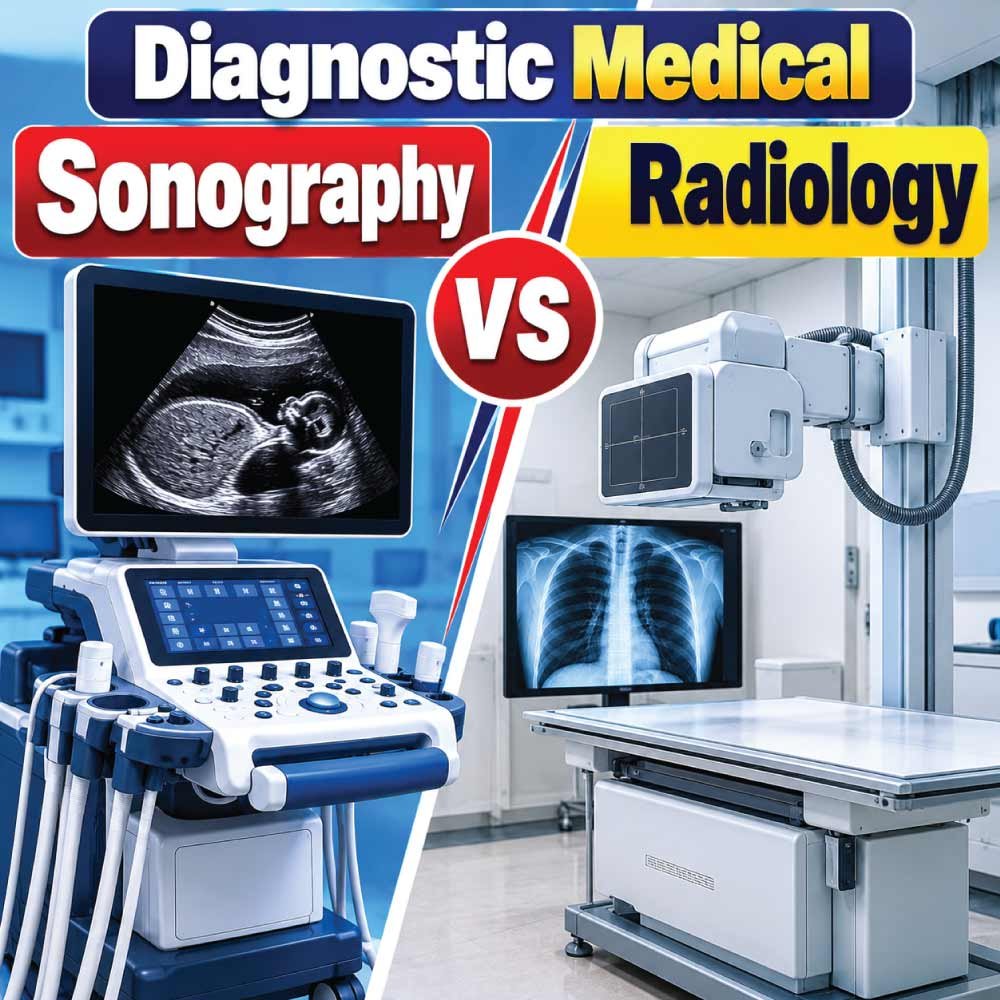
Diagnostic medical sonography and radiology are both important parts of modern medical imaging, but they are not the same career path. Sonographers use ultrasound equipment to create real-time images with sound waves, while radiologic technologists commonly perform X-rays and may work in other imaging areas after additional training.
For students comparing these fields, the difference goes beyond the equipment. Education, daily responsibilities, patient interaction, work settings, physical demands, specialization options, certification, salary, and long-term career development can all vary.
This guide explains diagnostic medical sonography vs radiology in practical terms so you can understand how the two professions overlap, where they differ, and what training may look like.
What Is Diagnostic Medical Sonography?
Diagnostic medical sonography is a medical imaging profession focused on ultrasound. A diagnostic medical sonographer operates specialized equipment that uses high-frequency sound waves to produce images of structures inside the body.
Unlike an X-ray image, ultrasound imaging can display structures in real time. Depending on the specialty, sonographers may examine organs, blood vessels, developing fetuses, muscles, tendons, or other soft tissues.
Sonographers are not simply equipment operators. Their work involves preparing patients, selecting appropriate imaging techniques, obtaining diagnostic-quality images, documenting findings, and working with physicians and other healthcare professionals.
Common sonography specialties include:
- Abdominal sonography
- Obstetric and gynecologic sonography
- Vascular sonography
- Breast sonography
- Cardiac sonography
- Musculoskeletal ultrasound
- Pediatric sonography
The exact scope of practice depends on the employer, specialty, credentials, and local regulations.
The U.S. Bureau of Labor Statistics reports that diagnostic medical sonographers typically enter the occupation with an associate degree or postsecondary certificate.
What Is Radiology?
Radiology is a broader medical specialty involving the use of imaging technology to diagnose and sometimes guide treatment of medical conditions.
When people compare a sonographer with a radiology professional, they are often referring to a radiologic technologist, particularly someone working in radiography.
Radiologic technologists operate imaging equipment to produce diagnostic images, most commonly using X-rays. Depending on their education and credentials, imaging professionals can also work in areas such as computed tomography (CT), mammography, or other specialized modalities.
Radiologists are different from radiologic technologists. A radiologist is a physician who has completed medical school and specialized training in diagnostic imaging. A radiologic technologist performs imaging procedures, while the radiologist generally interprets medical images and provides a physician-level diagnosis.
That distinction is important when researching careers because “radiology” can refer to a medical specialty rather than one specific technologist job.
Diagnostic Medical Sonography vs Radiology at a Glance
The two careers share a common purpose: producing useful medical images that help healthcare professionals evaluate patients. However, the technologies and daily responsibilities differ.
| Feature | Diagnostic Medical Sonography | Radiologic Technology |
|---|---|---|
| Primary technology | Ultrasound | X-ray and related imaging equipment |
| Main energy source | Sound waves | Ionizing radiation for X-ray-based imaging |
| Typical images | Real-time ultrasound images | Radiographic images |
| Common training | Associate degree or certificate | Typically associate degree |
| Patient interaction | Often substantial | Often substantial |
| Common workplaces | Hospitals, clinics, physician offices | Hospitals, imaging centers, clinics |
| Specialization | Abdomen, OB/GYN, vascular, cardiac, breast, etc. | Radiography, CT, mammography and other areas |
| Certification | May involve ARDMS or other credentials | ARRT is widely used in the U.S. |
| Physical demands | Patient positioning and scanning | Patient positioning and equipment operation |
| Radiation exposure | Ultrasound does not use ionizing radiation | X-ray-based imaging uses ionizing radiation |
The table describes broad occupational differences rather than every possible role. Individual jobs can vary significantly by employer and specialty.
How the Imaging Technology Differs
Ultrasound Uses Sound Waves
Sonography creates images using high-frequency sound waves. The transducer sends sound into the body and receives returning echoes. The ultrasound system processes those signals into an image.
One practical advantage is that ultrasound does not use ionizing radiation.
Sonography can also provide dynamic information. For example, an examination can show movement in real time, which is useful in several specialties.
The technology is particularly useful for many soft-tissue examinations, vascular studies, obstetric imaging, and cardiac applications.
Radiography Uses X-Rays
Radiography uses X-rays to produce images. Different tissues absorb X-rays differently, allowing structures to appear with varying levels of contrast.
X-ray imaging is widely used for examinations such as:
- Chest imaging
- Bone and joint studies
- Certain abdominal examinations
- Trauma imaging
- Portable bedside radiography
Because X-rays use ionizing radiation, radiologic technologists follow radiation-safety procedures designed to minimize unnecessary exposure to patients and staff.
Daily Work: Sonographer vs Radiologic Technologist
The daily routine can be quite different even though both professionals work directly with patients.
A sonographer may spend a significant portion of an examination physically scanning the patient with a transducer. The sonographer must adjust the probe, angle, pressure, depth, and imaging settings to obtain appropriate views.
A radiologic technologist may position patients relative to an X-ray system, select technical factors, operate the equipment, and ensure that the resulting images meet the examination requirements.
Typical Sonographer Responsibilities
A diagnostic medical sonographer may:
- Review the examination request
- Explain the procedure to the patient
- Position the patient
- Operate ultrasound equipment
- Obtain and document diagnostic images
- Make technical adjustments during the examination
- Recognize relevant anatomy and image characteristics
- Communicate important observations according to workplace procedures
- Maintain equipment and follow infection-control practices
Typical Radiologic Technologist Responsibilities
A radiologic technologist may:
- Verify the examination order
- Prepare and position the patient
- Operate radiographic equipment
- Select appropriate technical settings
- Produce diagnostic images
- Follow radiation-safety procedures
- Evaluate image quality
- Document the examination
- Maintain patient safety and infection-control standards
The exact duties depend on the imaging modality and workplace.
Education and Training Requirements
Education is one of the most important considerations when comparing these careers.
In the United States, the BLS states that diagnostic medical sonographers typically need at least an associate degree or postsecondary certificate.
Radiologic technologists also typically need an associate degree. The BLS notes that most states require radiologic technologists to be licensed or certified, while employers commonly require or prefer certification.
Sonography Education
A sonography program generally combines classroom instruction with hands-on clinical education.
Students may study subjects such as:
- Anatomy and physiology
- Medical terminology
- Patient care
- Physics
- Ultrasound physics
- Scanning techniques
- Pathology
- Professional ethics
- Clinical procedures
Clinical training is particularly important because students need experience operating ultrasound equipment and interacting with patients.
Radiography Education
Radiography programs also combine academic study with clinical training.
Coursework may include:
- Anatomy and physiology
- Radiographic positioning
- Radiation protection
- Patient care
- Image production
- Radiographic procedures
- Radiation physics
- Medical terminology
- Pathology
ARRT’s primary pathway requires an associate degree or higher and completion of an ARRT-approved educational program for eligible credentials.
Also Read:
Certification and Professional Credentials
Certification requirements vary according to location, employer, specialty, and profession.
For sonography, the American Registry for Diagnostic Medical Sonography (ARDMS) is a major credentialing organization. Other credentialing pathways also exist.
The American Registry of Radiologic Technologists (ARRT) offers credentials in radiography and sonography, among other disciplines. Its primary pathway includes education, ethics, and examination requirements.
ARRT also recognizes sonography as a primary credentialing discipline, which demonstrates that sonography and radiography can exist within related but distinct credentialing pathways.
Certification should therefore be researched as part of the specific job and state where you plan to work rather than treated as identical across the two careers.
Work Environment and Patient Interaction
Both professions can involve frequent patient contact.
Sonographers may spend a considerable amount of time directly interacting with patients because the examination requires positioning the body and manipulating a transducer over the area being examined.
Radiologic technologists also interact closely with patients. They may work with people who are experiencing pain, recovering from injuries, or unable to move easily.
Hospitals can require shift work, including evenings, weekends, or overnight hours. The BLS notes that both diagnostic medical sonographers and radiologic and MRI technologists commonly work full time, although schedules depend on the workplace.
Also Read:
Physical Demands of Each Career
The physical side of medical imaging is easy to overlook when comparing programs.
Sonographers can experience repetitive physical demands because scanning may require maintaining awkward postures while applying pressure with the transducer. Patient positioning and moving equipment can also require physical effort.
Radiologic technologists may regularly move or reposition patients, particularly in hospitals and emergency settings. Portable imaging can add another physical component because equipment may need to be transported to different areas.
Important physical considerations include:
- Standing for extended periods
- Moving or positioning patients
- Reaching and bending
- Repetitive hand and arm movements
- Maintaining proper body mechanics
- Working around medical equipment
The actual demands vary substantially by specialty and workplace.
Salary Comparison: Sonography vs Radiologic Technology
Salary is another major search intent behind the comparison, but national figures should be interpreted carefully.
According to the U.S. Bureau of Labor Statistics, the median annual wage for diagnostic medical sonographers was $96,590 in May 2025. The lowest 10 percent earned less than $67,820, while the highest 10 percent earned more than $129,370.
For radiologic technologists and technicians, the BLS reported a $80,110 median annual wage in May 2025. The lowest 10 percent earned less than $55,980, while the highest 10 percent earned more than $118,660.
| Occupation | Median annual wage, May 2025 | Lowest 10% | Highest 10% |
|---|---|---|---|
| Diagnostic medical sonographers | $96,590 | < $67,820 | > $129,370 |
| Radiologic technologists and technicians | $80,110 | < $55,980 | > $118,660 |
These are U.S. national occupational statistics, not guaranteed salaries for an individual. Pay can change according to location, experience, employer, specialty, shift, credentials, and other factors.
MRI technologists, for example, are reported separately by the BLS and had a May 2025 median wage of $95,480.
Also Read:
Job Outlook and Employment Opportunities
Employment projections provide another useful point of comparison.
The BLS projects employment of diagnostic medical sonographers to grow 14% from 2025 to 2035, with about 6,000 openings projected per year on average.
For radiologic and MRI technologists combined, employment is projected to grow 5% from 2025 to 2035, with about 15,300 openings per year on average.
These figures should not be interpreted as a guarantee of employment. They describe national occupational projections and include openings created by both employment growth and replacement needs.
The difference in occupational growth rates also should not be confused with the total number of available jobs. Radiologic technology represents a much larger occupational group, so its projected number of annual openings is higher even though its percentage growth is lower.
Specialization Options in Sonography
One of the most distinctive features of sonography is the range of specialties available.
Obstetric and Gynecologic Sonography
These examinations focus on reproductive and pelvic anatomy and may include pregnancy-related imaging.
Vascular Sonography
Vascular sonographers examine blood vessels and blood flow using ultrasound techniques such as Doppler imaging.
Cardiac Sonography
Cardiac sonographers perform specialized ultrasound examinations of the heart and related structures.
Abdominal Sonography
Abdominal examinations can evaluate organs and structures such as the liver, gallbladder, kidneys, pancreas, and spleen.
Specialization can affect the type of patients you see, the procedures you perform, the credentials you pursue, and the environment in which you work.
Specialization Options in Radiologic Technology
Radiologic technology can also provide opportunities to move into specialized imaging areas.
A technologist may begin in general radiography and later pursue additional training or credentials in areas such as:
- Computed tomography
- Mammography
- Magnetic resonance imaging
- Interventional imaging
- Other advanced imaging specialties
ARRT provides primary and postprimary credentialing pathways for multiple imaging disciplines. Its postprimary pathway includes options such as CT, MRI, mammography, vascular sonography, and other specialties, subject to the applicable eligibility requirements.
This means that radiologic technology can serve as a foundation for a broader imaging career rather than limiting a professional to conventional X-ray examinations.
Which Career Involves More Direct Scanning?
The answer depends on what you mean by “scanning.”
Sonographers directly manipulate the ultrasound transducer and continuously adjust the examination while observing the images. Their hands-on role in image acquisition is central to the procedure.
Radiologic technologists also operate imaging equipment and are responsible for producing appropriate images, but conventional radiography generally involves positioning the patient and equipment before making an exposure.
The distinction becomes less straightforward when radiologic technologists specialize in advanced modalities such as CT or MRI, where equipment operation and image acquisition can become considerably more involved.
Diagnostic Medical Sonography vs Radiology: Key Similarities
Despite their differences, the professions have several important similarities.
Both careers require technical knowledge and attention to detail. Both involve patient care, anatomy, medical terminology, image quality, safety procedures, and communication with healthcare teams.
Professionals in both fields also need to understand that producing an image is not merely a mechanical task. Patient positioning, technical settings, anatomy, and image quality can all affect the usefulness of an examination.
| Similarity | Sonography | Radiologic Technology |
|---|---|---|
| Patient interaction | ✓ | ✓ |
| Medical imaging | ✓ | ✓ |
| Anatomy knowledge | ✓ | ✓ |
| Clinical training | ✓ | ✓ |
| Equipment operation | ✓ | ✓ |
| Image-quality assessment | ✓ | ✓ |
| Hospital employment opportunities | ✓ | ✓ |
| Specialty pathways | ✓ | ✓ |
How to Choose Between Sonography and Radiology
Rather than focusing on a single factor such as salary, prospective students can compare the actual nature of the work.
Consider the following questions:
- Do you prefer ultrasound technology and real-time imaging?
- Are you interested in X-ray-based imaging and potentially advancing into CT or other modalities?
- How much direct patient interaction do you want?
- Are you comfortable with frequent patient positioning?
- Which specialties interest you most?
- What educational programs are available in your area?
- What certification or licensing rules apply where you plan to work?
- Which work environments appeal to you?
- Do you prefer a career centered heavily on ultrasound scanning or a broader radiologic technology pathway?
Job-shadowing opportunities, conversations with working professionals, and reviewing accredited programs can provide useful information that salary tables alone cannot show.
Can a Radiologic Technologist Become a Sonographer?
In some circumstances, professionals can transition between imaging disciplines, but the process is not automatically transferable.
ARRT recognizes sonography as a credentialing discipline and has pathways for individuals who meet the applicable education, clinical, ethics, and examination requirements.
Additional credentials can also create opportunities to work across related imaging areas. However, the exact requirements depend on the credential and pathway.
Someone considering a transition should check the current requirements of the relevant credentialing organization and the licensing authority in the state where they intend to work.
The Bottom Line on Diagnostic Medical Sonography vs Radiology
Diagnostic medical sonography and radiologic technology are closely related healthcare careers, but they involve different imaging technologies and day-to-day responsibilities.
Sonography centers on ultrasound and real-time image acquisition, while radiologic technology traditionally centers on radiography and can provide pathways into additional imaging specialties.
The U.S. BLS currently reports different median wages and employment projections for the two occupations, while professional organizations such as ARRT provide specific education and credentialing pathways for imaging professionals.
For someone planning an imaging career, the most useful comparison is not simply which occupation has a higher salary. It is understanding the equipment, patients, education, physical demands, specialties, certification requirements, and workplace environment associated with each path.
That information can help you identify which type of medical imaging work fits your interests, skills, and long-term professional goals.

Zak is a dedicated medical and career writer specializing in sonography, healthcare education, and professional development. Through SonographerSalary.com, he shares in-depth insights on sonographer salaries, education pathways, and career tips to help readers build successful futures in medical imaging. His content combines accuracy with practical, easy-to-understand guidance, empowering students and professionals to make confident, informed career decisions.