
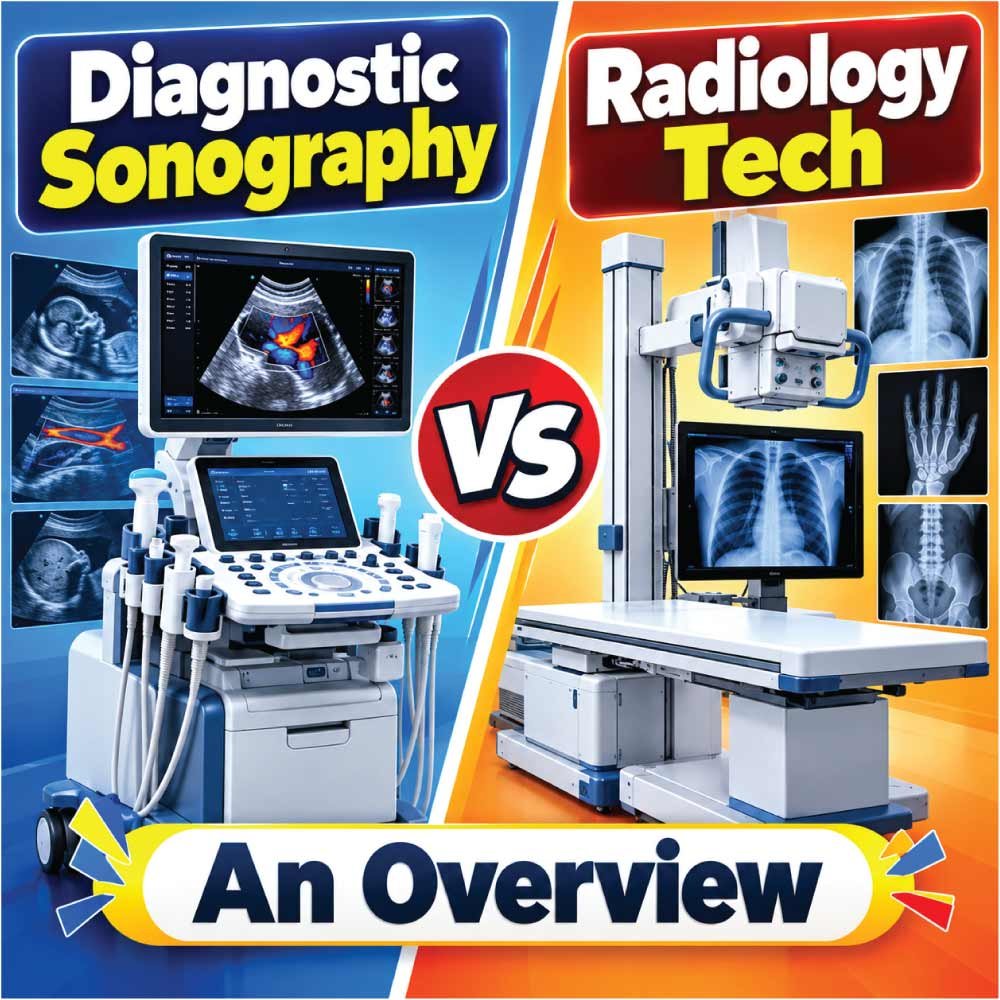
Choosing between diagnostic sonography and radiologic technology can be difficult because both careers belong to the medical imaging field. Both professionals work directly with patients, operate specialized equipment, produce diagnostic images, and support physicians in identifying injuries and medical conditions.
The biggest difference is the type of imaging each professional performs. A diagnostic medical sonographer uses ultrasound technology and sound waves to create real-time images of structures inside the body. A radiologic technologist, often called a radiology tech or radiographer, primarily uses X-rays to produce images of bones, organs, and other internal structures. Radiologic technologists may also work in areas such as fluoroscopy and, with additional training and credentials, other imaging modalities.
The two careers also differ in daily physical demands, patient interaction, educational pathways, certification options, and areas of specialization.
| Feature | Diagnostic Sonographer | Radiologic Technologist |
|---|---|---|
| Primary technology | Ultrasound | X-ray and related imaging equipment |
| Main role | Creates ultrasound images for diagnosis | Produces radiographic images for diagnosis |
| Common specialties | Abdomen, obstetrics, vascular, cardiac | General radiography, CT, mammography, MRI pathways |
| Patient interaction | High | High |
| Typical education | Associate degree or postsecondary certificate | Associate degree is common |
| Common credentialing organizations | ARDMS and other recognized pathways | ARRT and state regulators |
| Radiation exposure | Uses non-ionizing sound waves | Uses ionizing radiation |
| Work environments | Hospitals, physician offices, imaging centers | Hospitals, clinics, imaging centers and other healthcare facilities |
Neither profession is simply a more advanced version of the other. They are distinct healthcare careers with overlapping goals but different technical responsibilities.
What Does a Diagnostic Medical Sonographer Do?
A diagnostic medical sonographer operates an ultrasound system to create images of structures inside the body. Instead of using ionizing radiation, ultrasound equipment sends high-frequency sound waves into the body and processes returning echoes into images.
During an examination, the sonographer generally prepares the patient, selects the appropriate equipment and settings, positions the patient, applies ultrasound gel, and moves a transducer across the examination area.
The work requires more than simply taking pictures. Sonographers must recognize relevant anatomy, obtain technically adequate images, document measurements, and capture views that help physicians interpret the examination.
Common areas of sonography include:
- Abdominal ultrasound
- Obstetric and gynecologic imaging
- Vascular ultrasound
- Cardiac sonography
- Breast ultrasound
- Musculoskeletal ultrasound
- Pediatric sonography
The exact scope of practice depends on the employer, specialty, credentials, and applicable regulations.
The U.S. Bureau of Labor Statistics describes diagnostic medical sonographers as professionals who operate ultrasound equipment to create images of the inside of the body. Most work in hospitals or physicians’ offices, although medical and diagnostic laboratories and outpatient care centers are also important employment settings.
What Does a Radiologic Technologist Do?
A radiologic technologist performs diagnostic imaging procedures using X-ray equipment. The role is broader than simply operating an X-ray machine.
Radiologic technologists position patients, select appropriate technical factors, operate imaging equipment, protect patients and staff from unnecessary radiation exposure, and ensure that images meet the required quality standards.
Radiographers commonly produce images of:
- Bones and joints
- The chest and lungs
- Abdomen
- Spine
- Extremities
- Other anatomical regions requested by a physician
Some radiologic technologists also participate in procedures involving fluoroscopy or contrast media. Additional education and credentialing can provide pathways into specialized imaging fields such as computed tomography, mammography, magnetic resonance imaging, or interventional radiography. ARRT identifies radiography as a primary credentialing discipline and describes radiographers as professionals who capture images of internal organs, soft tissues, and bones using X-ray equipment.
This means the phrase “radiology tech” can sometimes describe a broader career pathway rather than one single type of imaging job.
Diagnostic Sonography vs Radiology Tech: Technology Differences
The technology used is one of the clearest distinctions between the careers.
Ultrasound Technology
Sonography uses high-frequency sound waves. A transducer sends sound waves into the body, and the system converts returning echoes into images.
Because diagnostic ultrasound does not rely on ionizing radiation, it can be particularly useful for applications where real-time imaging is important.
For example, ultrasound can display movement and blood flow and is widely used in obstetric, vascular, abdominal, cardiac, and other examinations.
The sonographer therefore needs strong knowledge of anatomy and imaging technique. Small changes in transducer position, pressure, angle, or machine settings can affect the resulting image.
X-Ray Technology
Radiography uses X-rays, a form of ionizing radiation, to create images. Different tissues absorb X-rays differently, allowing the system to produce a representation of internal structures.
Radiologic technologists must understand positioning, exposure factors, image quality, and radiation protection.
The equipment and workflow can also differ significantly between a portable bedside X-ray examination and a routine examination performed in an imaging department.
| Technology | Sonographer | Radiologic Technologist |
|---|---|---|
| Ultrasound | ✓ | — |
| General X-ray | — | ✓ |
| Radiation protection | Limited relevance to ultrasound | Essential |
| Real-time ultrasound imaging | ✓ | — |
| Fluoroscopy assistance | — | Can be part of radiography practice |
| Advanced modalities | Specialty-dependent | Possible with additional credentials/training |
Education Requirements for Each Career
Education is another important factor when comparing diagnostic sonography vs radiology tech.
Sonography Education
Diagnostic medical sonographers typically enter the field through an associate degree program or a postsecondary certificate, depending on their previous education and the program they choose. The BLS lists an associate degree as the typical entry-level education for diagnostic medical sonographers.
Sonography programs commonly combine classroom instruction with hands-on clinical education. Students learn subjects such as anatomy, physiology, patient care, ultrasound physics, instrumentation, scanning techniques, and specialty-specific procedures.
Clinical training is especially important because image acquisition is a practical skill. Knowing the theory behind ultrasound does not automatically mean a student can consistently obtain diagnostically useful images.
Radiologic Technology Education
Radiologic technology programs also commonly involve an associate degree along with classroom and clinical education.
ARRT’s primary pathway requires candidates to earn an associate degree or higher and complete an ARRT-approved educational program in the discipline for which they are seeking a credential. Candidates must also meet ethics and examination requirements.
Radiography education generally covers:
- Patient care
- Radiation safety
- Radiographic procedures
- Image production
- Anatomy and physiology
- Radiation physics
- Positioning
- Clinical practice
The clinical component is important because radiologic technologists must be able to translate classroom knowledge into safe patient procedures.
Certification and Licensing Considerations
Certification and licensing requirements vary by location, so students should check the rules in the state or country where they intend to work.
In the United States, ARRT offers certification and registration pathways in radiography and several other imaging disciplines. Its primary pathway includes education, ethics, and examination requirements.
Sonographers may pursue professional credentials through organizations such as the American Registry for Diagnostic Medical Sonography. Eligibility can depend on education, clinical experience, and the specific examination or credential being pursued.
For example, ARDMS documentation describes different prerequisite pathways involving accredited education and clinical ultrasound experience. Requirements can differ substantially according to the applicant’s educational background.
This is why prospective students should not choose a program based only on its title. Before enrolling, verify that the program meets the credentialing requirements relevant to the jobs you want.
How the Daily Work Compares
The daily routine can feel quite different even though both professionals work with patients and diagnostic imaging equipment.
A sonographer may spend a large part of the examination continuously interacting with the patient while manually scanning the body. The professional must adjust the transducer and imaging settings while watching the screen and deciding which images and measurements are needed.
Radiologic technologists often work through a sequence of examinations involving different patients and anatomical regions. Positioning is a major component of the job, and workflow may involve portable imaging, emergency examinations, outpatient procedures, or inpatient studies.
| Daily responsibility | Sonographer | Radiologic Technologist |
|---|---|---|
| Patient preparation | ✓ | ✓ |
| Patient positioning | ✓ | ✓ |
| Equipment operation | ✓ | ✓ |
| Image quality assessment | ✓ | ✓ |
| Manual scanning | ✓ | — |
| Radiation safety | — | ✓ |
| Real-time image acquisition | ✓ | Sometimes, depending on modality |
| Communication with physicians/clinical teams | ✓ | ✓ |
Physical Demands and Patient Interaction
Both careers can be physically demanding.
Sonographers may stand for extended periods, position patients, and repeatedly move a transducer while maintaining awkward arm, shoulder, wrist, or neck positions. The BLS specifically notes that sonographers may need to stand for long periods and lift or turn patients who are ill or disabled.
Radiologic technologists also position patients and may need to assist people who have limited mobility. In hospitals, they can encounter patients in emergency departments, intensive care units, operating rooms, or inpatient rooms.
Both careers therefore benefit from:
- Good communication skills
- Proper body mechanics
- Physical stamina
- Attention to patient comfort
- Ability to work calmly under pressure
- Willingness to assist patients with mobility limitations
The amount of physical strain varies by workplace, specialty, equipment, staffing, and examination volume.
Also Read:
Work Settings and Schedules
Diagnostic sonographers and radiologic technologists can both work in hospitals, outpatient centers, clinics, and other healthcare environments.
According to the BLS, hospitals employed the largest share of diagnostic medical sonographers in 2025, followed by physicians’ offices and medical and diagnostic laboratories. Sonographers may also work evenings, weekends, or overnight shifts because some medical facilities operate continuously.
Radiologic technologists similarly work across hospital and outpatient environments. Hospital-based radiographers may have schedules that include nights, weekends, holidays, or on-call work.
A private outpatient imaging center may provide a more predictable schedule than a large hospital, but this is employer-specific rather than a universal difference between the professions.
Diagnostic Sonography vs Radiology Tech Salary
Salary should be evaluated using current local data because compensation varies by location, specialty, experience, employer, shift, and credentials.
For a U.S. benchmark, the BLS reported a May 2025 median annual wage of $96,590 for diagnostic medical sonographers. The same source reported that the lowest 10 percent earned below $67,820 while the highest 10 percent earned above $129,370.
For comparison, BLS occupational projection data lists a May 2025 median annual wage of $80,110 for radiologic technologists and technicians.
| U.S. BLS measure | Diagnostic Medical Sonographers | Radiologic Technologists & Technicians |
|---|---|---|
| Median annual wage, May 2025 | $96,590 | $80,110 |
| Typical entry education | Associate degree | Associate degree |
| Employment outlook, 2025–2035 | 14% | 5%* |
*The 5% figure is for radiologic and MRI technologists as reported by BLS, while the $80,110 wage figure is for the radiologic technologists and technicians occupation.
These figures are U.S. national occupational statistics rather than guaranteed salaries for an individual worker. They should not be treated as a direct prediction of what a new graduate will earn.
Also Read:
Job Outlook for Sonographers and Radiologic Technologists
Employment projections can help students understand how each occupation is expected to change.
The BLS projects employment of diagnostic medical sonographers to grow 14% from 2025 through 2035, with about 12,900 additional jobs projected over the period. The agency also estimates approximately 6,000 openings per year on average, including openings caused by workers leaving the occupation.
For radiologic and MRI technologists, the BLS projects 5% employment growth from 2025 through 2035, with approximately 15,300 openings per year on average across the combined occupation.
The two statistics measure somewhat different occupational groups, so they should not be interpreted as a simple head-to-head prediction.
Demand for both professions is connected to healthcare needs. An aging population and continued demand for diagnostic procedures contribute to the need for medical imaging professionals.
Career Specialization Opportunities
Specialization can substantially change what a professional does each day.
Sonographers may develop expertise in areas such as:
- Vascular sonography
- Cardiac sonography
- Breast imaging
- Obstetric and gynecologic sonography
- Abdominal imaging
- Pediatric imaging
Radiologic technologists can also pursue additional imaging specialties. Depending on qualifications and local requirements, possible directions include CT, MRI, mammography, interventional radiography, and other advanced imaging areas.
ARRT’s credentialing structure includes radiography as well as several advanced or specialized imaging disciplines, allowing qualified professionals to build on an existing imaging career.
This makes career development an important part of the comparison. Someone interested in one specific imaging specialty may find that the available educational and credentialing pathway influences the decision as much as the starting job itself.
Also Read:
Which Skills Are Important in Sonography?
Successful sonographers need a combination of technical knowledge and interpersonal skills.
Technical skills matter because image acquisition depends heavily on the operator. The sonographer must understand anatomy, ultrasound physics, scanning planes, equipment controls, and appropriate measurements.
Communication is equally important because patients may be anxious, uncomfortable, or unfamiliar with the examination.
Useful qualities include:
- Strong attention to anatomical detail
- Good hand-eye coordination
- Patience
- Communication skills
- Physical stamina
- Comfort working independently
- Ability to recognize technically inadequate images
- Willingness to continually develop technical skills
Which Skills Are Important for Radiologic Technologists?
Radiologic technologists need strong knowledge of anatomy, positioning, radiation safety, imaging equipment, and patient care.
Accuracy is especially important because poor positioning or inappropriate technical factors can reduce image quality and potentially require an examination to be repeated.
Important skills include:
- Precise patient positioning
- Radiation safety awareness
- Technical problem-solving
- Equipment operation
- Patient communication
- Attention to detail
- Ability to work efficiently
- Adaptability in emergency situations
Radiography can also provide exposure to a broad range of clinical environments, particularly in hospitals.
Diagnostic Sonography vs Radiology Tech: Which Career Fits Your Interests?
Rather than viewing the two careers as interchangeable, consider the type of work you actually want to perform.
Sonography may appeal to someone who enjoys:
- Real-time imaging
- Close patient interaction
- Manual scanning
- Anatomy-focused examinations
- Developing highly specialized scanning skills
Radiologic technology may appeal to someone interested in:
- X-ray imaging
- Patient positioning
- Radiographic equipment
- Hospital-based imaging
- Building toward additional imaging modalities
There is also an important difference in how the image is acquired. A sonographer is actively scanning the patient and continuously adjusting the transducer and equipment. A radiographer focuses heavily on positioning, exposure, equipment operation, and obtaining appropriate radiographic views.
A Practical Career Comparison
| Career factor | Diagnostic Medical Sonography | Radiologic Technology |
|---|---|---|
| Core imaging method | Ultrasound | X-ray |
| Radiation exposure from primary modality | No ionizing radiation | Yes |
| Patient contact | High | High |
| Manual scanning | Central to the job | Not central to general radiography |
| Typical education | Associate degree or certificate | Associate degree |
| Clinical training | Essential | Essential |
| Common credentialing pathway | Specialty-dependent | ARRT/state-dependent |
| Advancement | Sonography specialties | CT, MRI, mammography, interventional and other pathways |
| Typical work environments | Hospitals, offices, imaging centers | Hospitals, clinics, imaging centers |
| Work schedule | Can include shifts | Can include shifts |
The table shows why neither occupation can be understood simply by comparing job titles. The daily responsibilities, technology, physical workflow, and opportunities for specialization are different.
Questions to Ask Before Choosing a Program
Before enrolling in either field, investigate the actual requirements where you intend to work.
Ask the school:
- Is the program properly accredited or recognized for the credential you want?
- What clinical experience is included?
- Which certification examinations do graduates typically pursue?
- What are the program’s completion requirements?
- Where do students complete clinical rotations?
- What are the typical class and clinical schedules?
- What additional credentials can graduates pursue?
Also check local licensing rules. Certification and registration requirements do not automatically mean that every jurisdiction has identical licensing requirements.
For students considering the United States, checking current information from ARRT, ARDMS, state regulators, and accredited educational programs is especially important because credentialing pathways can change.
Diagnostic Sonography vs Radiology Tech: Final Takeaway
Diagnostic sonography and radiologic technology are closely related healthcare careers, but they involve different imaging methods and day-to-day responsibilities.
Sonographers specialize in ultrasound-based imaging and spend substantial time manually scanning patients and producing real-time images. Radiologic technologists primarily perform X-ray-based imaging and may build additional credentials in other imaging specialties.
Current U.S. BLS data shows different wage and employment projections for the occupations, while professional organizations such as ARRT and ARDMS outline education, clinical, and credentialing pathways.
The most useful comparison is therefore not simply salary versus salary. Consider the technology, patient interaction, physical demands, education, certification requirements, workplace environment, and specialization opportunities. Those factors provide a much clearer picture of what working in each profession can actually involve.

Zak is a dedicated medical and career writer specializing in sonography, healthcare education, and professional development. Through SonographerSalary.com, he shares in-depth insights on sonographer salaries, education pathways, and career tips to help readers build successful futures in medical imaging. His content combines accuracy with practical, easy-to-understand guidance, empowering students and professionals to make confident, informed career decisions.