

Choosing the right ultrasound tech school is one of the most important decisions you’ll make if you’re planning a career in diagnostic medical sonography. The school you select affects your education quality, certification eligibility, job opportunities, and even your long-term salary growth.
With so many programs available online, on-campus, private, and community-based, it’s easy to feel overwhelmed.
This guide breaks everything down step by step, helping you confidently find the best ultrasound tech school that matches your career goals, budget, and lifestyle.
Understand the Role of an Ultrasound Technician
Ultrasound technicians, also known as diagnostic medical sonographers, use imaging equipment to capture internal body images. These images help physicians diagnose medical conditions related to pregnancy, heart disease, abdominal disorders, and more.
Sonographers work closely with patients, requiring both technical expertise and strong communication skills. Because of this, proper education and hands-on training are essential.
Why Choosing the Right School Matters
Not all ultrasound tech schools offer the same level of training, accreditation, or clinical exposure. A strong program prepares you for certification exams, real-world patient care, and competitive job markets.
Graduating from a poorly ranked or non-accredited school can limit employment options and delay career growth. Choosing wisely from the beginning saves time, money, and frustration.
Types of Ultrasound Tech Programs Available
Ultrasound tech programs are available in multiple academic formats to suit different education levels, timelines, and career goals. Whether you are entering healthcare for the first time or advancing an existing medical career, understanding each program type helps you choose the most practical and cost-effective path.
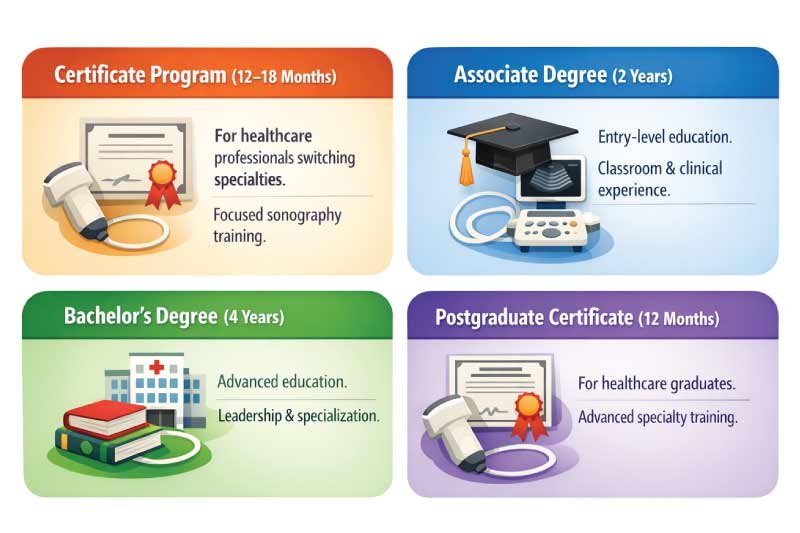
1- Certificate Program (12–18 Months)
Certificate ultrasound tech programs are designed for healthcare professionals such as nurses, radiologic technologists, or medical assistants who want to switch specialties. These programs focus on core sonography skills and clinical training, allowing faster entry into the field without completing a full degree.
2- Associate Degree (2 Years)
An associate degree in diagnostic medical sonography is the most common entry-level option. It combines classroom instruction with hands-on clinical experience, covering anatomy, ultrasound physics, and patient care. Graduates are eligible for certification exams and entry-level sonographer positions.
3- Bachelor’s Degree (4 Years)
A bachelor’s degree in ultrasound or diagnostic medical sonography offers advanced education in imaging technology, research, and healthcare management. This option is ideal for students seeking leadership roles, specialization opportunities, or long-term career growth within hospitals, teaching institutions, or healthcare administration.
4- Postgraduate Certificate (12 Months)
Postgraduate ultrasound certificates are designed for individuals who already hold a degree in a related healthcare field. These programs provide focused sonography training without repeating general education courses, making them ideal for professionals seeking specialization or expanded clinical responsibilities.
| Program Type | Duration | Best For |
|---|---|---|
| Certificate Program | 12–18 months | Healthcare professionals switching careers |
| Associate Degree | 2 years | Entry-level sonographers |
| Bachelor’s Degree | 4 years | Advanced roles or leadership |
| Postgraduate Certificate | 12 months | Degree holders in related fields |
Understanding these options helps narrow your search early.
Accreditation: The Most Important Factor
Accreditation ensures that a school meets national education and training standards. Employers and certification bodies often require graduation from an accredited program.
Look for programs accredited by organizations such as CAAHEP or those recognized by professional sonography boards. Without accreditation, you may not be eligible for certification exams.
Also Read:
Certification Exam Preparation and Pass Rates
Strong certification exam preparation is a key factor when choosing an ultrasound tech school. Programs with high pass rates, structured board exam prep, and faculty support help students feel confident, pass on the first attempt, and become job-ready immediately after graduation.
| School Feature | Why It Matters |
|---|---|
| High exam pass rate | Indicates strong curriculum |
| Board exam prep courses | Boosts first-time success |
| Practice exams | Builds confidence |
| Faculty mentorship | Personalized guidance |
Strong certification preparation increases employability immediately after graduation.
Clinical Training and Hands-On Experience
Hands-on clinical experience is essential in sonography education. Reputable programs partner with hospitals, imaging centers, and clinics.
Ask how many clinical hours are required and whether placements are guaranteed. Programs that arrange internships internally are usually more reliable.
Faculty Experience and Teaching Quality
Instructors should be certified, experienced sonographers with real-world clinical backgrounds. Experienced faculty can bridge the gap between theory and practice.
Look for programs where instructors actively work or have worked in hospitals, diagnostic centers, or specialized ultrasound departments.
Also Read:
School Reputation and Graduate Employment Rate
A school’s reputation plays a major role in graduate hiring success. Ultrasound tech programs with strong employer recognition, high job placement rates, and active alumni networks often provide better career opportunities, smoother clinical placements, and faster employment after graduation.
| Metric | What to Look For |
|---|---|
| Graduate employment rate | Above 80% is ideal |
| Employer partnerships | Indicates trust |
| Alumni success | Shows career outcomes |
| Program longevity | Stability and credibility |
Schools with strong industry ties often help students secure jobs faster.
Specialization Options Within the Program
Many ultrasound tech programs offer specialization tracks that allow students to focus on specific imaging areas. Choosing the right specialization can improve clinical skills, increase job opportunities, and support long-term career growth by aligning training with personal interests and industry demand.
1- Obstetric and Gynecologic Sonography
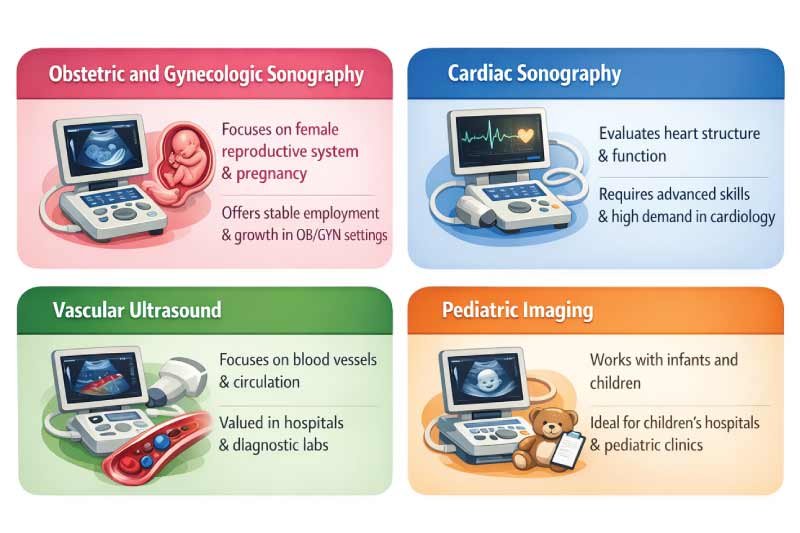
This specialization focuses on imaging the female reproductive system and monitoring pregnancy. Students learn fetal development assessment, prenatal imaging, and patient care techniques. OB/GYN sonographers are in high demand in hospitals, clinics, and private practices, offering stable employment and career growth.
2- Cardiac Sonography
Cardiac sonography, also known as echocardiography, trains students to evaluate heart structure and function. This specialization requires advanced technical skills and attention to detail. Cardiac sonographers often earn higher salaries due to specialized training and strong demand in cardiology departments.
3- Vascular Ultrasound
Vascular ultrasound focuses on imaging blood vessels and assessing blood flow throughout the body. Students learn to detect blockages, clots, and circulation issues. This specialization is valued in hospitals and diagnostic labs and offers consistent job opportunities with specialized clinical expertise.
4- Pediatric Imaging
Pediatric imaging prepares sonographers to work with infants and children, requiring both technical precision and strong communication skills. This specialization covers age-specific anatomy and patient care techniques, making graduates suitable for children’s hospitals and specialized pediatric healthcare facilities.
Online vs On-Campus Ultrasound Tech Schools
Ultrasound tech schools now offer on-campus, online, and hybrid learning formats to meet different student needs. Each option varies in flexibility, structure, and clinical access. Understanding the pros and cons of each format helps you choose a program that fits your schedule and learning style.
| Learning Format | Pros | Cons |
|---|---|---|
| On-campus | Structured learning, lab access | Fixed schedule |
| Online | Flexible, convenient | Requires self-discipline |
| Hybrid | Best of both | Limited availability |
Choose the format that fits your lifestyle without sacrificing clinical experience.
Also Read:
Tuition Costs and Financial Aid Options
Tuition costs vary widely among ultrasound tech programs, depending on degree type and institution. While affordability matters, program quality and clinical training should remain priorities. Exploring financial aid options such as scholarships, grants, and payment plans can make reputable programs more accessible.
| Expense Type | Average Cost Range |
|---|---|
| Tuition | $5,000–$40,000 |
| Books & supplies | $1,000–$3,000 |
| Clinical fees | $500–$2,000 |
| Certification exams | $200–$500 |
Ask about scholarships, grants, payment plans, and employer-sponsored tuition assistance.
Location and Commuting Considerations
School location plays an important role in daily comfort, expenses, and long-term success in an ultrasound tech program. While convenience matters, training quality should remain the priority. Evaluating commuting distance, clinical site locations, and transportation options helps students maintain consistency and academic performance.
-
Shorter commutes reduce transportation costs and daily fatigue.
-
Nearby campuses make attending labs and early clinical shifts easier.
-
Clinical training sites should be within reasonable driving distance.
-
Long travel times can negatively affect attendance and punctuality.
-
Reliable public transportation can be a major advantage for urban students.
-
Relocating may be worthwhile for highly accredited programs.
-
Parking availability and safety should also be considered.
Class Size and Student Support Services
Smaller class sizes allow for better instructor interaction and hands-on learning. Ask about student-to-faculty ratios.
Support services such as tutoring, career counseling, resume help, and job placement assistance are signs of a student-focused program.
Questions to Ask Before Enrolling
Asking the right questions before enrolling in an ultrasound tech program helps you avoid costly mistakes. Clear answers about accreditation, exam success, clinical placements, and job support reveal a school’s transparency, credibility, and commitment to student outcomes.
- Is the program accredited?
- What is the certification exam pass rate?
- Are clinical placements guaranteed?
- What are total program costs?
- What job placement support is offered?
Clear answers indicate transparency and professionalism.
Also Read:
Program Length and Scheduling Flexibility
Program length and scheduling flexibility are important factors for students balancing work, family, or other responsibilities. The best ultrasound tech schools offer structured yet adaptable schedules that maintain training quality while allowing students to complete their education within a realistic timeframe and enter the workforce without unnecessary delays.
1- Full-Time Program Options
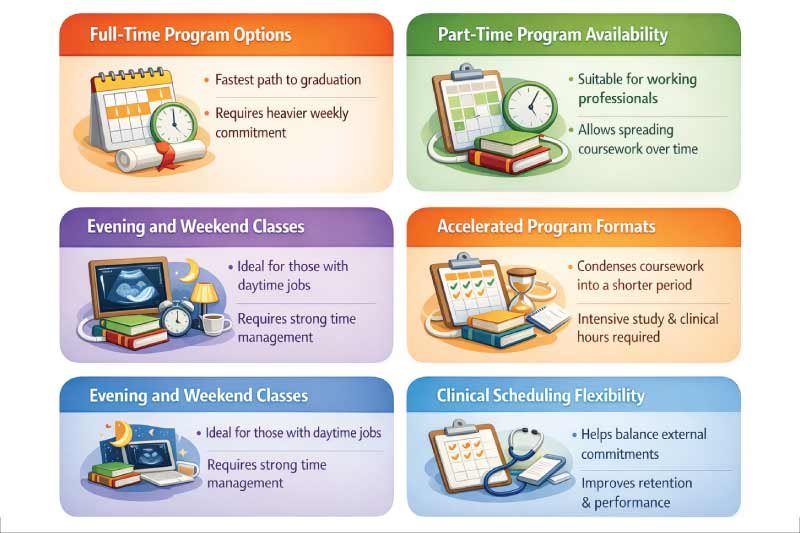
Full-time ultrasound tech programs offer the fastest path to graduation and workforce entry. These programs require a heavier weekly commitment but provide consistent learning and clinical exposure. They are ideal for students who can dedicate most of their time to education without significant outside obligations.
2- Part-Time Program Availability
Part-time programs allow students to spread coursework over a longer period, making them suitable for working professionals or parents. While completion takes more time, these programs maintain the same academic standards and clinical requirements, offering flexibility without sacrificing essential hands-on training.
3- Evening and Weekend Classes
Evening and weekend scheduling options support students who work traditional daytime hours. These programs follow the same curriculum as daytime tracks but require strong time management. Flexible class timing helps students stay enrolled while meeting financial or family responsibilities.
4- Accelerated Program Formats
Accelerated ultrasound tech programs condense coursework into a shorter timeframe, often requiring intensive study and clinical hours. These options are best for motivated students with prior healthcare experience who want to enter the workforce quickly without compromising core competencies.
5- Clinical Scheduling Flexibility
Clinical rotations often have fixed hours, but some schools offer flexible placement options. Programs that coordinate clinical schedules thoughtfully help students balance external commitments while meeting required competencies, improving retention, performance, and overall educational success.
Also Read:
How to Become a Certified Surgical Technologist in 2026
Final Thoughts: Choosing the Best Ultrasound Tech School for You
Finding the best ultrasound tech school isn’t about choosing the most popular or cheapest option—it’s about finding the right fit for your goals. Accreditation, clinical training, faculty expertise, and job placement support matter far more than flashy marketing.
Take time to research, compare programs, and ask detailed questions. A well-chosen school sets the foundation for a rewarding, stable, and well-paying career in diagnostic medical sonography.
FAQs:
What is the best school to go to for ultrasound tech?
The best ultrasound tech school is one that is properly accredited, offers strong clinical training, and has high certification exam pass rates. Programs with solid employer partnerships and graduate job placement support often provide better long-term career outcomes.
What is the hardest part of ultrasound tech school?
The most challenging part of ultrasound tech school is balancing academic coursework with hands-on clinical training. Learning ultrasound physics, anatomy, and image interpretation while managing clinical schedules requires strong time management, focus, and consistent practice.
Is ultrasound tech school worth it?
Ultrasound tech school is worth it for students seeking a stable healthcare career with strong demand and competitive salaries. Graduates often find employment quickly, enjoy patient interaction, and benefit from career growth opportunities without the extended education required for some medical professions.
What should I study if I want to be an ultrasound tech?
Students interested in ultrasound technology should study anatomy, physiology, medical terminology, physics, and basic patient care. A strong foundation in biology and math is helpful, along with developing communication skills and attention to detail for clinical accuracy.
Is ultrasound school harder than nursing?
Ultrasound school and nursing school are challenging in different ways. Ultrasound programs focus heavily on imaging accuracy, physics, and hand-eye coordination, while nursing involves broader patient care responsibilities, medications, and longer clinical shifts. Difficulty depends on personal strengths and learning style.
How long does ultrasound take to study?
Ultrasound education typically takes between 12 months and four years, depending on the program type. Certificate programs are shorter, while associate and bachelor’s degrees require more time but often provide broader training and career advancement opportunities.
Is the math hard for ultrasound techs?
The math required for ultrasound techs is manageable and mainly involves basic algebra and physics concepts. Understanding calculations related to sound waves and measurements is important, but programs provide structured instruction to help students succeed without advanced mathematics.

Zak is a dedicated medical and career writer specializing in sonography, healthcare education, and professional development. Through SonographerSalary.com, he shares in-depth insights on sonographer salaries, education pathways, and career tips to help readers build successful futures in medical imaging. His content combines accuracy with practical, easy-to-understand guidance, empowering students and professionals to make confident, informed career decisions.