
If you’ve ever visited a hospital for an X-ray, CT scan, or MRI, you have already met the professionals who make diagnostic imaging possible: radiologic technologists. People usually call them “radiology techs,” and over the last decade, this career has become one of the most stable and better-paying options in the healthcare field. With rising demand, an aging population, and increasing use of medical imaging in modern diagnosis, more students are looking at this field not just out of passion but also for financial security.
This brings us to the most common question: How much does a radiology tech earn?
The answer is not just a number, it’s a mix of experience, certifications, geographic location, and the type of facility you work for. In this guide, I will break down radiology tech salaries in a natural, human way so you understand what real professionals in the field earn today, what affects those earnings, and how you can grow your income if you choose this path.
Why Radiology Tech Salary Matters More Today
Over the last few years, healthcare salaries have shifted. Some medical roles have stagnated, while others, especially diagnostic imaging—have surged. Hospitals rely heavily on images for nearly every diagnosis, whether it’s a suspected fracture, chest infection, internal bleeding, or cancer screening. That means radiology techs are no longer “support staff.” They’re essential clinical professionals whose skills directly influence patient care.
Because of that, salaries have improved, job openings have increased, and career growth looks much better than it did ten years ago. Students and career-changers want a stable job with strong earning potential, and radiology is offering exactly that.
Average Radiology Tech Salary in 2026
While the average salary varies by state and facility, the typical U.S. radiologic technologist earns between $58,000 and $82,000 per year, with many landing right around $70,000–$74,000.
But these numbers shift a lot based on several factors, which we’ll dive into. For now, here’s the general breakdown:
Hourly pay: $26 – $38 per hour
Monthly salary: $4,500 – $6,800
Yearly salary: $58,000 – $82,000
Top earners: Over $95,000 per year
Entry-level: $45,000 – $55,000
These are nationwide averages, but they don’t tell the full story. A tech in California earns very differently from a tech in Tennessee. Someone working nights or weekends earns more than someone working a regular daytime shift. And technologists who specialize—like CT, MRI, mammography, or interventional radiology—often earn significantly more than general X-ray techs.
How Location Affects Radiology Tech Salary
Location is the biggest salary influencer in almost every healthcare job, but imaging sees even more dramatic differences. States with high living costs tend to pay much more, while rural states usually have modest pay. But something interesting has happened in the last five years: smaller states with limited imaging professionals have started offering higher salaries to attract talent.
Highest-paying states for radiology techs
Radiology techs in these states often earn $80,000–$100,000+ yearly:
- California
- New York
- Massachusetts
- Washington
- Oregon
- Colorado
- Hawaii
These states benefit from large healthcare systems and heavy imaging usage in hospitals and outpatient centers. California, especially, offers some of the highest wages in the country due to strict licensing and strong union presence.
Mid-range earning states
These areas offer $65,000–$78,000 on average:
- Texas
- Florida
- Georgia
- Arizona
- Virginia
- North Carolina
- Illinois
Most new techs start their careers in states like these because the cost of living is moderate and opportunities are everywhere.
Lower-paying states
Radiology techs here typically earn $52,000–$62,000:
- Mississippi
- Arkansas
- South Dakota
- North Dakota
- Iowa
- West Virginia
But don’t let these numbers fool you—techs in rural areas often enjoy lower rent, cheaper living, and less competition, which means good job stability and a comfortable lifestyle.
📊 Diagnostic Medical Sonographer Salary is one of the most talked-about topics for healthcare professionals and students. From entry-level pay to top specialties, this guide breaks down everything you need to know. Read on to discover how experience, location, and certifications can maximize your earnings in this rewarding career.
Salary by Experience Level
A radiology tech’s income improves steadily with experience, especially when they add advanced imaging certifications. Here’s what it realistically looks like:
1. New graduates (0–2 years)
Fresh radiology tech graduates usually begin their careers in high-demand hospital areas like emergency rooms, trauma departments, and inpatient units. Their starting pay ranges from $22 to $27 per hour, and this early phase helps them build strong foundational skills, confidence, and speed.
2. Mid-level techs (3–7 years)
By the time radiology techs reach the mid-level stage, most have added advanced certifications such as CT or MRI, which significantly boost earning potential. Salaries typically rise to $30–$40 per hour, with annual earnings often crossing $75,000 due to experience and specialized skills.
3. Senior or specialized techs (8+ years)
Senior radiology techs with years of hands-on experience and high-demand specialties like MRI, Interventional Radiology, or the Cath Lab earn some of the strongest salaries in the field. Many bring in $90,000–$110,000+ yearly, especially in states offering competitive healthcare wages.
How Certifications Influence Salary
One of the best things about being a radiologic technologist is the ability to grow your income without going back to school for a full degree. The ARRT makes it easy to stack specialties, and each specialty increases earning potential.
Most profitable certifications:
CT (Computed Tomography) – One of the fastest ways to increase salary.
MRI (Magnetic Resonance Imaging) – High-paying, especially in private imaging centers.
Mammography – Lower stress, good schedule, strong demand.
Interventional Radiology (IR) – One of the highest-paying imaging roles.
Cardiac Cath Lab – Excellent pay, especially with call shifts.
Techs with two or more of these certifications are often among the highest earners in the field, sometimes crossing the $120,000 yearly mark in top states.
📊 Sonographer Salary Per Hour is a key factor for anyone considering a career in diagnostic medical imaging. This guide breaks down hourly pay across experience levels, specialties, and locations, helping you understand what you can realistically earn and how to increase your income over time.
Hospital vs. Clinic vs. Travel Radiology Tech Salary
Where you choose to work can significantly shape your income as a radiology tech. Different workplaces offer different workloads, benefits, and pay structures, making your job setting just as important as your location when it comes to overall salary potential.
1. Hospitals
Hospitals generally offer the strongest earning potential for radiology techs, especially Level I trauma centers where imaging demand is constant. Techs working evenings, nights, weekends, and holidays earn additional shift differentials that can significantly increase yearly income, often adding several thousand dollars.
2. Outpatient imaging centers
Outpatient centers provide competitive salaries, though typically a bit lower than busy hospital environments. Their biggest advantage is a stable schedule—usually Monday to Friday, 8 a.m. to 5 p.m. This predictable routine attracts techs who want solid pay without the fast-paced pressure of trauma work.
3. Clinics and urgent care
Clinics and urgent care facilities tend to pay the least, but they offer a calmer and more relaxed work setting compared to hospitals. Many radiology techs appreciate the slower workflow, fewer emergency cases, and the consistent daytime hours that support a healthier work–life balance.
4. Travel Radiology Techs
Travel radiology techs earn some of the highest incomes in the field by accepting short-term contracts in states facing staffing shortages. Weekly pay often ranges from $2,300 to $3,800, and additional perks like housing stipends, reimbursements, and bonuses can push total yearly earnings well into six figures.
Annual income for travel techs can cross $140,000–$170,000, depending on the contracts they take.
Shift Differentials and Overtime Can Boost Pay Dramatically
Many new students don’t know this, but radiology techs earn far more than their base salary through extra shifts:
Night shift differential: +10%–20%
Weekend differential: +$3–$8 per hour
Holiday pay: 1.5× or 2×
On-call pay: $3–$8 per hour + call-back rates
If you work in a busy trauma center, overtime and call-backs can push your income into six figures even without switching specialties.
Radiology Tech Salary vs. Other Imaging Careers
Many students compare radiology with other healthcare imaging careers before choosing a path. Here’s a realistic comparison:
Radiology Tech (X-ray): $58k–$82k
CT Tech: $70k–$95k
MRI Tech: $72k–$100k
Ultrasound Tech / Sonographer: $75k–$105k
Nuclear Medicine Tech: $85k–$120k
Interventional Radiology Tech: $95k–$135k
In most states, radiology techs start slightly lower than sonographers or MRI techs, but they have more specialty options to grow into.
📊 Texas Cardiovascular Sonographer Salary reveals what heart-focused sonographers earn across hospitals, clinics, and private practices in the Lone Star State. This guide breaks down hourly, monthly, and yearly pay, plus tips on boosting income with experience, certifications, and specialty training. Read on to see the full picture.
Is Radiology a Good Career for the Future?
Short answer: yes—one of the best.
The healthcare industry is dealing with a massive shortage of imaging professionals. Many older techs are retiring, and hospitals are expanding imaging departments faster than schools can train new students.
This shortage has increased salaries, job security, and career opportunities.
Why the future looks strong:
- Nearly every medical diagnosis requires imaging.
- Aging population = more X-rays, CT scans, and MRIs.
- Advancements in AI imaging require skilled techs, not fewer.
- Travel imaging jobs have exploded nationwide.
- Specialties offer long-term earning potential.
You can enter the field with a two-year degree and grow your income every year through experience and certifications.
How to Increase Your Salary as a Radiology Tech
Radiology tech salaries can grow quickly with the right strategy, and the highest earners follow a clear path to boost their income. Whether you’re new or experienced, small career decisions—like certifications, shifts, and travel work—can dramatically increase your overall yearly earnings.
1. Master general X-ray for your first year
Your first year should focus on becoming confident with general X-ray, especially in fast-paced areas like trauma, surgery, and inpatient portables. Learning to work quickly and accurately builds the foundation that makes future transitions into CT, MRI, or advanced specialties much easier.
2. Add CT certification (ARRT)
CT certification is one of the fastest ways to increase your salary because nearly every hospital relies heavily on CT imaging. Many facilities offer on-the-job training for X-ray techs, allowing you to gain experience, qualify for the ARRT exam, and move into higher-paying roles.
3. Move into MRI or IR
Once you’ve built confidence, shifting into MRI or Interventional Radiology can significantly boost income. MRI offers high pay in a quieter, controlled environment, while IR provides some of the strongest salaries in imaging due to its complexity, teamwork, and fast-paced procedural workflow.
4. Take night or weekend shifts
A simple way to raise your income without changing specialties is working nights, weekends, or holidays. Shift differentials add up quickly, and many radiology techs earn an extra $8,000–$15,000 per year just by choosing schedules with higher hourly incentives.
5. Consider travel assignments
Experienced radiology techs often take travel contracts to dramatically increase earnings. Travel pay packages frequently include weekly stipends, bonuses, and higher hourly rates, allowing many techs to double their annual income while exploring new cities and gaining valuable experience in diverse clinical environments.
📊 California Cardiovascular Sonographer Salary shows what heart-focused sonographers earn in hospitals, outpatient centers, and clinics across the Golden State. This guide breaks down hourly, monthly, and yearly pay while offering tips on boosting income with experience, certifications, and specialized skills. Read on to get the full salary picture.
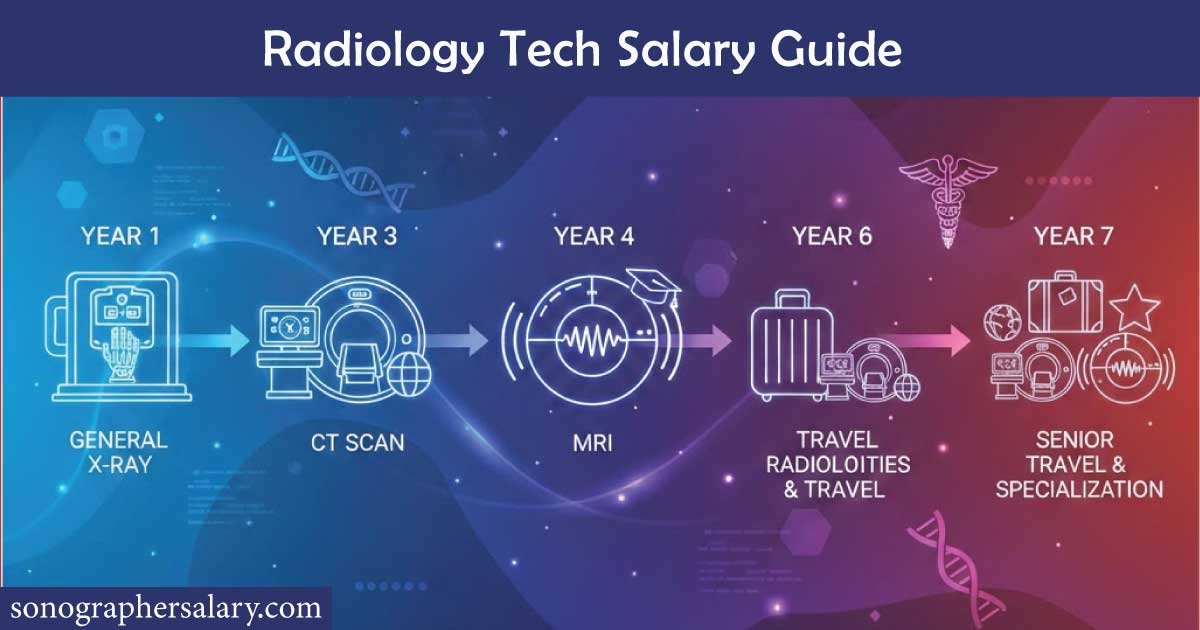
Example: How Salary Grows Over Time
Radiology tech careers offer steady financial growth, and many professionals see their income rise quickly as they gain new skills and certifications. This example shows a realistic path that many techs follow, demonstrating how experience and specialization gradually lead to significant salary increases over the years.
Year 1
Most radiology techs begin in general X-ray, earning around $24 per hour as they learn the workflow of trauma, surgery, and portable imaging. This first year is focused on building speed, confidence, and technical accuracy, resulting in an annual income close to $50,000.
Year 3
By the third year, many techs transition into CT, one of the highest-demand imaging areas. With certification and hands-on experience, salaries typically reach about $32 per hour, pushing annual earnings to roughly $68,000 as responsibilities expand and skills become more specialized.
Year 5
At this point, techs who earn dual certification in CT and MRI see another major jump in income. With broader expertise and access to advanced imaging departments, hourly pay often rises to $38, bringing yearly earnings to about $82,000 and opening doors to higher-paying roles.
Year 7
After gaining strong experience, many techs move into travel assignments where demand—and pay—is much higher. Travel radiology techs frequently earn around $2,900 per week, resulting in annual incomes surpassing $145,000, often doubling what they made earlier in their careers without additional degrees.
Is Radiology Tech Salary Worth the Workload?
Radiology techs work hard. Between trauma cases, inpatient portables, OR support, and emergency imaging, there are days when the department feels nonstop. But for many techs, the combination of good pay, strong benefits, and meaningful patient interaction makes the effort worth it.
Most techs appreciate:
- Steady income
- Shift flexibility
- Opportunities to specialize
- Ability to move anywhere in the U.S.
- Respect within the medical team
If you like technology, patient care, and a fast-moving hospital environment, this career offers strong financial rewards.
📊 Travel Sonographer Pay: Hourly, Weekly & Annual breaks down exactly what traveling sonographers earn across the U.S. From hourly rates to weekly and yearly income, this guide covers pay differences, perks, and tips to maximize earnings while exploring new locations. Read on to see full details.
Final Thoughts: Should You Pursue Radiology for the Salary?
If you are choosing a career purely for the paycheck, radiology offers something rare: high earnings without a long educational path.
But beyond the salary, it’s a job with purpose. You’re helping diagnose injuries, detecting cancer, assisting trauma patients, and playing a major role in patient care. The emotional fulfillment is just as strong as the financial stability.
Radiology techs in 2026 continue to earn strong salaries—whether you are a fresh graduate starting at $50,000 or a specialized travel tech earning $150,000+. And with the demand for imaging growing every year, radiology remains one of the smartest career choices for anyone seeking a stable, well-paid future in healthcare.
FAQs:
Which radiology tech makes the most money?
Specialized radiology techs like MRI technologists, CT technologists, and interventional radiology techs typically earn the highest salaries. Advanced certifications, multiple imaging skills, and experience in high-demand areas can increase pay. In some U.S. states, MRI techs can earn over $100,000 annually due to specialization and local demand.
How much do radiology techs make in the UK?
In the UK, radiographers earn between £24,000 and £37,000 annually for standard roles. Senior or specialized radiographers in MRI, CT, or interventional imaging can earn £40,000–£45,000. NHS pay scales, regional demand, and experience level significantly affect salaries. Additional certifications can further increase earning potential.
Can I be a radiographer without a degree?
Generally, becoming a professional radiographer requires a bachelor’s degree or accredited program. Some entry-level positions, such as X-ray or radiology assistant roles, may accept diplomas or associate-level qualifications. However, licensure and full practice rights typically require completion of a recognized degree in radiography or medical imaging.
Do radiology techs make good money?
Radiology technologists earn competitive salaries compared to other allied health professions. In the U.S., median annual wages are around $77,000–$78,000, with top earners exceeding $100,000. Specialization in MRI, CT, or interventional radiology can significantly increase earnings, making this a financially rewarding healthcare career.
Is rad tech in demand?
Yes. Radiologic technologists are in strong demand worldwide due to aging populations, growing healthcare needs, and advanced imaging technology. Employment growth is faster than average, especially in specialized areas like MRI, CT scans, and nuclear medicine. Demand creates ample opportunities for both new graduates and experienced techs.
What are entry-level jobs in radiology?
Entry-level positions include radiology assistant, X-ray technician, CT or MRI trainee, and sonography trainee. These roles require minimal experience and sometimes only an associate degree. They provide hands-on exposure to medical imaging and a pathway to full certification and specialization in advanced radiology modalities.
What influences radiologic technologist pay?
Radiologic technologist salaries are influenced by factors such as location, level of experience, type of imaging specialty (MRI, CT, interventional), certifications, employer type, and demand in the healthcare market. Urban hospitals or specialized clinics often pay more, and technologists with multiple skills or years of experience earn higher salaries.
How much do radiology techs make a year?
In the U.S., the median annual salary for radiology techs is around $77,660, with an average hourly rate of $39–$40. Experienced specialists in MRI, CT, or interventional radiology can earn over $100,000 per year. Salaries vary by state, hospital type, and certifications, with urban areas generally offering higher pay.
How much does a Physician – Radiology make?
Radiologists, who are medical doctors specializing in imaging, earn significantly more than technologists. In the U.S., the average annual salary ranges from $350,000 to $450,000, depending on experience, location, and subspecialty. Interventional radiologists and those in private practice often earn above $500,000 annually.
How much does a radiographer make a year?
Radiographers in the UK earn £24,000–£37,000 annually for standard roles, while senior or specialized radiographers can make £40,000–£45,000. In Pakistan, entry-level radiographers earn around Rs 53,000 per month, with experienced professionals earning significantly more. Pay depends on experience, specialty, location, and employer type.

Zak is a dedicated medical and career writer specializing in sonography, healthcare education, and professional development. Through SonographerSalary.com, he shares in-depth insights on sonographer salaries, education pathways, and career tips to help readers build successful futures in medical imaging. His content combines accuracy with practical, easy-to-understand guidance, empowering students and professionals to make confident, informed career decisions.