
The beginning of your career as a sonographer is a great thing. The clinical rotations are over, the exams are passed, and you are now entering the world of patients and diagnostic imaging processes. The simplest question that new graduates usually have is as follows: How much does a new sonographer actually earn in 2025?
This guide takes you through that answer in a comfortable, sincere, and realistic manner, so that you are aware of what to look forward to when you begin your first employment in ultrasound.
Understand the Starting Salary for New Sonographers in 2025
The medical sector will still experience a shortage of workers in 2025, which implies high demand among trained diagnostic medical sonographers, particularly those who have just been licensed. Aggressive hiring is being done by hospitals, imaging centers and even travel agencies.
For a new graduate, the common starting point across the United States in 2025 falls between:
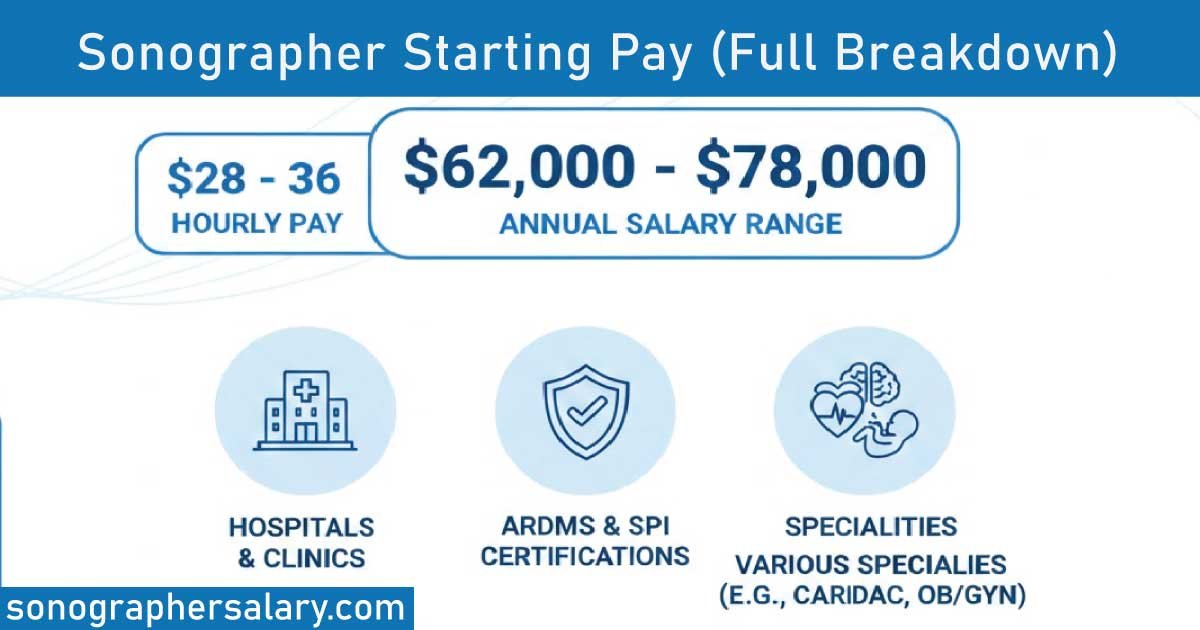
$62,000 to $78,000 per year (entry-level range) or $28 to $36 per hour.
This is the median starting bracket, though you can be below this bracket or much higher than this bracket, based on a number of factors. The question is why is there a variance in salaries and what can I do to place myself in the upper part of the scale.
Why the Starting Salary Is not the Same Everywhere
When you question two graduates who joined about the same period you may find their payrolls are light years apart. One can be offered a job of 34$/hour and another can get a job of 28/hour. And this difference is not accidental: it is predetermined by a number of factors that can be predicted:
1. Your State and Cost of Living
Some states such as California, Washington, New York, and Massachusetts have one of the highest starting salaries as the cost of living is high too. In the meantime, such states as Alabama, Mississippi, Iowa, and Oklahoma are more likely to offer low entry-level salaries. 2025 trend: The Northeast and West Coast continue leading in pay for new sonographers.
2. Type of Facility Hiring You
Generally, a hospital will pay higher than a doctor office. A big outpatient clinic can hardly ever match a trauma center in payments. A mobile ultrasound company can provide good remuneration but needs additional travelling.
In 2025:
Hospitals → Best average starting pay
Diagnostic Imaging Centers → Mid-range
Private Practices → Lower but stable
Travel Agencies → Highest potential (but usually not for brand-new grads)
3. Specialization (Even as a New Graduate)
There are more practical students during clinical rotations in such fields as cardiac or vascular ultrasound. You will be able to bargain about your initial pay by demonstrating your strong points even having a new degree.
Specialties with higher starting ranges in 2025:
Cardiac Sonography (Echo)
Vascular Sonography
High-Risk Obstetrics
General ultrasound offers solid pay, but specialty-focused students get better offers.
4. Certifications You Hold
New grads with ARDMS credentials such as:
RDMS
RVT
RDCS
…have more bargaining power. Many employers in 2025 offer a salary bump the moment you show certification proof.
5. Local Demand
When you are ready to work in the country in villages where the staff is not sufficient, you will often have a better salary, bonuses, or moving costs- even as a novice. Such areas have difficulties in recruiting qualified sonographers, thus employers provide monetary rewards, housing, and expedited recruitment processes. It is among the simplest methods of increasing your first year earnings.
What a Typical First-Year Paycheck Looks Like
Most new sonographers start with hourly wages between $28–$36/hour.
Let’s break it down in a simple, real-world way:
If you make $30/hour and work full-time (40 hrs/week), your yearly pay is around $62,400.
If your starting rate is $34/hour, you’ll make around $70,700/year.
With shift differentials for nights/weekends, your total pay can jump by $4,000–$8,000 in your first year.
Most new graduates do not realize the accumulation of those differentials. Provided you are willing to work night shifts or on rotating weekends during your first year, you can get to the top of the beginner salary range in a short time.
Example: What New Grads Experienced in 2025
To make this guide feel more real, here’s a scenario based on actual 2025 hiring trends:
Maria, a new general sonography graduate from Texas, received three job offers:
A hospital offering $33/hour
A family clinic offering $29/hour
An imaging center offering $31/hour
She chose the hospital not just because of the higher pay, but also because:
They offered $4/hour differential for weekend shifts
They offered training in vascular studies
They provided tuition reimbursement if she pursued RVT certification
Within her first 12 months, Maria’s income reached $78,000, including extra hours, differentials, and holiday pay. This kind of story is very common in 2025 because hospitals are build stronger incentives to attract new sonographers.
States That Offer the Highest Starting Salary in 2025
Based on 2025 hiring trends, the highest paying states for new graduates include:
California – often above $35/hour
Washington – around $34–$37/hour
New York – $33–$36/hour
Oregon – $32–$35/hour
Massachusetts – $33–$36/hour
Colorado – $31–$34/hour
On the lower end of the scale, you’ll find states like:
Alabama
Oklahoma
Arkansas
Kentucky
Mississippi
These states often offer entry-level rates between $27–$30/hour, but sometimes provide bonuses or training programs to make up for the difference.
Benefits You Can Expect as a New Sonographer
Starting pay is significant, yet it is just a part of your actual salary. Numerous new graduates do not pay attention to benefits, yet it is possible to add thousands of dollars to overall compensation. Hospitals and imaging centers of 2025 are making better packages than ever, and knowledge of these perks can make you appreciate the value of your first job.
Health Insurance
The vast majority of hospitals cover full-time new sonographers medically, dentally, and visionally. These advantages save you a lot of bucks on a monthly basis, particularly where you have dependents. Premiums with no employer insurance are very high, so this cover alone puts close to thousands of dollars in your effective annual income.
401(k) Matching
A lot of employers are now contributing 3%-6% of your 401(k) savings, which is in effect free money on your retirement. Although you are a new sonographer, you can take advantage of this advantage and establish financial security over the long term. In the long-term, employer matching can increase your total pay and wealth greatly.
Paid Time Off
The entry-level sonographers begin with a good package of PTO which comprises of 10-15 days of vacation, 5-7 days of sick leaves, and paid holidays. All these days are paid at your full hourly rate and this is where you earn money even when you are on leave. Good PTO also helps to avoid burnout and increases your work life balance in the first year.
Certification Bonuses
Health Care institutions often offer new employees bonuses ranging between 1000 and2500 to complete ARDMS certifications. Such bonuses are a reward of your developed skills and save employers on training time. Numerous newly graduated earn an additional pay in the initial months just because they attained the credentials of RDMS, RVT and RDCS.
Relocation Assistance (in shortage areas)
There is a shortage of qualified sonographers in some areas particularly, the rural towns and underserved states. Such regions may provide relocation bonuses up to $5000, housing allowances or even signing bonuses as high as 7500. You can earn a lot of money during your first year with the help of one of these choices in case you are flexible.
Continuing Education Support
CME credits are paid by many employers or they reimburse ultrasound workshops and specialty training. This will assist you in growing without any out of pocket expense and train you on the higher paying specialties in the future. It also demonstrates your employers dedication to enhancing your long time career.
How These Benefits Increase Your Real Income
With insurance benefits, PTO, bonuses and matching on retirement many new sonographers make much more than their base salary would indicate. Such benefits can easily apply real value in your first year of many thousands of dollars, or $8,000-15,000 on paper, which makes your job offer significantly better than it looks on paper.
New Sonographer Benefits Comparison Table (2025)
| Benefit Type | What You Receive | Estimated First-Year Value | Why It Matters |
|---|---|---|---|
| Health Insurance | Medical, dental & vision coverage | $4,000–$7,000 | Saves thousands in premiums and reduces medical expenses for new grads and families. |
| 401(k) Matching | Employer match of 3%–6% | $1,200–$3,000 | Free retirement money that grows over time with compound interest. |
| Paid Time Off (PTO) | 10–15 vacation days, 5–7 sick days, paid holidays | $2,000–$4,500 | You get paid while taking time off, increasing your effective salary. |
| Certification Bonuses | Bonus for ARDMS credentials | $1,000–$2,500 | Rewards your skills and motivates you to specialize early. |
| Relocation Assistance | Relocation bonus, housing stipend, signing bonus | $5,000–$12,500 | Rural/shortage areas offer big bonuses to attract new graduates. |
| Continuing Education Support | CME credits, workshop/course reimbursement | $500–$1,500 | Helps you advance your skills without spending your own money. |
How to Increase Your Starting Salary Before Your First Job
An increase in starting salary is not just a question of luck, but a plan. Being a new graduate in the sonography profession, making a few wise choices can help a lot in your initial offer. These are practical steps, which are widely applied, and proven to make the new sonographers earn more immediately.
1. Get at Least One ARDMS Certification Before Applying
Having an ARDMS certification like RDMS (Abdomen/OB) or RVT prior to application submission is an automatic boost to a candidate. Employers like new grads who are already credentialed, and the certified applicants do not have to go through probation-pay. With just a single certification, your base salary will increase, and you will have access to more preferred hospitals and clinics.
2. Gain Specialty Experience in Clinical Rotations
To increase the pay as a new sonographer, work on increasing the clinical rotation time in the high-value specialty. Ask to be assigned more practical experience in vascular, echo, OB/GYN and high-risk OB, as those would tend to be better-paid in the country. Demonstrating actual practice in the high scans stands out among other new graduates and will also aid in bargaining.
3. Be Flexible With Your Schedule
The easiest of all ways is to make more money immediately by being flexible. An important portion of hospitals charge higher rates during night, weekend, or evening shifts, particularly with fresh graduates. Embracing such changes in the first place would allow you to increase your earnings and move to daytime shifts later when you can negotiate better.
4. Apply in Multiple States
Applying to many states even the ones you have no intention to move to gives you bargaining power. Higher paying states would have more powerful packages to start with and having that available would assist you in negotiating locally. Employers care more about you when they realize other regions are appreciating your skills.
5. Build Confidence During Interviews
Interview confidence is a big issue to your salary offer. Employers seek entry-level sonographers who can be heard to sound competent, composed, and willing to work without any supervision. Being able to articulate your clinical experiences, strengths and certifications is mature. A self-assured, yet modest voice will make hiring managers place their trust in you at the outset by paying you more.
Comparison Table: Actions vs Salary Impact for New Grads
| Strategy You Use | Difficulty Level | Impact on Starting Salary | Why It Helps |
|---|---|---|---|
| ARDMS Certification | Medium | High | Immediately proves competency and reduces employer risk |
| Specialty Rotation Experience | Medium | High | Advanced skills increase your value on day one |
| Schedule Flexibility | Easy | High | Night/weekend shifts pay more for new grads |
| Applying in Multiple States | Easy | Medium | Creates negotiation leverage with local employers |
| Strong Interview Confidence | Easy | Medium–High | Helps employers trust your skills even as a new grad |
How Long It Takes to Move Beyond Entry-Level Pay
The best thing about a sonography career is that one does not have to remain in the entry level positions long enough. The average level of increase in the salaries of new graduates within:
6–12 months: After pass the certification exams
12–24 months: After gain the multi-specialty experience
2–3 years: When transition to senior roles or travel sonography
In 2025, many new sonographers reach $80,000+ per year within two years, sometimes even in their first year if they take on shift differentials and on-call shifts.
Travel Sonography: Can New Graduates Join?
Travel contracts usually require:
1 year minimum experience
Solid specialty skills
Ability to work independently
Most new grads do not start as travel sonographers immediately. There are, however, parts of the U.S. where there have been severe staffing shortages, and in that case, agencies have provided what is known as new graduate transition programs, wherein:
Train you for 6–12 weeks
Then move you into supervised travel contracts
Starting pay for these ranges from $2,000–$2,800 per week, but again, this is not typical for day-one beginners.
Is Sonography Still a Good Career for New Graduates in 2025?
Absolutely—2025 continues to be one of the strongest years for healthcare imaging jobs.
Why?
More aging patients
Higher need for non-invasive diagnostic tools
Expansion of outpatient imaging centers
Increased focus on women’s health
Growing demand for vascular and cardiac studies
The job market is stable, salaries are rising, and sonography remains one of the most rewarding and balanced careers in healthcare.
Conclusion: What You Can Expect as a New Graduate Sonographer in 2025
You have a good standing to enter the sonography career in 2025. The average salaries of most of the new graduates are between $62,000 and $78,000 annually in their states, type of facility, certifications, and the readiness to work in various shifts. However, for numbers to count, your first year in ultrasound is not only the year of gaining confidence, enhancing your scanning abilities, mastering how to handle real patients, and establishing the base of a long-term, high-paying career. When you treat your first job with a sense of inquiry, commitment and willingness to develop, it will automatically increase you in terms of salary, and in most cases more quickly than you anticipate it to increase.
👉 Cardiac Sonographer Pay Scale 2026 is becoming one of the most talked-about career topics in healthcare, and this post breaks it down clearly for you. From starting pay to specialty boosts and real earning potential, you’ll discover exactly what to expect in 2026. Keep reading to understand how to maximize your income and career growth.

Zak is a dedicated medical and career writer specializing in sonography, healthcare education, and professional development. Through SonographerSalary.com, he shares in-depth insights on sonographer salaries, education pathways, and career tips to help readers build successful futures in medical imaging. His content combines accuracy with practical, easy-to-understand guidance, empowering students and professionals to make confident, informed career decisions.