
Becoming an ultrasound tech, or diagnostic medical sonographer, is an excellent career choice for anyone interested in healthcare, patient care, and advanced medical technology. Ultrasound techs play a critical role in diagnostic imaging, helping physicians evaluate conditions, monitor pregnancies, and guide procedures. With healthcare expanding and the demand for skilled sonographers rising, knowing how to choose the right ultrasound tech program is essential.
This guide will cover program types, requirements, costs, clinical training, certification, and career pathways. By the end, you will understand exactly what it takes to become a successful ultrasound tech in 2026.
What Are Ultrasound Tech Programs?
An ultrasound tech program is a formal educational pathway that trains students to operate ultrasound equipment, perform diagnostic imaging exams, and interact effectively with patients. Programs vary in length, cost, and focus, but all include a combination of classroom instruction, laboratory practice, and clinical rotations in real medical settings.
These programs teach:
Anatomy and physiology
Medical terminology
Pathology basics
Ultrasound physics and instrumentation
Patient care and communication
Specialty imaging (e.g., obstetrics, cardiac, vascular)
Completing a program is required before obtaining professional certification, which is crucial for employment.
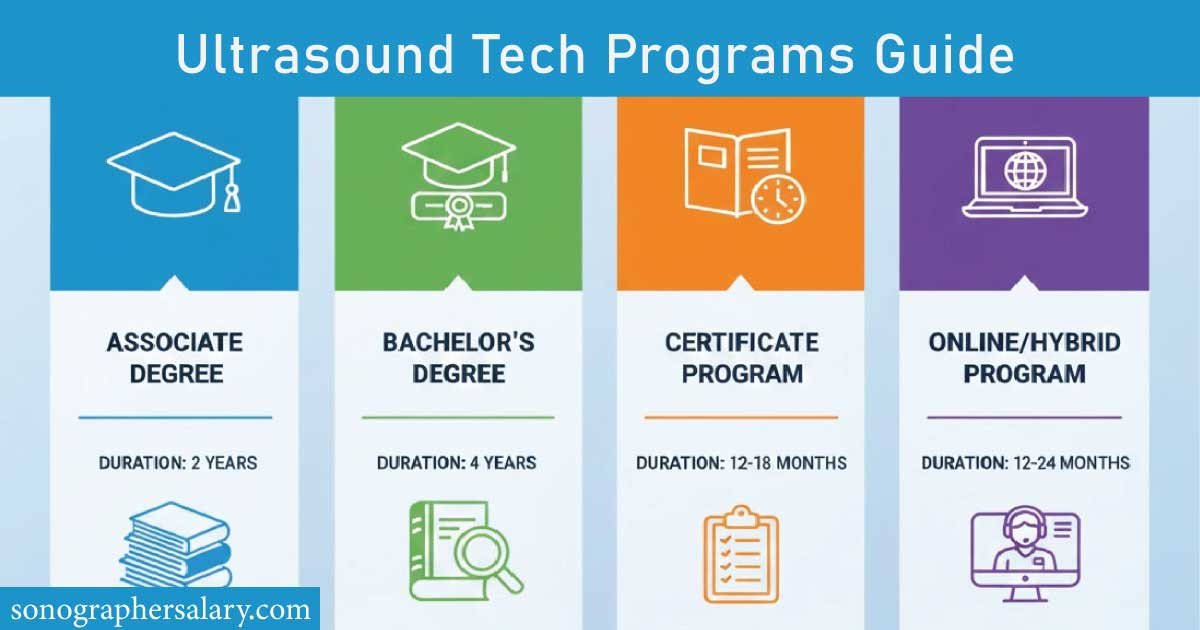
Types of Ultrasound Tech Programs
Ultrasound tech programs vary based on prior education, career goals, and desired pace. Understanding each type helps you choose the pathway that best matches your professional ambitions, whether you seek entry-level roles or advanced specialization.
1. Associate Degree Programs
Duration: 2 years
Most common pathway for new students
Combines general education with sonography coursework
Prepares students for certification exams
Includes clinical rotations in hospitals or imaging centers
2. Bachelor’s Degree Programs
Duration: 4 years
Includes advanced coursework and leadership/management training
Allows specialization in cardiac, vascular, or pediatric sonography
Prepares students for supervisory or educator roles in the future
3. Certificate Programs
Duration: 12–18 months
Designed for students who already have a healthcare background (nurses, radiologic technologists)
Focuses on ultrasound-specific training
Includes clinical rotations for hands-on experience
4. Online or Hybrid Programs
Some programs offer online coursework for theory and anatomy
Clinical rotations are done at approved healthcare facilities
Flexible for working professionals
👉 Sonography Programs: Complete Guide offers a detailed look at the best educational paths for aspiring ultrasound technicians. From program types and costs to certifications and career outcomes, this post covers everything you need to succeed. Read the full guide to choose the right Sonography Program and kickstart your healthcare career with confidence!
Admission Requirements for Ultrasound Tech Programs
Admission requirements vary by program type and school. Generally, they ensure students have a strong academic foundation, relevant science knowledge, healthcare exposure, and proper application materials, preparing them for success in ultrasound training and certification.
1. High School Diploma or Equivalent
A high school diploma or GED is essential. Programs usually prefer coursework in biology, chemistry, and physics to ensure students have a foundational understanding of sciences needed for sonography. Strong academic performance helps in meeting competitive program standards.
2. Minimum GPA
Most programs require a minimum GPA between 2.5 and 3.0 on a 4.0 scale. Maintaining a higher GPA increases admission chances, reflecting consistent academic performance and readiness for rigorous sonography courses and clinical training.
3. Prerequisite Courses
Prerequisite courses often include anatomy, physiology, medical terminology, and algebra. These courses provide essential knowledge for understanding human biology, ultrasound technology, and medical communication, ensuring students can handle technical and clinical aspects of sonography effectively.
4. Healthcare Experience or Observation Hours
Many programs require shadowing a sonographer or completing observation hours. This hands-on exposure introduces students to clinical workflows, patient interaction, and ultrasound procedures, giving valuable insight into the daily responsibilities and expectations of a professional sonographer.
5. Application Materials
Application materials generally include transcripts, letters of recommendation, a personal statement, and sometimes an interview. These components showcase your academic history, character, and motivation, helping admissions committees assess your suitability for ultrasound training programs.
6. Certificate Program Note
Some certificate programs accept healthcare professionals with prior degrees, even if they lack all prerequisites. This pathway allows nurses, radiologic technologists, or other healthcare workers to specialize in sonography efficiently without repeating foundational coursework.
7. Table Summary: Admission Requirements
| Requirement Category | Details |
|---|---|
| High School Diploma | High school diploma or GED; focus on biology, chemistry, and physics |
| Minimum GPA | Usually 2.5–3.0 on a 4.0 scale |
| Prerequisite Courses | Anatomy, physiology, medical terminology, and algebra |
| Healthcare Experience | Shadowing a sonographer or observation hours |
| Application Materials | Transcripts, letters of recommendation, personal statement, sometimes an interview |
| Certificate Program Note | May accept healthcare professionals with prior degrees without all prerequisites |
👉 Diagnostic Medical Sonography is a growing healthcare field where skilled professionals use imaging technology to help diagnose medical conditions. This post covers key responsibilities, required education, and career opportunities in sonography. Read the full post to learn how to start your journey in Diagnostic Medical Sonography and excel as a healthcare professional!
Program Curriculum
Ultrasound tech programs combine theory, lab practice, and clinical experience to prepare students for professional sonography. Understanding the curriculum helps students know what to expect and excel in both academic and clinical training.
1. Core Coursework
Core courses cover essential knowledge for sonographers, including anatomy, imaging physics, disease processes, medical terminology, and patient care. These classes build a strong foundation for understanding both normal and pathological imaging.
Anatomy & Physiology – Learn the structure and function of human organs
Ultrasound Physics – Sound waves, Doppler effect, and image formation
Pathophysiology – How diseases appear in imaging
Medical Terminology – Essential language for healthcare professionals
Patient Care & Ethics – Communication, professionalism, and HIPAA compliance
2. Specialty Courses
Specialty courses allow students to focus on a specific area of sonography, developing advanced skills and preparing for certification in targeted fields. These courses match your career interests and professional goals.
OB/GYN Sonography
Abdominal Imaging
Cardiac/Echocardiography
Vascular Sonography
Pediatric Sonography
3. Laboratory & Simulation Training
Lab and simulation training provides practical experience using models and simulators, helping students refine scanning skills, image optimization, and measurement techniques before working with actual patients.
Students practice on models or simulators before scanning patients
Learn image optimization, transducer handling, and measurement techniques
3. Clinical Rotations
Clinical rotations give hands-on exposure in real healthcare settings under expert supervision. This practical experience is essential for competency, confidence, and readiness for professional sonography practice.
Hands-on experience in hospitals, outpatient imaging centers, or specialty clinics
Usually 12–24 weeks, depending on program length
Supervised by experienced sonographers
Cost of Ultrasound Tech Programs
The cost of ultrasound tech programs depends on program type, school, and location. Understanding tuition, fees, and additional expenses helps students plan finances and choose a program that fits both career goals and budget.
Table: Estimated Program Costs (2026)
| Program Type | Duration | Tuition & Fees | Notes |
|---|---|---|---|
| Associate Degree | 2 years | $15,000–$35,000 | Public colleges often lower cost than private |
| Bachelor’s Degree | 4 years | $30,000–$70,000 | Includes general education + sonography courses |
| Certificate Program | 12–18 months | $8,000–$20,000 | For students with prior healthcare experience |
| Online/Hybrid | 12–24 months | $10,000–$25,000 | Clinical rotations arranged locally |
Financial aid, scholarships, and loan options are commonly available.
Certification After Completion
After finishing an accredited ultrasound tech program, passing a certification exam is essential. Certification validates your skills, increases employability, and ensures hospitals and clinics recognize your professional competency in diagnostic medical sonography.
Common Certification Options
ARDMS (American Registry for Diagnostic Medical Sonography)
RDMS (Abdomen, OB/GYN)
RVT (Vascular)
RDCS (Cardiac)
CCI (Cardiovascular Credentialing International)
ARRT (American Registry of Radiologic Technologists)
Certification ensures employers trust your skill, and it is often required by hospitals and clinics.
Job Outlook & Salary for Graduates
The demand for skilled ultrasound techs is growing steadily. Graduates can expect strong career prospects due to healthcare trends, technological advances, and expansion in specialized fields like cardiology, OB/GYN, and vascular imaging.
Aging population
Increased use of ultrasound in outpatient care
Non-invasive imaging preference over CT scans or X-rays
Expansion in OB/GYN, cardiology, and vascular specialties
Table: Average Ultrasound Tech Salary by Experience (2026)
| Experience Level | Hourly | Monthly | Yearly |
|---|---|---|---|
| Entry-Level | $28–$33 | $4,800–$5,300 | $58,000–$63,500 |
| Mid-Level | $35–$43 | $6,000–$7,200 | $73,000–$86,000 |
| Senior/Lead | $45–$55+ | $7,500–$9,500 | $90,000–$115,000+ |
Salaries also vary by state, specialty, and employer type.
Specializations and Career Pathways
Graduates can enhance their skills and career opportunities by specializing in specific sonography fields. Choosing a specialty allows for advanced expertise, higher earning potential, and the ability to work in targeted clinical areas.
OB/GYN Sonography – Focused on pregnancy and female reproductive health
Cardiac/Echocardiography – Heart structure and function
Vascular Sonography – Blood flow, vein, and artery imaging
Pediatric Sonography – Imaging for infants and children
Musculoskeletal Sonography – Joints, muscles, tendons
Table: Salary by Specialty (2026)
| Specialty | Average Yearly Salary | Notes |
|---|---|---|
| Echocardiography | $95,000–$120,000 | Highest-paying field |
| Vascular | $88,000–$110,000 | In-demand for hospitals |
| OB/GYN | $82,000–$100,000 | Most popular choice |
| Pediatric | $85,000–$105,000 | Requires special training |
| Abdominal/General | $78,000–$95,000 | Entry-level friendly |
👉 Ultrasound Tech is a dynamic healthcare career where professionals use imaging technology to assist in diagnosing medical conditions. This post explains the roles, required training, and career opportunities for ultrasound technicians. Read the full post to learn how to become a skilled Ultrasound Tech and thrive in this high-demand field!
How to Choose the Right Program
Selecting the right ultrasound tech program is crucial for career success. Consider accreditation, flexibility, clinical experience, cost, and specialty options to ensure the program aligns with your goals, schedule, and long-term professional aspirations.
1. Accreditation
Choose only programs accredited by CAAHEP or JRC-DMS, as these meet national standards for sonography education. Accreditation ensures eligibility for ARDMS exams, quality instruction, and recognition by employers, which is critical for your professional credibility.
2. Program Length & Flexibility
Program length and format should match your personal schedule. Some programs are full-time, part-time, online, or hybrid. Flexibility allows you to balance work, family, or other commitments while completing the required coursework efficiently.
3. Clinical Rotation Opportunities
High-quality clinical rotations are essential. Look for programs partnered with hospitals or imaging centers that provide hands-on training under experienced sonographers. Strong clinical exposure builds competence, confidence, and readiness for professional practice.
4. Tuition & Financial Aid
Compare costs between public and private institutions, factoring in tuition, fees, and additional expenses. Explore scholarships, grants, and payment plans to make education affordable while minimizing student debt. Financial planning ensures you can complete the program successfully.
5. Specialty Focus
If you have career goals in cardiac, vascular, or OB/GYN sonography, choose programs offering targeted training. Specialty courses allow advanced skill development, improve employability, and help you stand out in competitive job markets.
Summary Table: Choosing the Right Program
| Consideration | Key Points |
|---|---|
| Accreditation | CAAHEP or JRC-DMS-accredited programs only; ensures eligibility for ARDMS exams |
| Program Length & Flexibility | Full-time, part-time, online, or hybrid options; matches personal schedule |
| Clinical Rotation Opportunities | Hands-on training in hospitals or imaging centers; supervised by experienced sonographers |
| Tuition & Financial Aid | Compare costs, explore scholarships, grants, and payment plans |
| Specialty Focus | Choose programs offering cardiac, vascular, or OB/GYN training if aligned with career goals |
Conclusion
Choosing the right ultrasound tech program is the first step toward a rewarding healthcare career. Programs vary in length, cost, and focus, but all include classroom instruction, lab practice, and clinical rotations. After completing a program, certification is essential for employment and career growth.
With the demand for skilled sonographers increasing across hospitals, clinics, and specialty centers, enrolling in an accredited program today can lead to stable employment, high salaries, and meaningful patient care opportunities in 2026 and beyond.
FAQs:
How long does it take to study to become an ultrasound tech?
Becoming an ultrasound tech typically takes 1–4 years, depending on the program. Certificate programs take 12–18 months, associate degrees take about 2 years, and bachelor’s degrees require 4 years. Clinical rotations are included to provide hands-on experience essential for professional certification.
What qualifications do I need to be an ultrasound technician?
You need a high school diploma or equivalent with courses in biology, chemistry, and physics. Completing an accredited ultrasound tech program (certificate, associate, or bachelor’s) is required. Additional requirements include clinical training, observation hours, and passing certification exams like ARDMS, RDMS, or RVT for professional practice.
What is the fastest way to become an ultrasound technician?
The fastest route is completing a certificate program for students with prior healthcare experience. These programs take 12–18 months and focus on ultrasound-specific training, combining theory and clinical rotations. This allows eligible students to quickly gain hands-on skills and become certified sonographers.
How many years is an ultrasound tech uni course?
University-level ultrasound tech courses vary: an associate degree usually lasts 2 years, and a bachelor’s degree lasts 4 years. Both include general education, core sonography coursework, and clinical rotations. Certificate programs are shorter, typically 12–18 months, for those with prior healthcare education.
What is the highest paid ultrasound tech?
Echocardiography (Cardiac) sonographers generally earn the highest salaries, often $95,000–$120,000 per year. Specialized roles like vascular or pediatric sonography also pay well, depending on experience, location, and employer type. Advanced certifications and supervisory positions further increase earning potential.
Is being an ultrasound tech worth it?
Yes, it is worth it for those interested in healthcare, technology, and patient care. Ultrasound techs enjoy strong job demand, competitive salaries, flexible work settings, and opportunities to specialize. The career combines hands-on medical practice with professional growth, making it rewarding and stable long-term.

Zak is a dedicated medical and career writer specializing in sonography, healthcare education, and professional development. Through SonographerSalary.com, he shares in-depth insights on sonographer salaries, education pathways, and career tips to help readers build successful futures in medical imaging. His content combines accuracy with practical, easy-to-understand guidance, empowering students and professionals to make confident, informed career decisions.