
In the world of medical imaging, few professions are as essential yet often misunderstood as that of a sonographer. Sonographers, also known as ultrasound technicians, play a vital role in diagnosing and monitoring medical conditions by using high-frequency sound waves to create images of the inside of the body. Unlike X-rays or CT scans, ultrasound imaging is non-invasive and does not expose patients to radiation, making it a safe and widely used diagnostic tool.
The demand for skilled sonographers is rising steadily due to advancements in medical technology and the increasing need for precise imaging in various medical fields. Whether it’s monitoring a pregnancy, evaluating heart function, or examining internal organs, sonographers provide critical information that helps doctors make informed decisions. Understanding what a sonographer does, the training involved, and the career opportunities available can guide anyone considering this rewarding healthcare career.
What Does a Sonographer Do?
A sonographer’s primary responsibility is to operate ultrasound equipment to capture images of internal body structures. However, their role goes far beyond simply taking pictures. Sonographers must carefully assess the area being scanned, adjust equipment settings, and analyze the quality of images to ensure accurate results.
For example, a cardiac sonographer, also called an echocardiographer, examines the heart, measuring blood flow and heart valve functions. Obstetric sonographers, on the other hand, focus on fetal development and maternal health during pregnancy. Each specialization requires unique knowledge of anatomy, physiology, and disease processes, making the sonographer’s role both technically challenging and highly rewarding.
Types of Sonography Specializations
Sonography is not a one-size-fits-all profession. There are several areas of specialization, each offering distinct opportunities and responsibilities:
Obstetric and Gynecologic Sonography – Monitoring fetal development and female reproductive health.
Cardiac Sonography – Evaluating heart function and diagnosing cardiac conditions.
Abdominal Sonography – Examining organs such as the liver, kidneys, and gallbladder.
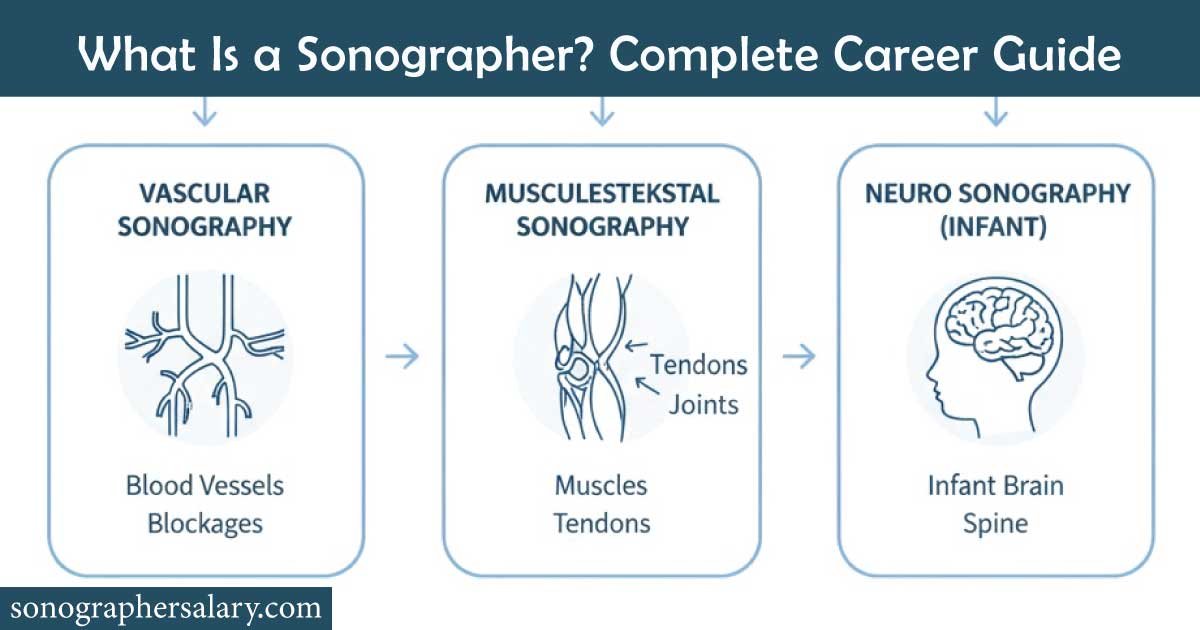
Vascular Sonography – Assessing blood vessels and blood flow to detect blockages or clots.
Musculoskeletal Sonography – Investigating muscles, tendons, and joints for injuries or abnormalities.
Understanding the differences between these specializations can help aspiring sonographers choose the path that aligns with their interests and career goals.
📌 Sonography vs Radiology: Key Differences Explained explores how these medical imaging fields differ in techniques, applications, and career paths. This post helps you understand roles, responsibilities, and opportunities in each area. Read the full guide to make an informed choice and advance your healthcare career wisely.
How Ultrasound Technology Works
At its core, ultrasound technology relies on high-frequency sound waves that travel through the body and bounce back when they hit tissues, fluids, or bones. These echoes are then converted into images displayed on a monitor. Unlike X-rays, ultrasound does not use ionizing radiation, which makes it safe for repeated use, especially during pregnancy.
The quality of the ultrasound images depends on the skill of the sonographer, the type of equipment used, and the patient’s body composition. A skilled sonographer must adjust the frequency, angle, and focus of the ultrasound waves to obtain accurate, high-resolution images.
Education and Training Requirements
Becoming a sonographer requires formal education and hands-on clinical training. Most sonographers complete either an associate degree (2 years) or a bachelor’s degree (4 years) in diagnostic medical sonography. Coursework typically includes anatomy, physiology, medical ethics, physics, and imaging techniques.
In addition to classroom instruction, clinical rotations are essential for gaining real-world experience. During rotations, students work under the supervision of experienced sonographers, learning how to interact with patients, operate equipment, and interpret images accurately.
Table: Typical Education Path for Sonographers
| Degree Type | Duration | Core Subjects | Clinical Hours Required |
|---|---|---|---|
| Associate Degree | 2 years | Anatomy, Physiology, Sonography Physics | 1,000 |
| Bachelor’s Degree | 4 years | Advanced Imaging, Patient Care, Ethics | 1,500 |
| Certificate | 1 year | Focused Training in Sonography Specialties | 500 |
Certification and Licensure
While not all states require licensure, obtaining professional certification is highly recommended and often preferred by employers. The American Registry for Diagnostic Medical Sonography (ARDMS) is the most recognized certifying body. To earn certification, candidates must pass exams that test knowledge in physics, anatomy, and specific sonography specialties.
Certification demonstrates a commitment to professional standards and can significantly increase job opportunities and earning potential.
Daily Responsibilities of a Sonographer
A typical day in the life of a sonographer involves more than just scanning patients. Daily responsibilities include reviewing patient histories, explaining procedures to patients, performing scans, analyzing images for abnormalities, and documenting findings for physician review.
For instance, a sonographer working in a hospital may scan multiple patients with varying conditions, requiring adaptability and attention to detail. Good communication skills are essential, as sonographers often help reassure anxious patients while explaining complex procedures in understandable terms.
Skills Required for Success
To succeed as a sonographer, one must develop a combination of technical, analytical, and interpersonal skills. Technical proficiency involves mastering ultrasound equipment and staying updated on evolving imaging technologies. Analytical skills are crucial for interpreting subtle differences in images that can indicate medical conditions.
Interpersonal skills matter equally because sonographers frequently work with patients experiencing stress or pain. Patience, empathy, and the ability to communicate clearly are essential for ensuring a positive patient experience.
Some common mistakes new sonographers make include improper probe positioning, failing to adjust machine settings, and misinterpreting normal anatomical variations as abnormalities. Avoiding these errors requires ongoing practice and professional development.
Equipment and Tools Used by Sonographers
Modern sonographers use a variety of tools to perform scans efficiently and accurately. The primary tool is the ultrasound machine, which consists of a transducer, a computer, and a monitor. The transducer emits sound waves and captures the returning echoes, while the computer processes these signals into images.
Specialized probes are available for different applications, such as transvaginal probes for obstetrics or linear probes for musculoskeletal imaging. Additionally, sonographers often use gel to ensure proper transmission of sound waves and maintain image quality.
Table: Common Ultrasound Equipment and Uses
| Equipment | Purpose |
|---|---|
| Linear Probe | Musculoskeletal, small parts imaging |
| Curvilinear Probe | Abdominal and obstetric scans |
| Transvaginal Probe | Female reproductive system imaging |
| Cardiac Probe | Heart and vascular imaging |
| Doppler Device | Blood flow measurement |
📌 Sonography vs Diagnostic Imaging explains the differences between these closely related medical fields, their techniques, and practical applications. This post helps clarify professional roles and career opportunities. Read the full guide to fully understand both areas and choose the right path for your healthcare journey.
Career Opportunities and Salary Expectations
Sonography offers a wide range of career opportunities in hospitals, clinics, imaging centers, and even mobile ultrasound services. According to recent industry data, the average salary for sonographers in the United States ranges between $65,000 and $90,000 per year, depending on specialization and experience.
Table: Average Sonographer Salaries by Specialty
| Specialty | Average Salary (USD) |
|---|---|
| Obstetric/Gynecologic Sonography | $70,000 |
| Cardiac Sonography | $80,000 |
| Abdominal Sonography | $68,000 |
| Vascular Sonography | $75,000 |
| Musculoskeletal Sonography | $72,000 |
Career growth is promising, with opportunities to advance into supervisory roles, become educators, or specialize further in advanced imaging techniques such as 3D and 4D ultrasound.
Common Challenges in Sonography
While rewarding, a sonography career comes with challenges. Physical strain from standing for long periods or maneuvering equipment can be significant. Additionally, interpreting complex cases requires constant learning and attention to detail. Emotional challenges may arise when working with patients in critical conditions.
Sonographers can mitigate these challenges by maintaining good ergonomics, participating in professional development, and practicing stress-management techniques. Peer support and mentorship can also play a crucial role in building resilience.
Advance Your Career in Sonography
Advancement in sonography often involves additional certifications or degrees. For example, a general sonographer might pursue cardiac certification to broaden opportunities. Others may move into leadership roles, such as chief sonographer or imaging department supervisor, managing teams and overseeing operational protocols.
Networking with other professionals, attending conferences, and staying current with emerging technologies are also critical for career growth. The field is dynamic, and continuous learning ensures long-term success.
Table: Career Advancement Opportunities for Sonographers
| Career Step | Description |
|---|---|
| Entry-Level Sonographer | Conducts standard imaging procedures |
| Specialized Sonographer | Focuses on a specific field like cardiac or vascular |
| Lead or Chief Sonographer | Supervises teams and manages department operations |
| Educator or Trainer | Teaches new sonographers or provides clinical instruction |
| Advanced Imaging Specialist | Works with 3D/4D or interventional imaging |
Future Outlook for Sonography
The future of sonography looks promising. The Bureau of Labor Statistics projects a growth rate of over 14% for diagnostic medical sonographers over the next decade, much faster than the average for all occupations. This growth is driven by an aging population, increased use of imaging for preventive care, and advancements in ultrasound technology.
Emerging trends include portable and point-of-care ultrasound, AI-assisted imaging interpretation, and expansion into telemedicine applications. Aspiring sonographers entering the field now have a wealth of opportunities to specialize, innovate, and make a lasting impact on patient care.
Practical Tips for Aspiring Sonographers
For those considering a career in sonography, there are practical strategies to maximize success. First, gaining early exposure through internships or volunteering in medical imaging departments can provide valuable insight. Second, focus on developing strong communication and empathy skills, as these are critical in patient interactions. Third, stay proactive about continuing education, including workshops, certifications, and new technology training.
A mini list of actionable steps includes: 1) Research accredited programs, 2) Prepare for ARDMS certification, 3) Build a professional portfolio, 4) Network with experienced sonographers, and 5) Stay updated with industry developments.
Conclusion: Why Sonography Is a Rewarding Career
Sonography is a dynamic and fulfilling healthcare profession that blends technical expertise with patient care. Sonographers play a crucial role in diagnosing, monitoring, and guiding medical treatment, making their work indispensable to modern medicine.
By understanding the education, skills, and opportunities involved, aspiring sonographers can make informed choices about their career path. Whether you are drawn to obstetrics, cardiology, or vascular imaging, a career in sonography offers job stability, professional growth, and the chance to make a meaningful difference in patients’ lives.
In a rapidly evolving healthcare landscape, skilled sonographers are in high demand, and the profession promises both personal and professional fulfillment for those willing to commit to excellence and continuous learning.
FAQs:
What does the sonographer do?
A sonographer operates ultrasound equipment to capture images of organs, tissues, and blood flow. They assess patient health, record images accurately, and assist doctors in diagnosis. Sonographers specialize in areas like obstetrics, cardiac, or vascular imaging, ensuring high-quality, non-invasive, and safe diagnostic imaging for patient care.
What qualifications do you need to be a sonographer?
To become a sonographer, you need an Associate’s or Bachelor’s degree in Diagnostic Medical Sonography. Certification from accredited organizations, like the ARDMS, is often required. Practical clinical experience and strong anatomy, physics, and patient-care knowledge are essential for accurate imaging and a successful career in medical diagnostics.
How many years does a sonographer take?
Becoming a sonographer typically takes 2 to 4 years. An Associate’s degree usually takes 2 years, while a Bachelor’s degree may take 4 years. Additional time may be needed for clinical training, internships, and certification exams to gain the skills and credentials required for professional practice.
What’s the difference between a sonographer and an ultrasound tech?
A sonographer and an ultrasound tech are often the same, but sonographer implies specialized training and professional certification. Sonographers usually focus on accurate imaging, interpretation, and patient care, whereas “ultrasound tech” can refer to anyone operating ultrasound equipment, sometimes without full professional credentials or specialization.
What is the average salary for a sonographer?
The average salary for a sonographer in the U.S. ranges between $70,000 and $90,000 per year, depending on specialization, experience, and location. Cardiac and vascular sonographers often earn higher. Benefits, overtime, and demand in hospitals or clinics can increase overall compensation, making it a financially rewarding healthcare career.
Is becoming a sonographer hard?
Becoming a sonographer can be challenging due to the need for detailed anatomical knowledge, technical skills, and clinical training. Students must master physics, imaging techniques, and patient care while gaining hands-on experience. Despite these challenges, dedication and practice make it achievable, leading to a rewarding and stable healthcare career.

Zak is a dedicated medical and career writer specializing in sonography, healthcare education, and professional development. Through SonographerSalary.com, he shares in-depth insights on sonographer salaries, education pathways, and career tips to help readers build successful futures in medical imaging. His content combines accuracy with practical, easy-to-understand guidance, empowering students and professionals to make confident, informed career decisions.