
The decision to change nursing to sonography is one of the occupational choices which seem exciting and frightening at the same time. On the one hand, you already possess medical knowledge, experience in working with patients, and the efficient stress coping. Then there is the other side, where when you enter an entirely new specialty in diagnostics, you ask yourself: Will I be good at this? How long will it take? Is it worth it?
The silver lining is not hard, as nurses are good, and thousands of RNs have successfully shifted to diagnostic medical sonography in the past 10 years. You have a good background already, now it is high time to acquire a new piece of knowledge, learn the concepts of imaging, and familiarize yourself with ultrasound equipment.
This guide simply divides the process into teaching-step-by-step just as you would hear it by a more experienced clinical instructor taking you through your next career step.
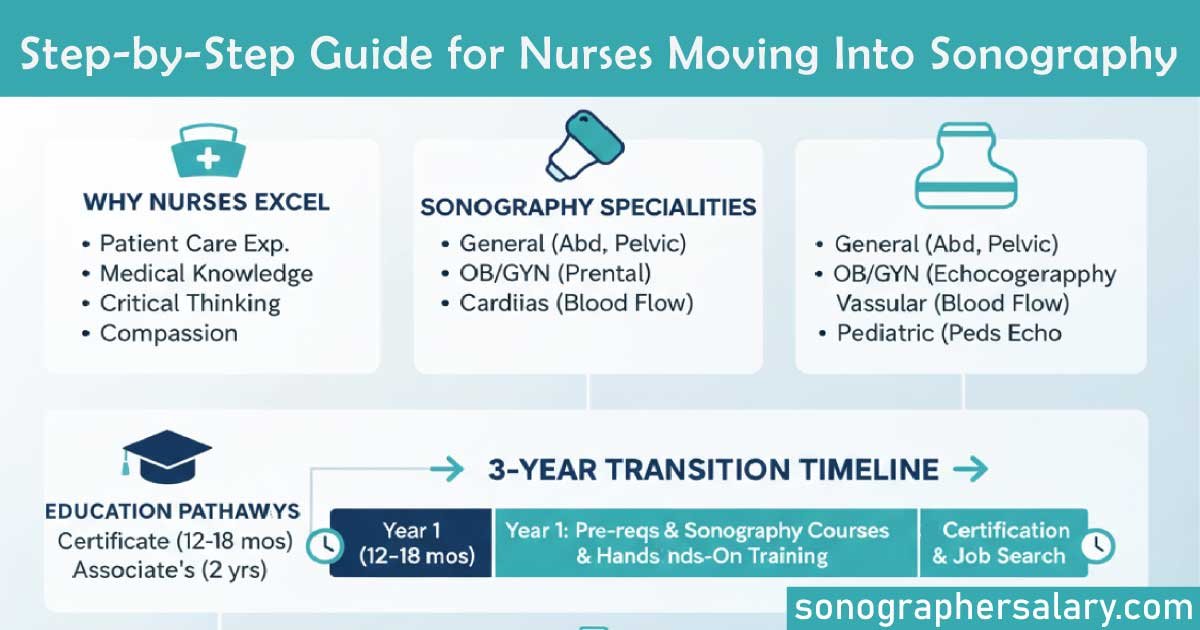
Why Nurses Are a Great Fit for Sonography
Before talking about the “how,” it helps to understand the “why.” Many nurses choose sonography because it offers:
Less physically demand shifts compared to floor nursing.
More predictable schedules, especially in outpatient imaging centers.
Higher earning potential in many states.
More autonomy when perform exams and communicate findings.
Lower burnout, because the work is focused and task-driven rather than deal with constant emergencies.
Vascular to OB to cardiac Sonographers are important in diagnosis, and nurses already possess the medical reasoning and patient rapport capabilities to succeed. Sonography can be a new breath of fresh air in case you are changing careers because of a need to have a stable life, more clinical work which is more specialized, or just a change of pace.
Step 1: Understand What Sonographers Actually Do
Some RNs think sonography is “just scanning” — but the role is far more detailed. As a sonographer, you will be responsible for:
Operate advanced ultrasound machines
Capture diagnostic-quality images
Understand anatomy in multiple planes
Identify abnormalities that require additional views
Communicate findings to radiologists
Guide patients through procedures
Position patients safely and effectively
You will not be administering medication and handling a representation of patients simultaneously as in nursing. Rather, you will give much attention to each case. It consists of a combination of technical proficiency, anatomy, and clinical judgment – and the nurses learn it more quickly than those with no healthcare experience in the first place.
Step 2: Choose the Right Sonography Specialty
Sonography is not a single field. You can choose from:
1. General/Abdominal Sonography
General or abdominal sonography refers to the imaging of large organs which include the liver, gallbladder, spleen, kidney, pancreatic and thyroid glands and other soft tissues. The specialty is general and presents a good background in the identification of most common pathologies. The diversity of the cases and the predictable and constant workflow are usually valued by nurses moving into this area.
2. OB/GYN Sonography
OB/GYN sonography dwells on fetal growth, pregnancy imaging, reproductive health, and gynaecological health issues. It is a valuable niche to someone who likes to work with pregnant mothers and support them through the key phases of family development. Labor and delivery nurses, female health nurses, or nurses in the NICU specialties frequently find themselves in this profession profoundly satisfying since it provides the sympathetic treatment of patients with technical expertise.
3. Cardiac Sonography (Echocardiography)
Cardiac sonography or echocardiography is the scan of the heart which measures its chambers, valves and the general functioning of the heart. This is a specialty in which good anatomy and specific technical skills are needed. Many nurses who have worked in ICU, telemetry, or cardiac care usually adjust well since they are used to the cardiac physiology, cardiac rhythms, and cardiac clinical significance of timely cardiac evaluations.
4. Vascular Sonography
Vascular sonography focuses on blood flow and vessel health, including carotid arteries, peripheral arteries, veins, and deep vein thrombosis studies. This is an area that puts much emphasis on Doppler imaging and needs comprehensive knowledge of circulation. Experienced nurses in terms of critical care, emergency surgery or after-surgical units are usually outstanding because of their knowledge on vascular conditions.
5. Pediatric Sonography
Pediatric sonography is a medical specialty that deals with imaging of infants, children and occasionally adolescents. It takes patience, soft communication and the capacity to deal with younger patients who can be nervous or unable to sit still. Pediatric, NICU, or family-centered care-based nurses often feel satisfied working in this area, as it is a combination of technical skills and a caring attitude.
For example:
Former ICU nurses often love cardiac or vascular.
Mother–baby or NICU nurses shift easily into OB/GYN or pediatric.
Med-surg nurses adapt well to general sonography.
Choose a specialty early helps you select the right program and clinical placements.
Step 3: Understand the Education You’ll Need
Even with an RN license, you will still need formal sonography education. You have three main pathways:
Option A: Accredited Sonography Certificate (Fastest Route)
Accredited certificate program is the fastest route to take by nurses as it is the only one that solely concentrates on the ultrasound classes and practical clinical training. There will be no need to retake general education courses and the workload will be more targeted and effective. The course takes 1218 months to complete and therefore is appropriate to those working RNs who desire a quicker transition into the new career.
Option B: Associate Degree (AAS in Sonography)
An associates degree in sonography lasts approximately two years and provides a more formal learning experience as compared to certificate program. It involves ultrasound course work, general education, and massive clinical rotations. This would be an excellent choice to those who desire a good education foundation, and more employment opportunities and the option to acquire more certifications in future.
Option C: Bachelor’s Degree (BS in Diagnostic Medical Sonography)
The highest course is a bachelor degree which normally takes four years, however it exposes graduates to leadership, teaching, research and advanced imaging opportunities. The training involves intensive training to the students by way of specialized course work and advanced clinical experience. This alternative is applicable to nurses that desire long-term career development, professional progress, or other possibilities that do not involve the regular sonographer jobs.
Which Option Should a Nurse Choose?
It is natural that most RNs tend to follow the certificate path due to their already existing degrees and fitting a lot of requirements. It reduces the learning period and makes them to join the sonography profession earlier. Best option however remains at the discretion of the career goals, time at hand, financial state, as well as, the interest of the advanced positions in the future.
Step 4: Check Program Prerequisites (You May Already Have Them)
Nurses usually have almost all prerequisites completed. Programs typically require:
Anatomy & Physiology
Medical terminology
College-level math
Physics (some programs require ultrasound physics, others accept general physics)
Communication skills
CPR certification
You probably already fulfill 70-90 percent of these, in case you have the RN license. Most schools go as far as to skip some classes due to the prior training you underwent.
Step 5: Shadow a Working Sonographer Before Enroll
Before you commit, spend a few hours observe in:
A hospital radiology department
A vascular lab
An OB imaging center
A cardiology clinic
Shadow helps you understand:
The pace of the work
How sonographers interact with patients
What skills you will need to learn
Whether you enjoy the hands-on scanning environment
Many nurses fall in love with the field immediately after shadow because it’s a focused, meaningful, low-chaos environment.
Step 6: Plan for the Transition (Especially Financially)
Going back to school means:
Pay tuition
Reduce work hours (at least during clinicals)
Rearrange home or childcare responsibilities
Here’s a realistic timeline many RNs follow:
Year 1
During the first year, you are working on the accomplishment of any outstanding prerequisites, including anatomy, physics, or medical terminology. A good number of nurses remain in the part or full time job and study together as they establish a bridge between the two into sonography.
Year 2
The second year is generally classroom based, where core sonography courses and laboratory practice are both included. A significant number of nurses have one to three nursing shifts every week with flexible schedules to earn money and slowly absorb themselves in the theory of ultrasound and practical training.
Year 3
In the third year, there is the focus on clinical rotations. Students get three to four days in a week under supervision to carry out real exams. Majority of nurses cut their work hours in hospital or change to PRN designation, which enables to focus practice and learn sonography skills.
Hospitals usually allow you to work on a flexible or a weekend shift since you are already a nurse and study at the time.
Step 7: Prepare for Hands-On Skills (The Biggest Adjustment)
Nursing teaches patient care; sonography teaches technical imaging. Your biggest learning curve will be:
1. Hand–eye Coordination
The first skill you will achieve in sonography is hand-eye coordination. You get to know how to angle, rotate and slide the probe, holding your eyes on the screen, seeing the slightest movement as sharp images. It is hard initially but it becomes intuitive after taking practice.
2. Anatomical Mapping
Anatomical mapping is the familiarity of the location of organs and vessels in transverse and longitudinal planes. You begin to know the patterns, landmarks, and tissue layers so that you can maneuver the body with ease. This ability will make you sail through every examination with a purpose and not by guessing.
3. Image Optimization
Image optimization refers to the process of correcting depth, gain, TGC, Doppler angles and focus in order to produce images of diagnostic quality. Minor adjustments can go a long way as to clarification. With time, you can be able to set up settings pretty fast as you get accustomed to the body of each patient and the body parts you need to scan.
4. Completing Protocols
Each ultrasound study has a procedure you have to follow in which you are required to take an exact image that physicians will require. Being informed of these checklists, facilitates some form of consistency and accuracy. By learning the order, exams become more systematic and you get the confidence to give out full and solid studies. It is only natural to be clumsy in the beginning. Most nurses tell that it is like learning a musical instrument in the first few months uncomfortable, but exciting. It becomes a second nature after some time.
Step 8: Get Comfortable With Ultrasound Physics
All students of sonography should pass the SPI exam (Sonography Principles and Instrumentation). This, according to nurses, is the most difficult aspect, since physics can be abstract. But when you tie it to actual scanning Doppler angles, frequency, beam strength then it makes sense.
Useful tips:
Start study physics early.
Use visual learning tools.
Ask your instructors to explain real-world scenarios.
Once you understand physics, the rest of the program feels much easier.
Step 9: Clinical Training — Where Everything Comes Together
Your clinical rotations are where you truly develop as a sonographer.
Here’s what you will experience:
Scan real patients
Learn to identify pathology
Work directly with radiologists or cardiologists
Perform complete studies independently
Manage your workflow
Receive real-time feedback from clinical instructors
Nurses tend to perform very well in clinicals since they are already familiar with patients, charting and pressure working.
Step 10: Certification — Your Final Step Before Working
On completion of your program, you will pass one or more ARDMS, CCI or ARRT certification exams based on your specialty.
Common pathways:
General Sonography → Abdomen (AB) + OB/GYN (OB)
Vascular → RVT
Cardiac → RDCS or RCS
Nurses tend to be disciplined test-takers, so with consistent studying, most pass on the first attempt.
Step 11: Start Applying for Sonographer Jobs
Once you are certified, you can apply in:
Hospitals
Outpatient imaging centers
Cardiovascular clinics
OB practices
Pediatric hospitals
Mobile ultrasound services
Clinics especially love hiring RNs turned sonographers because:
You communicate well
You handle difficult patients professionally
You understand medical urgency
You bring a mature clinical presence
You already know hospital systems
Step 12: Expect Good Earnings and Career Stability
Most nurses switching to sonography notice:
Higher hourly pay
Better work-life balance
Less emotionally draining work
More technical skill satisfaction
Sonographers in most states earn between $75,000–$110,000+ per year and above depending on the specialty and experience. Cardiac and vascular sonographers tend to receive maximum remuneration. During the era of the growth of healthcare, the volume of ultrasound professionals is also increasing.
Final Thoughts: Your Nursing Background Is Your Superpower
When one leaves nursing and gets into sonography, it is not a fresh start, it is a promotion. Your patient-care underpinning, clinical rationale, and professionalism provide you with a massive advantage.
All you need now is:
The right program
Solid training
Consistent scanning practice
Confidence to step into a new role
When you are tired of nursing or just plain ready to take a new challenge, sonography may become a rewarding and stable profession that, nevertheless, keeps you tightly connected with patient care – but with a new specialized focus. You have already excelled in one field of healthcare. It is also a master able art with patience.
👉 Curious about how long it takes to become a sonographer? This guide explains sonography education, clinical training, and certification timelines step by step. Whether you’re a nurse or new to healthcare, learn realistic career timelines, training tips, and what it takes to start a successful sonography career. Read the full post now!

Zak is a dedicated medical and career writer specializing in sonography, healthcare education, and professional development. Through SonographerSalary.com, he shares in-depth insights on sonographer salaries, education pathways, and career tips to help readers build successful futures in medical imaging. His content combines accuracy with practical, easy-to-understand guidance, empowering students and professionals to make confident, informed career decisions.