
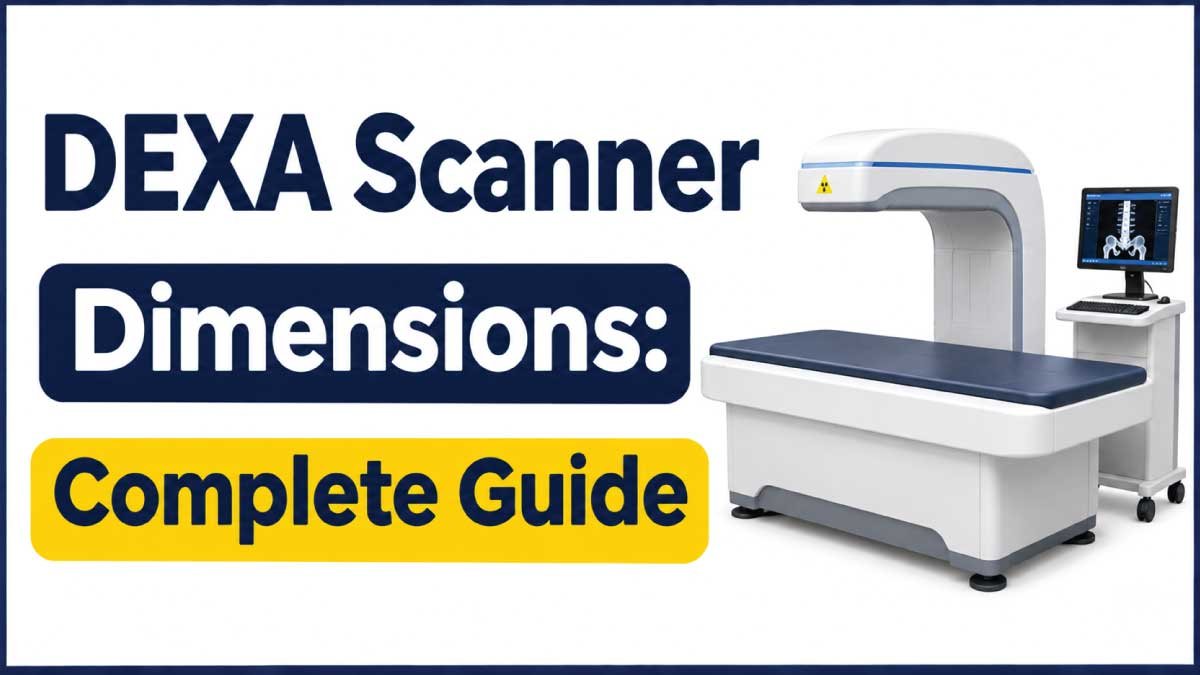
DEXA scanner dimensions are important when selecting bone density imaging equipment, planning a medical imaging room, replacing an existing scanner, or comparing different diagnostic systems. A DEXA scanner, also called a DXA scanner, uses low-dose X-ray technology to measure bone mineral density and help assess conditions such as osteoporosis.
An accurate DEXA Scanner Dimensions Chart helps radiology professionals, hospital administrators, biomedical engineers, equipment purchasers, and healthcare facility planners understand the physical size and installation requirements of different scanning systems.
Unlike conventional radiography tables, DEXA scanners have specialized patient platforms, scanning arms, detector assemblies, and supporting structures. Their overall dimensions vary according to the manufacturer, scanner generation, scanning technology, and clinical applications.
Many central DEXA scanners require a dedicated examination area with sufficient space for the patient table, scanning gantry, operator access, and maintenance clearance. Compact peripheral bone densitometers have considerably smaller footprints.
This guide explains DEXA scanner dimensions, common equipment configurations, manufacturer-specific examples, room requirements, measurement methods, and important factors to consider before purchasing a scanner.
What Are DEXA Scanner Dimensions?
DEXA scanner dimensions describe the physical measurements of a dual-energy X-ray absorptiometry system. These measurements determine how much floor space the equipment occupies and how much room is available for patient positioning and scanning operations.
A conventional central DEXA system generally consists of a patient table, scanning arm or gantry, X-ray source, detector assembly, and supporting electronics.
The dimensions of these components vary between manufacturers and equipment models.
Main Dimensions of a DEXA Scanner
The most important measurements include:
- Overall length: The total distance from one end of the scanner to the other.
- Overall width: The maximum horizontal width of the complete equipment.
- Overall height: The vertical measurement from the floor to the highest part of the scanner.
- Tabletop length: The length of the surface supporting the patient.
- Tabletop width: The width of the patient-supporting platform.
- Table height: The distance between the floor and the upper tabletop surface.
- Scanning arm dimensions: The physical size and movement envelope of the scanning assembly.
- Scanning area: The usable region where the scanner can perform measurements.
These specifications should be considered separately because the patient table and complete scanner assembly do not necessarily have identical dimensions.
Why DEXA Scanner Dimensions Matter
Correct dimensions are important for several reasons:
- Help determine whether the scanner fits within the available imaging room.
- Provide sufficient space for patient positioning.
- Support safe patient transfers.
- Ensure appropriate operator access.
- Help determine equipment installation requirements.
- Allow comparison between different manufacturers.
- Support maintenance and servicing arrangements.
- Help facilities plan electrical and environmental requirements.
A scanner that fits physically may still require additional clearance for its scanning arm, patient access, and maintenance.
DEXA Scanner Dimensions Chart
DEXA scanners are available in different configurations, including central bone densitometers and peripheral bone density measurement devices.
The following chart provides general dimensional reference categories for understanding these systems. These are planning-oriented reference ranges, not universal manufacturer specifications.
| Dimension | Central DEXA Scanner | Peripheral Bone Densitometer |
|---|---|---|
| Overall length | Approximately 200–250 cm | Model dependent |
| Overall width | Approximately 90–130 cm | Model dependent |
| Overall height | Approximately 100–150 cm | Model dependent |
| Patient platform length | Approximately 190–230 cm | Usually no full-length patient table |
| Patient platform width | Approximately 60–90 cm | Model dependent |
| Equipment configuration | Full-body scanning system | Compact measurement system |
| Installation space | Dedicated examination area | Smaller dedicated area |
Important: These ranges are approximate planning references and should not be used as purchasing specifications. Exact dimensions must be obtained from the technical documentation for the selected scanner.
DEXA Scanner Measurement Reference Chart
The following table provides common metric-to-imperial conversions useful when reviewing equipment catalogs.
| Measurement (cm) | Measurement (mm) | Measurement (Inches) | Measurement (Feet) |
|---|---|---|---|
| 60 cm | 600 mm | 23.62 in | 1.97 ft |
| 70 cm | 700 mm | 27.56 in | 2.30 ft |
| 80 cm | 800 mm | 31.50 in | 2.62 ft |
| 90 cm | 900 mm | 35.43 in | 2.95 ft |
| 100 cm | 1,000 mm | 39.37 in | 3.28 ft |
| 120 cm | 1,200 mm | 47.24 in | 3.94 ft |
| 150 cm | 1,500 mm | 59.06 in | 4.92 ft |
| 180 cm | 1,800 mm | 70.87 in | 5.91 ft |
| 200 cm | 2,000 mm | 78.74 in | 6.56 ft |
| 220 cm | 2,200 mm | 86.61 in | 7.22 ft |
| 240 cm | 2,400 mm | 94.49 in | 7.87 ft |
| 250 cm | 2,500 mm | 98.43 in | 8.20 ft |
DEXA Scanner Dimensions by Type
Different bone densitometry systems are designed for specific clinical applications. Their physical dimensions and installation requirements vary considerably.
1. Central DEXA Scanner
Central DEXA scanners are commonly used to measure bone mineral density at the lumbar spine and hip. Some systems also provide whole-body composition measurements.
These scanners generally include a full-length patient table and a scanning assembly that moves over or around the patient.
Main characteristics:
- Full-length patient-supporting platform.
- Integrated X-ray source and detector.
- Motorized scanning assembly.
- Computer-based image processing.
- Dedicated patient examination area.
- Manufacturer-specific table movement and positioning features.
Central DEXA scanners require more installation space than most peripheral densitometers.
2. Peripheral DEXA Scanner
Peripheral DEXA systems measure bone density at selected body locations, such as the forearm or heel, depending on the equipment design.
They are generally more compact than central scanning systems.
Common characteristics include:
- Smaller equipment footprint.
- Compact patient positioning arrangements.
- Dedicated peripheral measurement components.
- Reduced space requirements compared with full-body scanners.
- Application-specific scanning configurations.
Peripheral devices should not be assumed to provide the same examination capabilities as central DEXA systems.
3. Fan-Beam DEXA Scanner
Fan-beam systems use a fan-shaped X-ray beam and a detector arrangement designed to capture scanning information.
Their scanning mechanisms and gantry configurations influence the overall equipment dimensions.
Important specifications include:
- Patient platform size.
- Scanning arm movement.
- Detector configuration.
- Maximum patient weight.
- Scanning field dimensions.
- Required equipment clearance.
The exact physical dimensions depend on the scanner generation and manufacturer.
4. Pencil-Beam DEXA Scanner
Pencil-beam systems use a narrow X-ray beam to scan the selected anatomical region.
Their scanning technology and mechanical design differ from fan-beam equipment.
When comparing pencil-beam and fan-beam systems, consider the complete scanner footprint rather than comparing the patient table alone.
5. Compact Bone Densitometer
Compact bone densitometers are designed for selected bone density examinations and may be used in smaller clinical environments.
Their dimensions are generally smaller because they do not require the same full-length scanning arrangements as central DEXA systems.
However, compact systems may have different clinical capabilities and measurement locations.
DEXA Scanner Dimensions by Manufacturer
Different manufacturers offer bone densitometry systems with different equipment configurations.
Examples include:
- Hologic: Horizon series and other bone densitometry systems.
- GE HealthCare: Lunar bone densitometry systems.
- OsteoSys: DEXXUM and other bone densitometer products.
- Medilink: Bone densitometry equipment.
- BeamMed: Bone measurement systems.
The physical dimensions of these products vary by model and configuration.
When comparing equipment, obtain the manufacturer’s official dimensional drawing rather than relying on a general scanner category.
Manufacturer Specification Comparison
| Manufacturer | Equipment Family | Important Dimensions to Check |
|---|---|---|
| Hologic | Horizon series | Overall footprint, table size, height |
| GE HealthCare | Lunar series | Scanner length, width, height, table dimensions |
| OsteoSys | DEXXUM series | Equipment footprint and patient positioning area |
| Medilink | Bone densitometers | Overall dimensions and scanning configuration |
| BeamMed | Bone measurement systems | Device footprint and measurement assembly |
Note: This comparison identifies equipment families rather than claiming identical dimensions across all models. Exact numerical specifications should be taken from the relevant product manual.
DEXA Scanner Table Dimensions
The patient table is one of the most important components of a central DEXA scanner.
It supports the patient during examinations and provides a stable platform for the scanning process.
Patient Table Length
Table length determines the available space for patient positioning.
A central DEXA scanner generally needs a platform long enough to accommodate the examination positions required by its manufacturer-approved scanning procedures.
When reviewing table length, check:
- Usable patient-supporting length.
- Overall tabletop length.
- Head and foot positioning arrangements.
- Integrated positioning accessories.
- Available scanning coverage.
Do not assume that the physical tabletop length equals the scanner’s maximum imaging field.
Patient Table Width
Table width influences patient positioning and accessibility.
Important considerations include:
- Available patient-supporting surface.
- Maximum patient weight.
- Patient positioning requirements.
- Detector movement.
- Scanning arm clearance.
A wider table does not automatically mean that the scanner supports a wider imaging field.
Patient Table Height
Table height affects patient transfers and examination workflow.
Some scanners use a fixed-height platform, while other equipment offers different positioning arrangements.
Before installation, verify the actual table height and the accessibility requirements for the intended patient population.
Also Read:
DEXA Scanner Room Size Requirements
Planning the examination room is an important part of purchasing a DEXA scanner.
The required room size depends on the scanner footprint, patient access, operator workspace, equipment movement, and applicable radiation safety requirements.
There is no universal room dimension suitable for every DEXA system.
Important Room Planning Factors
Consider the following factors before installing a scanner:
- Scanner footprint: Measure the complete equipment dimensions.
- Patient access: Provide suitable space for patients to approach and transfer onto the table.
- Operator workspace: Allow sufficient space for positioning and equipment operation.
- Scanning arm clearance: Check the full movement envelope of the scanning assembly.
- Maintenance access: Follow the manufacturer’s recommended service clearances.
- Door dimensions: Confirm that the equipment can enter the room during installation.
- Electrical requirements: Verify power supply and grounding specifications.
- Radiation protection: Follow applicable local regulations and the manufacturer’s installation requirements.
Room Planning Checklist
| Planning Factor | What to Verify |
|---|---|
| Room length | Scanner length and required clearance |
| Room width | Scanner width and operator access |
| Ceiling height | Maximum equipment height |
| Door opening | Equipment delivery dimensions |
| Floor condition | Manufacturer’s installation requirements |
| Electrical supply | Approved voltage and power requirements |
| Radiation shielding | Applicable regulatory requirements |
| Service access | Manufacturer’s maintenance clearance |
A room should not be approved based only on the scanner’s tabletop dimensions. The complete installation drawing is essential.
Also Read:
How to Measure DEXA Scanner Dimensions
Accurate measurement helps determine whether a scanner will fit within an existing medical imaging room.
Follow these steps when documenting equipment dimensions.
Step 1: Measure Overall Length
Measure the complete scanner from its furthest front point to its furthest rear point.
Include fixed structural components where required by the manufacturer’s dimensional definition.
Step 2: Measure Overall Width
Measure the widest part of the complete equipment.
Check whether the scanning arm, supporting base, or other fixed components extend beyond the tabletop.
Step 3: Measure Overall Height
Measure vertically from the floor to the highest fixed point of the scanner.
If the scanning assembly moves vertically, record the maximum operating height separately.
Step 4: Measure the Patient Table
Record the tabletop length and width separately from the overall equipment dimensions.
Also document the tabletop height and any available positioning adjustments.
Step 5: Check the Scanning Movement
Identify the full movement range of the scanning assembly.
Make sure the room provides enough clearance for the scanner to complete its required examination movements.
Step 6: Record Equipment Specifications
Prepare a measurement record containing:
- Manufacturer.
- Scanner model.
- Overall length.
- Overall width.
- Overall height.
- Tabletop length.
- Tabletop width.
- Patient table height.
- Maximum patient weight.
- Installation clearance.
This information makes equipment comparison and room planning easier.
Factors to Consider When Choosing DEXA Scanner Dimensions
Selecting a suitable DEXA scanner involves more than checking its physical footprint.
The following factors can help healthcare facilities choose appropriate equipment.
1. Clinical Application
Identify the examinations the scanner must perform.
Central DEXA systems are commonly used for hip and spine bone density measurements, while peripheral systems serve more specialized measurement applications.
Select equipment according to the required clinical capabilities.
2. Available Floor Space
Measure the room before selecting a scanner.
Consider the complete equipment footprint, patient access, scanning arm movement, and maintenance clearance.
3. Patient Weight Capacity
Check the maximum patient weight specified by the manufacturer.
The weight limit is a separate specification from tabletop dimensions and must be suitable for the intended clinical population.
4. Scanning Technology
Fan-beam and pencil-beam systems have different technical and mechanical designs.
Consider the scanner’s examination capabilities, positioning requirements, and physical configuration.
5. Patient Accessibility
Evaluate how easily patients can approach and transfer onto the examination table.
This is particularly important in facilities serving patients with limited mobility.
6. Installation Requirements
Review the official pre-installation documentation.
Important requirements include:
- Electrical supply.
- Floor loading.
- Room temperature.
- Humidity.
- Radiation protection.
- Equipment clearance.
- Delivery and installation access.
7. Future Maintenance
Consider whether technicians can access the scanner for routine servicing and repairs.
A scanner should not be installed so close to walls or other equipment that essential maintenance becomes difficult.
Common DEXA Scanner Dimension Mistakes
Incorrect measurements can create installation problems and increase equipment purchasing costs.
Avoid the following mistakes:
- Measuring only the patient table: The complete scanner may require considerably more space.
- Ignoring scanning arm movement: The equipment needs clearance throughout its operating range.
- Confusing overall height with table height: These are separate specifications.
- Ignoring patient weight capacity: Physical dimensions do not establish loading limits.
- Assuming all scanners have identical dimensions: Equipment configurations differ between manufacturers.
- Overlooking delivery access: Doorways and corridors must accommodate the equipment during installation.
- Ignoring radiation protection: Room planning must follow applicable safety regulations.
- Using outdated specifications: Different generations of the same scanner family may have different dimensions.
Frequently Asked Questions About DEXA Scanner Dimensions
1. What are the standard dimensions of a DEXA scanner?
There is no universal standard dimension for all DEXA scanners. Central systems are generally larger than peripheral bone densitometers. Exact length, width, and height depend on the manufacturer and model.
2. How much space does a DEXA scanner require?
The required space depends on the scanner’s complete footprint, patient access, operator workspace, scanning arm movement, and service clearance. Always follow the manufacturer’s installation drawing.
3. What is the difference between DEXA and DXA?
DEXA and DXA refer to the same dual-energy X-ray absorptiometry technology. Both terms describe a method used to measure bone mineral density and assess bone health.
4. What is the length of a DEXA scanner table?
Table length varies by scanner model. Central DEXA systems generally use full-length patient platforms, while peripheral systems may not include a conventional examination table.
5. How wide is a DEXA scanner table?
Table width depends on the manufacturer’s design and model. Check the official product specification sheet for the exact tabletop width rather than relying on a universal measurement.
6. Are peripheral DEXA scanners smaller than central scanners?
Generally, yes. Peripheral systems are designed for selected measurement locations and usually have a smaller equipment footprint than full-body central DEXA systems.
7. What is the maximum patient weight for a DEXA scanner?
The maximum patient weight varies by manufacturer and model. Check the equipment manual because weight capacity is an important safety and operational specification.
8. Does a DEXA scanner require a special room?
A dedicated examination area is generally required. The room must meet equipment installation, electrical, radiation protection, patient access, and maintenance requirements.
9. What is the difference between DEXA scanner dimensions and scanning area?
Scanner dimensions describe the physical size of the equipment. Scanning area refers to the region that the scanner can image. A large scanner does not necessarily have an equally large imaging field.
10. Which measurements should I check before purchasing a DEXA scanner?
Check overall length, width, height, patient table dimensions, maximum patient weight, scanning movement, room clearance, electrical requirements, and manufacturer installation specifications.
Conclusion
DEXA scanner dimensions are essential when selecting bone densitometry equipment, planning medical imaging facilities, and comparing different scanner models.
Central DEXA systems generally require more space than peripheral bone densitometers because they include a full-length patient table and specialized scanning assembly. However, the exact dimensions vary according to manufacturer, technology, and equipment configuration.
Before purchasing or installing a scanner, verify its overall footprint, patient table measurements, height, scanning movement, weight capacity, and room clearance requirements.
Using the manufacturer’s official technical specifications is the most reliable way to ensure that a DEXA scanner fits the available space and meets the intended clinical requirements.

Zak is a dedicated medical and career writer specializing in sonography, healthcare education, and professional development. Through SonographerSalary.com, he shares in-depth insights on sonographer salaries, education pathways, and career tips to help readers build successful futures in medical imaging. His content combines accuracy with practical, easy-to-understand guidance, empowering students and professionals to make confident, informed career decisions.