
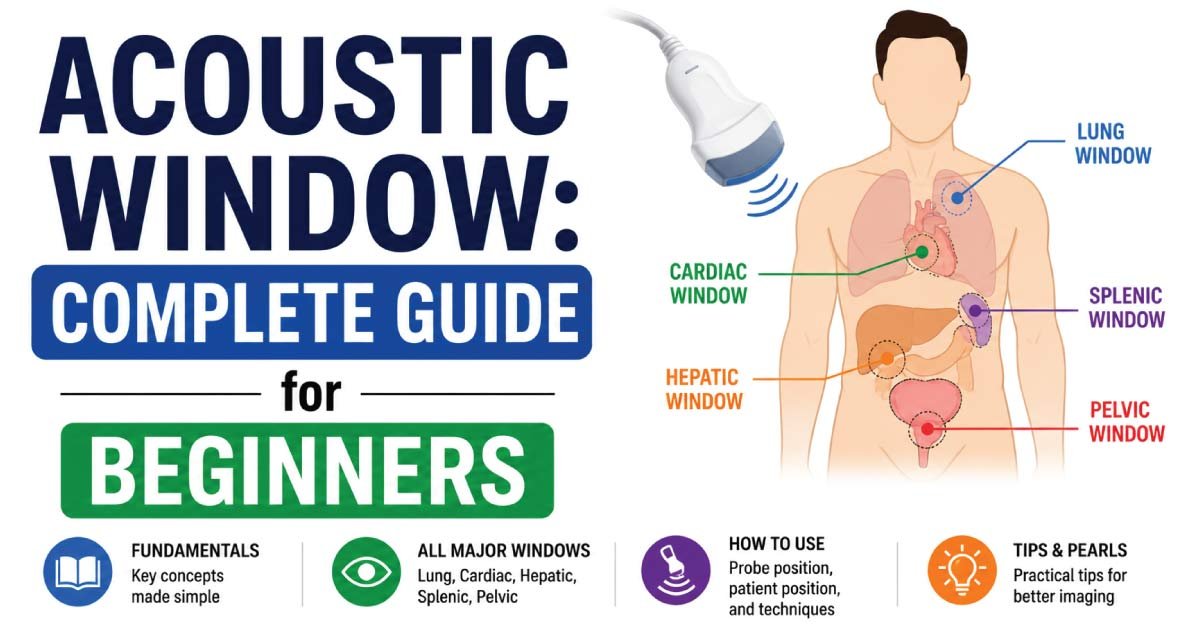
Ultrasound imaging depends on the ability of sound waves to travel through the body and return as echoes that create diagnostic images. However, not all body tissues transmit ultrasound waves equally. Some tissues allow sound waves to pass easily, while others block or scatter them. This is where the concept of an Acoustic Window becomes extremely important.
An acoustic window is a body structure or area that allows ultrasound waves to pass through with minimal interference, providing a clear pathway to deeper organs and tissues. Sonographers frequently use acoustic windows to obtain better image quality and improve diagnostic accuracy.
Understanding acoustic windows is essential for ultrasound students, sonographers, radiologists, and healthcare professionals because proper use of acoustic windows can significantly enhance the visualization of internal anatomy.
What Is an Acoustic Window?
An acoustic window is a tissue, organ, or fluid-filled structure that permits ultrasound waves to travel effectively to deeper anatomical structures.
In simple terms, it acts as a “window” through which the ultrasound beam can pass with minimal attenuation, reflection, or scattering.
Acoustic windows help sonographers visualize structures that might otherwise be obscured by:
- Bone
- Air or gas
- Dense tissue
- Excessive attenuation
Without suitable acoustic windows, obtaining diagnostic-quality images can become difficult or even impossible.
Definition of Acoustic Window in Ultrasound
In ultrasound imaging, an acoustic window refers to:
A pathway or structure that facilitates the transmission of ultrasound waves to the target anatomy while minimizing interference from surrounding tissues.
The ideal acoustic window:
- Transmits sound efficiently
- Produces minimal artifacts
- Allows deeper penetration
- Improves image quality
- Enhances diagnostic accuracy
Fluid-filled structures often serve as excellent acoustic windows because fluid transmits ultrasound exceptionally well.
Why Acoustic Windows Are Important
Acoustic windows play a critical role in ultrasound examinations.
They help:
Improve Image Quality
A good acoustic window allows more sound energy to reach the target structure.
Increase Diagnostic Accuracy
Clearer images help physicians identify abnormalities more confidently.
Reduce Artifacts
Proper windows minimize image distortion caused by bone and air.
Enhance Organ Visualization
Deep organs become easier to evaluate.
Improve Examination Efficiency
Better windows reduce scanning time and repeated image acquisition.
Because ultrasound is highly dependent on sound transmission, selecting the proper acoustic window is one of the most important skills in sonography.
How Acoustic Windows Work
Ultrasound imaging relies on sound wave transmission.
When ultrasound waves encounter different tissues:
- Some sound is transmitted.
- Some sound is reflected.
- Some sound is absorbed.
- Some sound is scattered.
An acoustic window provides a route where transmission is maximized and interference is minimized.
For example, a fluid-filled urinary bladder allows ultrasound waves to travel efficiently into the pelvis, helping visualize reproductive organs and surrounding structures.
The bladder essentially functions as a natural acoustic window.
Physics Behind Acoustic Windows
The effectiveness of an acoustic window is related to several ultrasound principles.
Acoustic Impedance
Different tissues have different acoustic impedances.
Large differences in impedance cause strong reflection.
Small differences allow better transmission.
Attenuation
As sound travels through tissue, energy decreases.
Structures with low attenuation make better acoustic windows.
Reflection
Excessive reflection prevents sound from reaching deeper tissues.
Fluid-filled structures produce minimal reflection.
Scattering
Scattering disperses sound energy and reduces image quality.
Acoustic windows minimize scattering effects.
These principles explain why certain tissues are excellent windows while others are poor imaging pathways.
Characteristics of a Good Acoustic Window
An effective acoustic window typically has several characteristics.
High Sound Transmission
Most ultrasound energy passes through the structure.
Low Attenuation
Minimal energy loss occurs.
Minimal Reflection
Sound waves continue toward deeper anatomy.
Low Scattering
The ultrasound beam remains focused.
Adequate Size
The window is large enough to visualize the target structure.
These features improve image quality and diagnostic confidence.
Common Acoustic Windows in Ultrasound
Several structures commonly serve as acoustic windows during ultrasound examinations.
Urinary Bladder
The urinary bladder is one of the most frequently used acoustic windows.
Because it contains fluid, it transmits ultrasound extremely well.
Applications include:
- Pelvic ultrasound
- Gynecological imaging
- Prostate evaluation
- Obstetric examinations
Patients are often instructed to maintain a full bladder before pelvic scans to improve visualization.
Liver
The liver serves as an excellent acoustic window for imaging adjacent structures.
It helps visualize:
- Gallbladder
- Pancreas
- Right kidney
- Inferior vena cava
The liver’s homogeneous tissue characteristics allow effective sound transmission.
Spleen
The spleen can function as a window for evaluating:
- Left kidney
- Adjacent abdominal structures
This is particularly useful during abdominal examinations.
Amniotic Fluid
During pregnancy, amniotic fluid acts as a natural acoustic window.
It facilitates visualization of:
- Fetal anatomy
- Placenta
- Umbilical cord
The fluid surrounding the fetus allows excellent ultrasound transmission.
Blood Vessels
Large blood vessels containing fluid can occasionally serve as acoustic windows for nearby structures.
Acoustic Windows in Abdominal Ultrasound
Abdominal ultrasound heavily relies on acoustic windows.
Liver Window
The liver frequently provides access to:
- Gallbladder
- Portal vein
- Pancreas
- Right kidney
Splenic Window
The spleen helps visualize:
- Left kidney
- Adjacent retroperitoneal structures
Fluid Collections
Ascites may improve visualization by creating additional acoustic windows.
Proper patient positioning often enhances these windows.
Acoustic Windows in Pelvic Ultrasound
Pelvic imaging commonly uses the urinary bladder as the primary acoustic window.
Female Pelvis
The bladder improves visualization of:
- Uterus
- Ovaries
- Endometrium
- Fallopian tube regions
Male Pelvis
The bladder assists in evaluating:
- Prostate gland
- Seminal vesicles
- Pelvic structures
A full bladder is often essential for optimal imaging.
Acoustic Windows in Obstetric Ultrasound
Pregnancy ultrasound benefits greatly from natural fluid windows.
Amniotic Fluid Window
Amniotic fluid surrounds the fetus and permits excellent sound transmission.
It improves visualization of:
- Fetal organs
- Limbs
- Spine
- Heart
- Brain
Maternal Bladder Window
Early pregnancy scans may also utilize the maternal bladder as an acoustic window.
This is especially important during first-trimester examinations.
Acoustic Windows in Echocardiography
Cardiac ultrasound depends on specialized acoustic windows.
Common echocardiographic windows include:
Parasternal Window
Located near the sternum.
Apical Window
Located near the heart’s apex.
Subcostal Window
Obtained beneath the rib cage.
Suprasternal Window
Obtained above the sternum.
These windows help sonographers avoid interference from the lungs and ribs.
Structures That Limit Acoustic Windows
Certain structures interfere with ultrasound transmission.
Bone
Bone strongly reflects ultrasound waves.
Examples include:
- Skull
- Ribs
- Spine
Bone often creates acoustic shadowing.
Gas and Air
Air is one of the greatest obstacles in ultrasound imaging.
Common sources include:
- Intestinal gas
- Stomach gas
- Lung air
Air causes significant reflection and scattering.
Dense Calcifications
Calcified structures may block sound transmission.
Examples:
- Kidney stones
- Gallstones
- Calcified plaques
These structures often produce acoustic shadows.
Techniques for Improving Acoustic Windows
Sonographers use several methods to improve acoustic windows.
Patient Positioning
Changing patient position may reduce interference.
Examples include:
- Left lateral decubitus
- Right lateral decubitus
- Upright positioning
Breath Holding
Deep inspiration may move organs into better viewing positions.
Bladder Filling
A full bladder creates an excellent pelvic acoustic window.
Probe Manipulation
Adjustments include:
- Angling
- Tilting
- Rotating
- Sliding
These maneuvers help identify the best imaging pathway.
Alternative Scanning Approaches
Different probe positions may provide superior acoustic access.
Advantages of Using Acoustic Windows
Acoustic windows provide numerous benefits.
Improved Image Quality
More sound reaches the target anatomy.
Better Visualization
Deep structures become easier to assess.
Reduced Artifacts
Image distortion decreases.
Higher Diagnostic Confidence
Physicians can interpret images more accurately.
More Efficient Examinations
Scanning becomes faster and more effective.
Limitations of Acoustic Windows
Despite their importance, acoustic windows have limitations.
Patient Anatomy Variations
Not all patients provide ideal windows.
Obesity
Increased tissue depth may reduce image quality.
Excessive Bowel Gas
Gas can obstruct visualization.
Surgical Changes
Scarring or altered anatomy may affect acoustic access.
These factors can complicate ultrasound examinations.
Future Developments Related to Acoustic Windows
Advances in ultrasound technology continue to improve imaging despite acoustic limitations.
Emerging innovations include:
- Artificial intelligence-assisted scanning
- Advanced beamforming
- Improved transducer technology
- Harmonic imaging
- Adaptive image processing
These developments may help overcome challenges associated with poor acoustic windows.
Conclusion
An Acoustic Window is a crucial concept in ultrasound imaging that refers to a pathway or structure allowing ultrasound waves to travel efficiently to deeper anatomical targets. Fluid-filled structures such as the urinary bladder, liver, spleen, and amniotic fluid often serve as excellent acoustic windows because they transmit sound waves with minimal interference.
By understanding how acoustic windows work and learning how to optimize them, sonographers can significantly improve image quality, reduce artifacts, and increase diagnostic accuracy. Whether performing abdominal, pelvic, obstetric, vascular, or cardiac ultrasound examinations, proper use of acoustic windows remains one of the most important skills in diagnostic sonography.
👉 Discover Acoustic Shadowing in Ultrasound and learn how this common ultrasound artifact helps identify structures such as stones, bones, and calcifications. This beginner-friendly guide explains the causes, appearance, clinical importance, and interpretation of acoustic shadowing in medical imaging. Read the full post to strengthen your understanding of ultrasound diagnostics and image analysis.

Zak is a dedicated medical and career writer specializing in sonography, healthcare education, and professional development. Through SonographerSalary.com, he shares in-depth insights on sonographer salaries, education pathways, and career tips to help readers build successful futures in medical imaging. His content combines accuracy with practical, easy-to-understand guidance, empowering students and professionals to make confident, informed career decisions.