
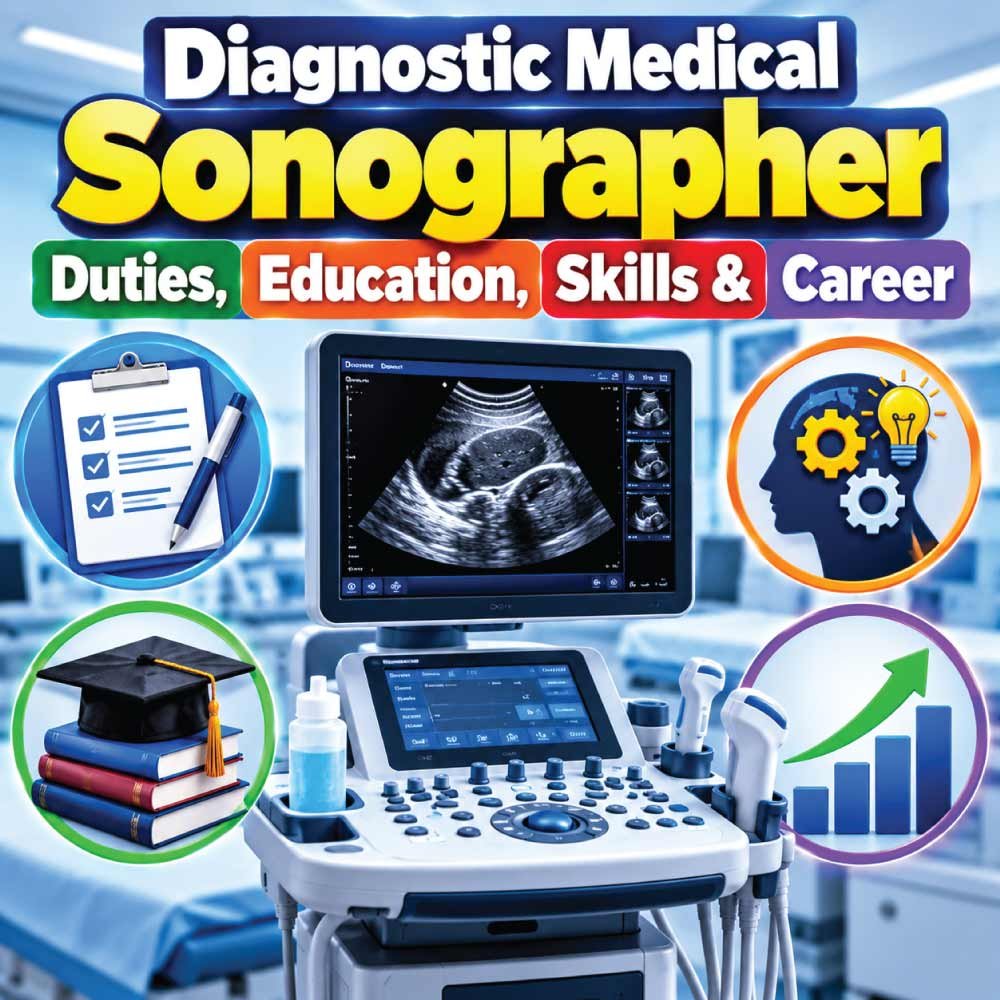
A diagnostic medical sonographer is a healthcare professional who uses ultrasound technology to create detailed images of structures inside the body. These images help physicians evaluate organs, tissues, blood vessels, and developing pregnancies without using ionizing radiation. Sonographers combine medical knowledge, technical skills, and direct patient care to perform examinations and capture high-quality diagnostic images.
A career in diagnostic medical sonography can involve several specialties, including abdominal, obstetric and gynecologic, cardiac, vascular, and musculoskeletal imaging. Depending on their training and credentials, sonographers may work in hospitals, outpatient imaging centers, physician offices, specialty clinics, or other healthcare settings.
This guide explains what a diagnostic medical sonographer does, how ultrasound examinations are performed, the education and certification typically involved, essential skills, common specialties, work environments, career opportunities, and factors that can influence salary. Whether you are exploring sonography as a career or simply want to understand the profession, the information below provides a practical overview of what the job involves.
Diagnostic Medical Sonographer: An Overview
A diagnostic medical sonographer is a healthcare professional who uses ultrasound equipment to create images of structures inside the human body. These images help physicians and other healthcare providers evaluate organs, tissues, blood vessels, and developing pregnancies.
Unlike X-rays and CT scans, diagnostic ultrasound uses high-frequency sound waves rather than ionizing radiation. Sonographers operate specialized equipment, position patients, select appropriate imaging techniques, capture diagnostic-quality images, and document important findings for interpretation by a physician or other qualified healthcare provider.
The profession combines medical knowledge, technology, communication, and hands-on patient care. A sonographer must understand anatomy while also knowing how to adjust an ultrasound machine to obtain useful images.
Diagnostic medical sonography can also offer several areas of specialization. Some professionals focus on abdominal imaging, while others work primarily in obstetrics and gynecology, vascular imaging, cardiac sonography, or musculoskeletal applications.
For people interested in healthcare but who prefer a technology-focused clinical role, sonography can be an appealing career path.
What Does a Diagnostic Medical Sonographer Do?
The main responsibility of a diagnostic medical sonographer is to perform ultrasound examinations and produce images that can assist with medical diagnosis.
The job involves considerably more than simply operating an ultrasound machine. Sonographers interact directly with patients, review examination requests, prepare equipment, select appropriate imaging views, and ensure that the resulting images contain the information required for clinical interpretation.
A typical examination may include several steps:
- Reviewing the patient’s examination request and relevant information
- Explaining the procedure to the patient
- Preparing and positioning the patient
- Selecting the appropriate ultrasound transducer
- Applying ultrasound gel to the examination area
- Operating and adjusting the ultrasound system
- Capturing appropriate images and measurements
- Recording relevant observations and technical information
- Cleaning and preparing equipment for the next examination
- Communicating important technical findings according to workplace procedures
Sonographers generally do not make the final medical diagnosis based solely on what they see during an examination. Their role is to acquire high-quality diagnostic information that can then be evaluated by an appropriate physician or other qualified professional.
Where Do Diagnostic Medical Sonographers Work?
Diagnostic medical sonographers work in a variety of healthcare environments. Hospitals are major employers, but they are not the only option.
Other workplaces can include:
- Outpatient imaging centers
- Physician offices
- Specialty clinics
- Diagnostic laboratories
- Women’s health centers
- Cardiovascular facilities
- Mobile imaging services
- Academic and teaching institutions
- Research environments
The workplace can influence the type of examinations a sonographer performs. A hospital may provide exposure to emergency, inpatient, and complex examinations, while an outpatient imaging center may have a more predictable schedule.
The work environment can also vary according to specialization. A vascular sonographer may spend much of the day performing blood-flow examinations, while an obstetric sonographer may primarily perform examinations related to pregnancy.
Types of Diagnostic Medical Sonographers
Sonography is a broad field, and professionals can develop expertise in different areas of medical imaging.
Abdominal Sonographer
Abdominal sonographers examine structures such as the liver, gallbladder, kidneys, pancreas, spleen, and related abdominal tissues.
Examinations may be performed to investigate symptoms or evaluate known conditions. The sonographer must understand abdominal anatomy and know how to obtain appropriate views from different patient positions.
Obstetric and Gynecologic Sonographer
Obstetric and gynecologic sonography focuses on the female reproductive system and pregnancy-related imaging.
During pregnancy, ultrasound examinations can provide images of the developing fetus and surrounding structures. Gynecologic examinations may evaluate reproductive organs and other pelvic structures.
Because these examinations can be emotionally significant for patients, communication and professionalism are especially important.
Vascular Sonographer
Vascular sonographers specialize in imaging blood vessels and evaluating blood flow.
They commonly use Doppler ultrasound, which provides information about the movement of blood through vessels. Vascular examinations may involve arteries or veins in different parts of the body.
This specialty requires a strong understanding of vascular anatomy, blood-flow principles, and ultrasound techniques.
Cardiac Sonographer
Cardiac sonographers, often called echocardiographers, perform ultrasound examinations of the heart.
They use specialized equipment and techniques to produce images of cardiac structures and assess aspects of heart function. This specialty requires detailed knowledge of cardiovascular anatomy and physiology.
Musculoskeletal Sonographer
Musculoskeletal sonography focuses on structures such as muscles, tendons, ligaments, joints, and other soft tissues.
This area can be useful for examining superficial structures and evaluating movement-related or soft-tissue concerns. It requires a strong understanding of anatomy and careful transducer positioning.
Diagnostic Medical Sonographer Skills
Successful sonographers need a combination of technical, clinical, physical, and interpersonal skills.
Technical Skills
Ultrasound equipment contains numerous controls that affect image quality. Sonographers need to understand how adjustments such as depth, gain, focus, frequency, and other imaging parameters affect the final image.
They also need to select an appropriate transducer for the examination.
Technical skills improve through formal education, supervised clinical experience, and continued practice.
Anatomy and Medical Knowledge
A sonographer needs a strong understanding of human anatomy.
Knowing where structures are located helps the professional identify the correct imaging plane and recognize whether the captured image adequately represents the area being examined.
Medical terminology, physiology, pathology, and patient-care knowledge are also important parts of sonography education.
Communication Skills
Sonographers spend much of their working day with patients. Some patients may be anxious, uncomfortable, or unfamiliar with ultrasound procedures.
Clear communication can make the examination easier for both the patient and the healthcare team.
Important communication skills include:
- Explaining procedures in understandable language
- Listening carefully to patients
- Maintaining professionalism
- Protecting patient privacy
- Giving clear positioning instructions
- Responding appropriately to questions and concerns
Attention to Detail
Small differences in anatomy, image quality, positioning, and measurements can matter. Sonographers therefore need strong attention to detail.
They must follow examination protocols carefully while also adapting their technique when patient anatomy or circumstances make standard imaging difficult.
Diagnostic Medical Sonographer Education and Training
Education requirements vary by location, employer, and specialty, but professional sonography generally requires formal training in diagnostic medical imaging or a related program.
Programs commonly combine classroom education with hands-on clinical training.
Classroom Education
Students may study subjects such as:
- Human anatomy
- Physiology
- Medical terminology
- Patient care
- Ultrasound physics
- Instrumentation
- Pathophysiology
- Imaging techniques
- Professional ethics
Ultrasound physics is particularly important because students need to understand how sound waves interact with tissues and how ultrasound equipment converts returning echoes into images.
Clinical Training
Classroom learning is supported by supervised clinical education.
During clinical training, students practice working with real patients while learning how to perform examinations under professional supervision. This experience helps connect theoretical knowledge with practical scanning skills.
Students learn how to position patients, select transducers, obtain imaging planes, take measurements, document examinations, and communicate professionally.
The combination of academic study and clinical experience is essential because sonography is both a technical and patient-facing profession.
Diagnostic Medical Sonographer Certification and Credentials
Certification and credentialing requirements depend on the country, region, employer, and specialty.
In the United States, professional credentials are commonly associated with organizations such as the American Registry for Diagnostic Medical Sonography (ARDMS) and other credentialing bodies. Specific eligibility and examination requirements can change, so students should verify current requirements directly with the relevant organization and their educational program.
Credentials may be available in different specialty areas, including abdominal, obstetric and gynecologic, vascular, and cardiac imaging.
Certification can demonstrate that a professional has met defined education, examination, and competency requirements. However, certification is not necessarily identical to legal licensure. Where licensing applies, sonographers must also meet the requirements established by the relevant jurisdiction.
Diagnostic Medical Sonographer Work Environment
Sonography is a hands-on healthcare profession. Much of the work is performed while standing or moving around an examination room, although some documentation and image-review activities are completed while seated.
A sonographer may work with patients of different ages and physical abilities. Some examinations are straightforward, while others require additional positioning, patience, or technical adaptation.
The job can also involve physically demanding tasks.
For example, sonographers may need to:
- Help patients get into appropriate positions
- Move equipment or supplies
- Maintain awkward arm or shoulder positions during scanning
- Perform repetitive scanning movements
- Stand for extended periods
- Work in busy clinical environments
Ergonomic technique is therefore an important consideration in long-term sonography practice.
Also Read:
Diagnostic Medical Sonographer vs. Other Imaging Professionals
Sonographers are part of the broader medical imaging team, but their responsibilities differ from those of radiologic technologists, MRI technologists, and other imaging professionals.
| Profession | Main Imaging Technology | Typical Role |
|---|---|---|
| Diagnostic medical sonographer | Ultrasound | Produces images using high-frequency sound waves |
| Radiologic technologist | X-ray and related systems | Produces radiographic images |
| MRI technologist | Magnetic resonance imaging | Produces detailed MRI examinations |
| CT technologist | Computed tomography | Performs CT imaging examinations |
| Nuclear medicine technologist | Radiopharmaceutical imaging | Performs examinations using radioactive tracers |
The technologies are different, but all require technical competence, patient-care skills, safety awareness, and accurate examination procedures.
How an Ultrasound Examination Works
Understanding the basic process helps explain what a diagnostic medical sonographer actually does.
The ultrasound transducer sends high-frequency sound waves into the body. These waves interact with tissues and structures and produce returning echoes.
The ultrasound system processes those echoes and displays them as an image.
The sonographer controls the transducer and adjusts the equipment to obtain useful images.
Patient Preparation
Preparation depends on the examination. Some procedures may require the patient to fast, drink water, or follow other instructions, while others require little preparation.
The sonographer confirms the appropriate preparation before beginning the examination.
Scanning and Image Acquisition
During scanning, the sonographer moves the transducer over the relevant area.
Different angles and positions may be necessary to visualize anatomy properly. The professional may also adjust equipment settings to improve contrast, depth, resolution, or other image characteristics.
Measurements can be taken when required by the examination protocol.
Documentation
The examination must be documented appropriately. Images, measurements, technical information, and other required details are recorded according to clinical protocols.
The completed study is then made available for interpretation by the appropriate healthcare professional.
Also Read:
Diagnostic Medical Sonographer Salary and Career Factors
Income for diagnostic medical sonographers varies substantially by location, experience, specialty, employer, work setting, credentials, and schedule.
For that reason, a single salary figure does not accurately represent what every sonographer can expect to earn.
Professionals should consider several factors when researching compensation:
- Geographic location
- Years of professional experience
- Specialty certification
- Hospital versus outpatient employment
- Full-time versus part-time work
- Shift and weekend requirements
- Overtime opportunities
- Local demand for qualified sonographers
- Additional responsibilities or advanced specialties
Salary should therefore be evaluated together with education costs, working conditions, career advancement opportunities, and the type of clinical work involved.
Also Read:
Career Growth for Diagnostic Medical Sonographers
Sonography can provide several directions for professional development.
A newly qualified sonographer may begin by building competence in a particular examination area and then pursue additional credentials or specialties.
With experience, professionals may move toward roles involving:
- Advanced specialty imaging
- Clinical education
- Student supervision
- Department coordination
- Quality assurance
- Equipment applications
- Management
- Research
- Professional education
Some sonographers also develop expertise in more than one specialty. Expanding technical knowledge can create additional career opportunities depending on local employer requirements.
Advantages and Challenges of Sonography
Like any healthcare profession, diagnostic medical sonography has both positive aspects and challenges.
Potential Advantages
Sonography can appeal to people who enjoy combining healthcare with technology.
Potential advantages include:
- Direct patient interaction
- A hands-on clinical role
- Use of advanced imaging technology
- Opportunities to specialize
- Multiple healthcare work environments
- Continuous opportunities to develop technical skills
- A role that contributes important diagnostic information
Many professionals also appreciate the variety of examinations and patient situations encountered during a working week.
Potential Challenges
The profession also has demanding aspects.
Sonographers may experience:
- Repetitive physical movements
- Extended periods of standing
- Difficult patient positioning
- Emotionally challenging examinations
- Busy clinical schedules
- Pressure to obtain diagnostic-quality images efficiently
- The need for continuous technical learning
Understanding these realities is important before choosing sonography as a career.
Who Is a Good Fit for Diagnostic Medical Sonography?
There is no single personality type required to become a sonographer. However, certain qualities can be especially useful.
A strong candidate may enjoy:
- Working directly with people
- Learning anatomy and medical science
- Using technology
- Solving practical problems
- Working with their hands
- Paying attention to small details
- Following established procedures
- Adapting when an examination does not go as planned
Patience is also valuable. Not every patient can easily hold a required position, and not every examination produces clear images immediately.
A successful sonographer needs to remain methodical while adapting techniques to individual circumstances.
Questions to Ask Before Choosing Sonography as a Career
Before enrolling in a program, prospective students should research the profession carefully.
Useful questions include:
- What education is required where I plan to work?
- Which specialties interest me?
- What clinical training does the program provide?
- Are professional credentials required or preferred by local employers?
- What is the typical work environment?
- Does the profession involve physical strain?
- What advancement opportunities are available?
- What types of patients and examinations would I encounter?
- What are the local employment conditions?
- What continuing education may be required?
Speaking with practicing sonographers can also provide valuable insight into the daily reality of the profession.
The Future of Diagnostic Medical Sonography
Ultrasound technology continues to develop, with improvements in image quality, portability, workflow, Doppler capabilities, and other imaging features.
Portable and point-of-care ultrasound systems have also expanded the situations in which ultrasound can be performed. However, advanced technology does not eliminate the importance of professional expertise.
The sonographer still needs to understand anatomy, choose appropriate imaging techniques, obtain useful views, recognize technical limitations, and communicate effectively with patients and healthcare teams.
Technology may change how examinations are performed, but skilled human operation remains an important part of diagnostic imaging.
Final Thoughts on Becoming a Diagnostic Medical Sonographer
A diagnostic medical sonographer combines patient care, medical knowledge, imaging technology, and practical problem-solving. The profession requires more than learning how to operate an ultrasound machine. It involves understanding anatomy, producing high-quality images, following examination protocols, protecting patients, and working effectively with other healthcare professionals.
There are multiple paths within the field, including abdominal, obstetric and gynecologic, vascular, cardiac, and musculoskeletal sonography. Each specialty has its own technical requirements and clinical focus.
For someone considering this career, researching education requirements, clinical training, certification, physical demands, work environments, and specialty options is an important first step.
Sonography can be a technically demanding profession, but it can also provide a meaningful role within modern healthcare by producing diagnostic information that helps clinicians evaluate and manage patients.

Zak is a dedicated medical and career writer specializing in sonography, healthcare education, and professional development. Through SonographerSalary.com, he shares in-depth insights on sonographer salaries, education pathways, and career tips to help readers build successful futures in medical imaging. His content combines accuracy with practical, easy-to-understand guidance, empowering students and professionals to make confident, informed career decisions.