
In the world of medical imaging, radiologic technologists play a vital role in helping diagnose and treat disease.
They are the trained professionals who perform X‑rays, CT scans, MRI scans, mammograms, and other imaging procedures that allow physicians to “see inside” the human body. This career blends healthcare, technology, patient care, and clinical precision.
Whether you are a high school student exploring medical careers, a professional considering a career change, or someone curious about radiologic technology, this guide covers everything from job duties to education, salary, and job outlook.
What Does a Radiologic Technologist Do?
Radiologic Technologists are skilled healthcare professionals who perform medical imaging procedures to help diagnose and treat patients.
They combine technical expertise with patient care, ensuring accurate images while minimizing radiation exposure.
Their work spans multiple imaging modalities, supporting radiologists in providing precise diagnoses and effective treatment plans.
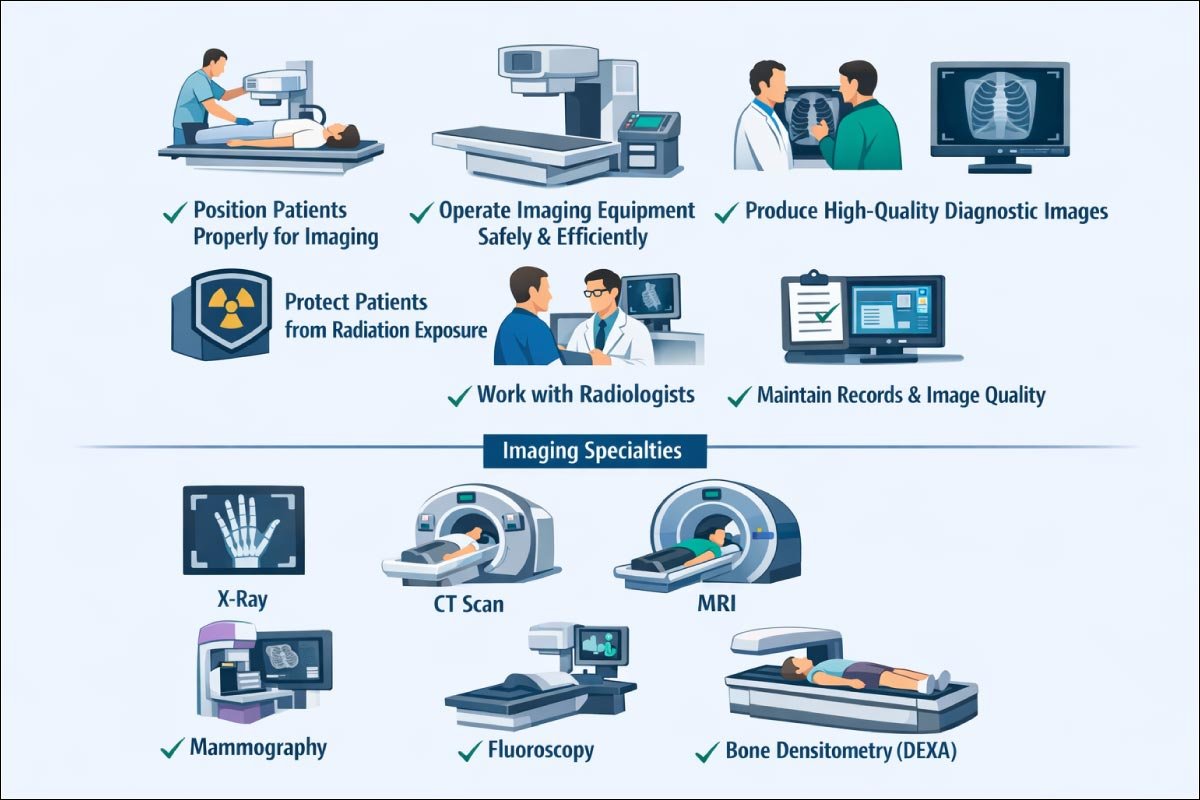
- Position patients properly for imaging
- Operate imaging equipment safely and efficiently
- Produce high‑quality diagnostic images
- Protect patients from excessive radiation exposure
- Work with radiologists (doctors who interpret images)
- Maintain records and ensure image quality standards
They may specialize in one or more imaging techniques:
-
X‑ray
-
Computed Tomography (CT)
-
Magnetic Resonance Imaging (MRI)
-
Mammography
-
Fluoroscopy
-
Bone Densitometry (DEXA)
While radiologists interpret images, technologists focus on image acquisition and patient care.
Common Imaging Modalities & What They Do
Medical imaging uses specialized techniques to visualize the inside of the body, aiding diagnosis and treatment planning.
Different modalities serve unique purposes—from detecting fractures with X‑rays to assessing soft tissues with MRI or monitoring bone density with DEXA.
Each method provides essential information for accurate patient care.
| Modality | Full Name | Purpose / Use |
|---|---|---|
| X‑ray | Radiography | Basic bone and chest imaging (fractures, pneumonia) |
| CT | Computed Tomography | Detailed cross‑sectional images (head trauma, cancer) |
| MRI | Magnetic Resonance Imaging | Soft‑tissue imaging (brain, joints, spinal issues) |
| Mammography | — | Breast cancer screening and diagnosis |
| Fluoroscopy | — | Real‑time moving images (barium studies) |
| DEXA | Dual‑Energy X‑ray Absorptiometry | Bone density evaluation (osteoporosis) |
Education Requirements
Education for Radiologic Technologists combines classroom learning with hands-on clinical experience.
Prospective technologists study anatomy, patient care, imaging technology, and radiation safety.
Completing an accredited program—typically two or four years—prepares them for certification exams and equips them with the skills needed to operate imaging equipment safely and effectively.
Typical Education Pathways
Radiologic technologists follow structured education pathways to gain the knowledge and practical skills needed for patient imaging.
Programs combine theoretical coursework—covering anatomy, radiation safety, and imaging techniques—with supervised clinical training.
These pathways prepare students to become competent, certified technologists capable of performing accurate and safe diagnostic procedures.
Associate Degree in Radiography
-
Most common path
-
Takes ~2 years
-
Includes classroom + hands‑on clinical training
2. Bachelor’s Degree in Radiologic Sciences
A bachelor’s degree in radiologic sciences provides a deeper, more comprehensive education for aspiring technologists.
It combines advanced imaging techniques, patient care, and leadership or management training.
This pathway not only prepares students for specialized clinical roles but also opens opportunities for career advancement and supervisory positions in healthcare settings.
-
Takes ~4 years
-
Often includes advanced imaging coursework + leadership/management studies
-
Helpful for career advancement
Educational Pathways
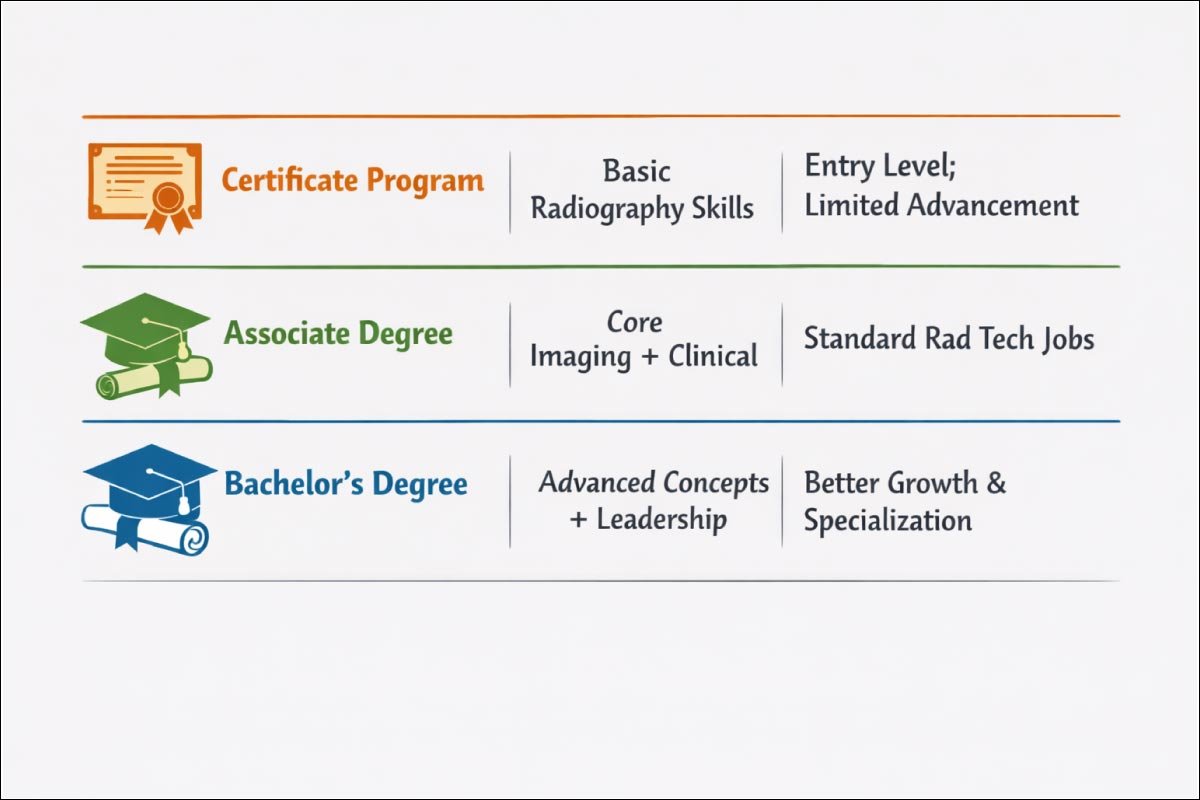
| Degree Type | Length | Typical Focus | Career Impact |
|---|---|---|---|
| Certificate Program | 1 year | Basic radiography skills | Entry level; limited advancement |
| Associate Degree | 2 years | Core imaging + clinical | Standard for Rad Tech jobs |
| Bachelor’s Degree | 4 years | Advanced concepts + leadership | Better growth & specialization |
Certification & Licensure
After completing an accredited educational program, radiologic technologists must obtain certification and, in many cases, state licensure. This ensures they meet professional standards for safety, competency, and patient care.
Certification demonstrates proficiency in imaging procedures and radiation protection, while licensure grants legal authority to practice in a specific jurisdiction.
Do You Need Certification?
Certification and licensure are essential for most radiologic technologists, ensuring they meet professional standards for safety, skill, and patient care.
Requirements vary by country and state, but generally include passing a recognized exam, such as the ARRT in the U.S., and obtaining legal authorization to practice imaging procedures.
In the United States:
-
American Registry of Radiologic Technologists (ARRT) certification is the most widely accepted credential.
-
After graduation, technologists must pass the ARRT exam to become certified.
-
Then they apply for state licensure (requirements vary by state).
Foreign countries may have their own national regulatory bodies.
Typical Certification Requirements
Certification in medical imaging ensures competency and professional standards. Graduating from an accredited program provides foundational training,
while passing the ARRT exam demonstrates national-level proficiency. Continuing education keeps skills current,
and obtaining a state license—where required—legally authorizes practice, collectively safeguarding patient care and supporting career credibility.
| Requirement | What It Means |
|---|---|
| Accredited Program | Graduate from a JRCERT‑accredited program (U.S.) |
| ARRT Exam | Pass national registry exam |
| Continuing Education | Maintain certification with ongoing learning |
| State License | Apply for a license where required |
Core Skills & Qualities
Radiologic technologists must combine technical expertise with strong interpersonal abilities to provide accurate imaging and compassionate patient care.
Essential skills include operating complex imaging equipment, understanding anatomy, ensuring radiation safety, and communicating clearly with patients and healthcare teams.
These qualities ensure both diagnostic accuracy and a positive patient experience.
Technical Skills
Technical skills are the foundation of a radiologic technologist’s role.
Proficiency in operating imaging equipment, accurately positioning patients, producing clear diagnostic images, and following radiation safety protocols ensures reliable results.
These abilities are essential for both patient safety and supporting radiologists in making precise medical diagnoses.
-
Operating complex imaging equipment
-
Understanding anatomy and positioning
-
Ensuring image clarity and accuracy
-
Radiation safety protocols
Soft Skills
-
Patient communication and comfort
-
Empathy and professionalism
-
Attention to detail
-
Teamwork within healthcare settings
Types of Work Settings
Radiologic technologists can work in a variety of healthcare environments, each offering unique experiences and responsibilities.
The choice of setting influences the type of procedures performed, patient interaction, and work schedule.
Understanding these settings helps technologists align their skills with career goals and preferred work-life balance.
5.1. Hospitals
Hospitals are the most common work setting for radiologic technologists.
They perform diagnostic imaging for a wide range of patients, from emergency cases to scheduled procedures.
Technologists in hospitals often work in specialized departments, such as trauma, cardiology, or pediatrics, and may experience varied shifts including nights and weekends.
5.2. Outpatient Imaging Centers
Outpatient imaging centers focus on scheduled diagnostic tests and procedures for non-emergency patients.
Technologists here often have a more predictable schedule, with limited exposure to critical emergencies.
These centers may specialize in advanced imaging techniques like MRI, CT, or mammography, offering a more controlled and patient-centered work environment.
5.3. Physician Clinics
Radiologic technologists in physician clinics support doctors by performing imaging procedures as part of patient consultations.
Work is generally routine and scheduled, with minimal emergency cases.
Clinics may offer specialized imaging services such as bone density scans or ultrasound, allowing technologists to develop expertise in specific diagnostic areas while fostering patient relationships.
5.4. Mobile Imaging Services
Mobile imaging services bring diagnostic equipment directly to patients, including nursing homes, sports facilities, or rural areas.
Technologists must be adaptable, traveling with portable X-ray or ultrasound equipment.
This setting requires strong organizational skills and flexibility but provides the opportunity to serve diverse populations and deliver essential care outside traditional healthcare facilities.
5.5. Research Facilities
Research facilities employ radiologic technologists to support clinical studies and imaging research.
Work may involve experimental imaging techniques or testing new equipment. This setting requires attention to detail, documentation, and collaboration with scientists and physicians.
Technologists contribute to medical advancements while often enjoying structured schedules and a focus on innovation.
5.6. Teaching Institutions
Teaching institutions, including universities and technical schools, employ radiologic technologists as educators or clinical instructors.
They train students in imaging techniques, patient safety, and technology use.
This environment combines hands-on practice with academic responsibilities, offering career growth through mentorship while maintaining involvement with the latest imaging technologies and protocols.
5.7. Emergency and Trauma Centers
Emergency and trauma centers provide imaging for critically ill or injured patients.
Technologists must work quickly, accurately, and under pressure, often during nights or on-call shifts.
This high-intensity setting requires strong technical skills, adaptability, and resilience.
It offers rewarding opportunities to make a significant impact on patient outcomes in urgent care situations.
Salary & Compensation
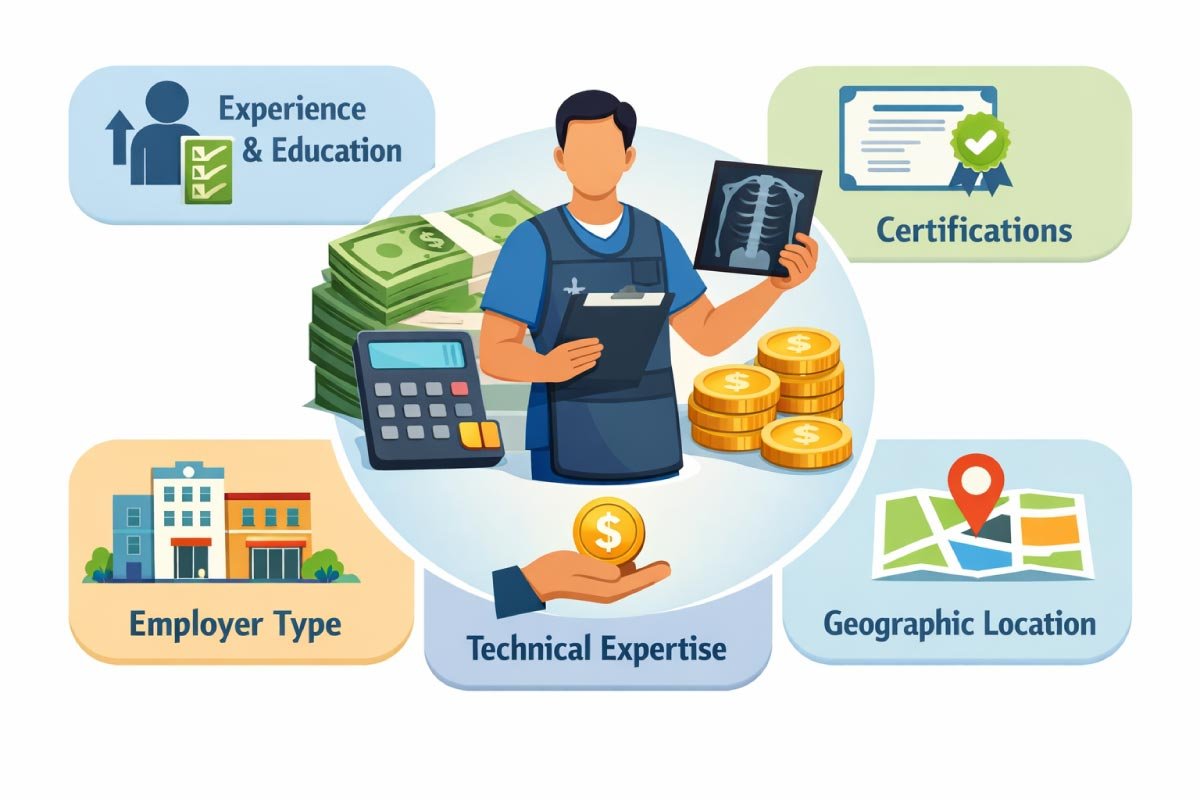
Radiologic technologists’ salaries depend on factors such as experience, education, certification, employer type, and geographic location.
Compensation reflects the technical expertise and responsibility required in medical imaging.
Understanding salary ranges helps aspiring technologists plan their careers and provides a benchmark for evaluating opportunities in different healthcare settings and regions.
Estimated Salary Ranges (U.S. Based)
Salaries in medical imaging vary by specialization, experience, and location.
General radiologic technologists typically earn around $60,000 annually, while CT and MRI technologists can reach $95,000–$100,000 with experience.
Supervisory roles offer higher earning potential. These figures are U.S.-based estimates and may differ in other countries due to local factors.
| Radiologic Tech Position | Median Salary (Annual) | Entry Level | Experienced / Specialized |
|---|---|---|---|
| General Radiologic Technologist | ~$60,000 | $45,000 | $80,000+ |
| CT Technologist | ~$75,000 | $55,000 | $95,000+ |
| MRI Technologist | ~$80,000 | $60,000 | $100,000+ |
| Mammography Tech | ~$70,000 | $50,000 | $90,000+ |
| Radiology Supervisor / Manager | ~$90,000+ | N/A | $120,000+ |
Note: These numbers are estimates and may vary in Pakistan, Europe, Canada, Asia, etc., based on local wages and healthcare systems.
Job Outlook & Demand
The need for radiologic technologists is rising as healthcare systems expand and imaging technology advances.
Factors such as aging populations, increased use of diagnostic imaging, and global healthcare growth drive demand.
Career prospects are strong, with job growth projected to outpace many other occupations over the next decade.
- Aging populations
- Greater use of diagnostic imaging
- Advancements in imaging technology
- Healthcare expansion globally
According to U.S. Bureau of Labor Statistics projections (2024–2034), job growth for radiologic technologists is faster than average compared to many occupations.
Future Growth Trends (Typical Projections)
The medical imaging field is expected to experience steady growth over the coming decade. U.S. projections indicate moderate to above-average increases in radiologic technologist jobs,
driven by aging populations and expanding diagnostic needs.
Globally, demand remains strong, reflecting the ongoing reliance on imaging technologies in modern healthcare systems.
| Year | Expected Growth Rate (U.S. Bureau of Labor) | Radiologic Tech Jobs |
|---|---|---|
| 2024 | +7% (average across jobs) | Moderate growth |
| 2030 | +6‑9% projected | Faster than average |
| 2035 | Continued demand | Stable demand as imaging expands |
International projections vary but generally show strong demand in developed and developing healthcare markets.
Also Read:
Typical Career Path & Advancement
Radiologic technologists have diverse career paths beyond routine imaging.
Opportunities range from entry-level roles to specialized positions in CT, MRI, or mammography.
Experienced technologists can advance into supervisory, educational, or administrative roles, as well as imaging equipment sales or informatics, allowing for professional growth and expanded responsibility within healthcare.
Career Ladder
-
Entry‑Level Technologist
-
Specialized Technologist (CT, MRI, Mammography)
-
Lead Technologist / Senior Tech
-
Radiology Supervisor / Manager
-
Education / Clinical Instructor
-
Sales / Product Specialist (Imaging Equipment)
Some technologists also pursue:
- Advanced practice roles
- Healthcare administration
- Radiology informatics
Pros & Cons of This Career
A career as a radiologic technologist offers both rewarding benefits and certain challenges.
Advantages include meaningful patient care, strong demand, competitive salaries, and opportunities in advanced imaging specialties.
Challenges involve radiation exposure (mitigated by safety measures), physical demands, variable shifts, and the need for continuous education to maintain certification and skills.
Advantages
- Meaningful patient‑centered work
- Strong job demand
- Good salary potential
- Variety of specialties
- Technologically forward field
Challenges
- Exposure to radiation (managed with safety protocols)
- Can involve physically assisting patients
- Variable shifts (especially in hospitals)
- Requires ongoing education to maintain credentials
Also Read:
How to Get Started
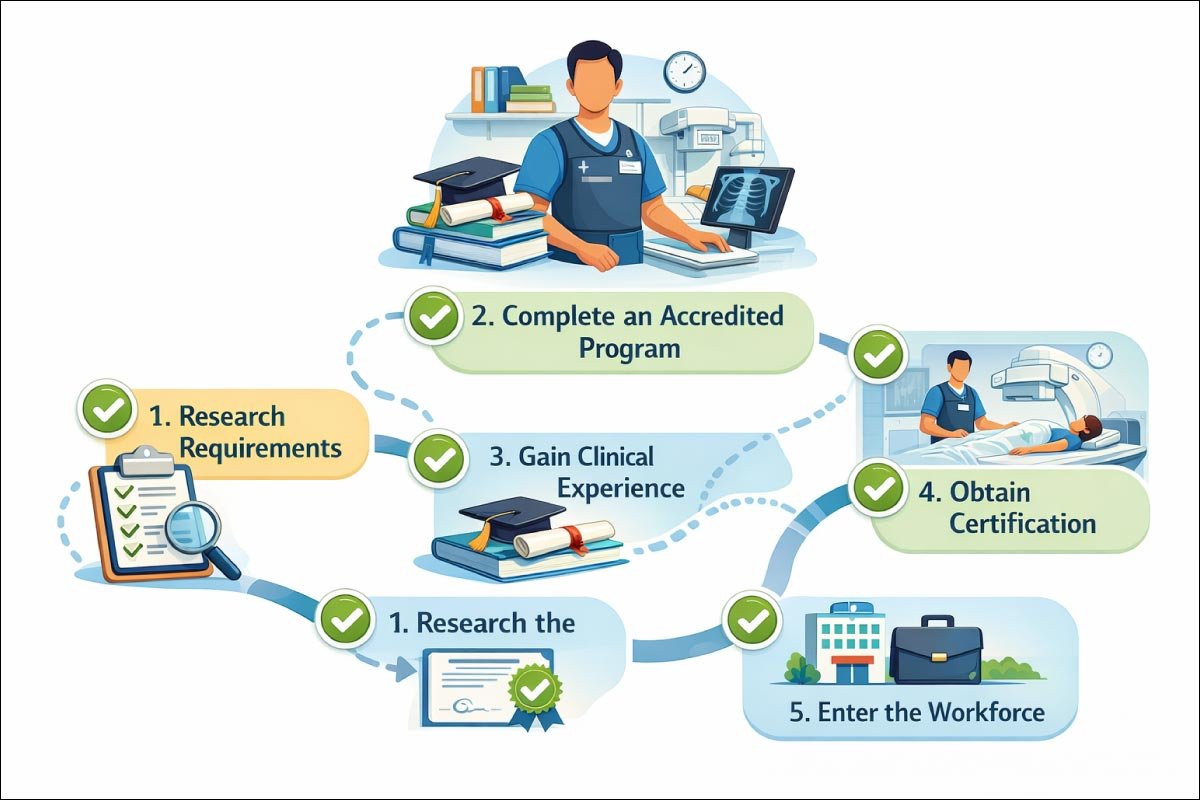
Beginning a career as a radiologic technologist requires planning, education, and practical experience.
Following a clear roadmap helps aspiring professionals navigate prerequisites, gain hands-on clinical skills, achieve certification, and enter the workforce confidently.
Strategic steps ensure both competence and compliance with state or national licensing requirements while laying the foundation for lifelong professional growth.
10.1 Research Radiologic Tech Programs
Start by identifying accredited radiologic technology programs that align with your career goals.
Consider factors such as curriculum, clinical rotation opportunities, tuition, program length, and reputation.
Research ensures you choose a program recognized by professional organizations like the Joint Review Committee on Education in Radiologic Technology (JRCERT), which is crucial for certification and future employment.
10.2 Complete Prerequisite High School Science Courses
High school coursework in biology, chemistry, physics, and mathematics provides a foundational understanding of human anatomy, physiology, and scientific principles.
Strong performance in these subjects prepares students for the technical aspects of radiography.
Completing these prerequisites is often required for program admission and helps build critical thinking skills essential for clinical decision-making.
10.3 Enroll in an Accredited Radiography Program
After meeting prerequisites, apply to an accredited radiography program.
These programs combine classroom instruction with hands-on lab work and clinical rotations.
Accreditation ensures the curriculum meets professional standards, providing eligibility for national certification exams and licensing.
Full-time dedication and consistent academic performance are key to successfully completing the program and preparing for a healthcare career.
10.4 Complete Clinical Internships
Clinical internships provide real-world experience under supervision, allowing students to practice imaging techniques, patient positioning, radiation safety, and equipment operation.
Internships enhance practical skills and professional confidence, making graduates more marketable.
They are a mandatory component of accredited programs and are essential for demonstrating competence to certification boards and potential employers.
10.5 Graduate, Certify, and Start Practice
Upon completing your program, graduate and apply for certification through the American Registry of Radiologic Technologists (ARRT) or a relevant body.
Passing the certification exam and obtaining a state license (if required) enables you to begin clinical practice legally.
Continuing education and optional specialization ensure career growth, professional competency, and alignment with evolving medical imaging technologies.
Final Thoughts
Radiologic technologists are essential healthcare professionals at the intersection of technology, medicine, and patient care.
If you enjoy working with people, learning advanced technology, and contributing to patient diagnosis and treatment, this field can be a rewarding career path.
Whether your goal is hands‑on clinical work, leadership, or specialization, radiologic technology offers a clear path to success, growth, and meaningful impact.
Also Read:

Zak is a dedicated medical and career writer specializing in sonography, healthcare education, and professional development. Through SonographerSalary.com, he shares in-depth insights on sonographer salaries, education pathways, and career tips to help readers build successful futures in medical imaging. His content combines accuracy with practical, easy-to-understand guidance, empowering students and professionals to make confident, informed career decisions.