
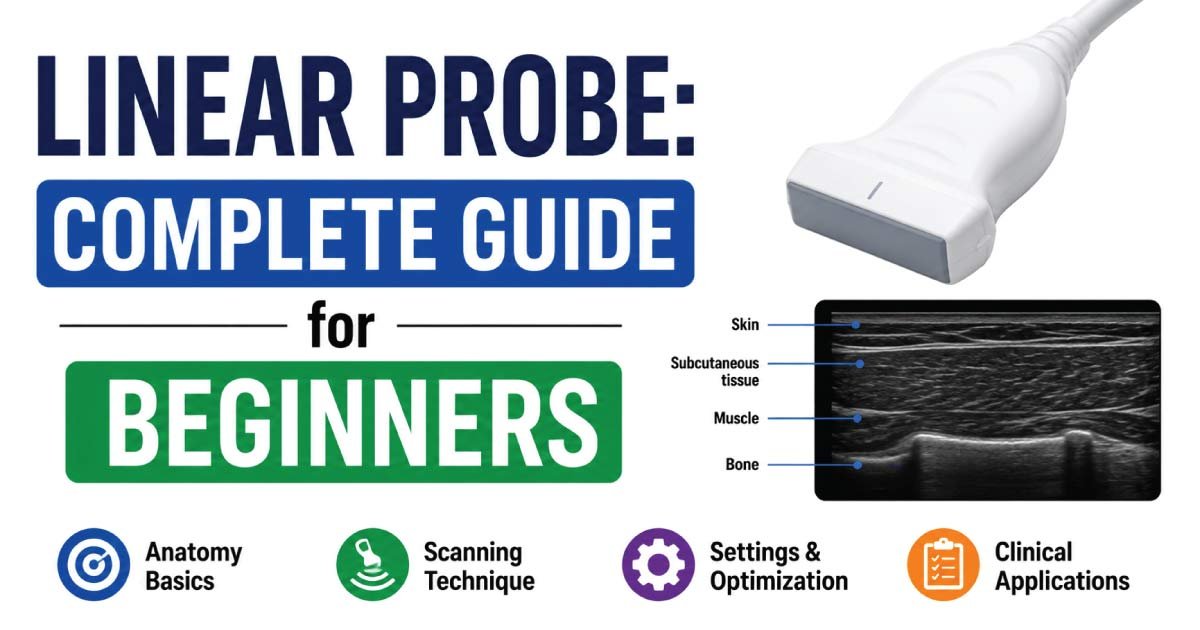
Ultrasound imaging relies heavily on transducers, commonly known as probes, to produce diagnostic images of the body’s internal structures. Among the various types of ultrasound probes, the Linear Probe is one of the most widely used and important. It is particularly valuable for imaging superficial structures, blood vessels, muscles, tendons, and small organs with exceptional detail.
The linear probe is a standard tool in radiology, emergency medicine, vascular imaging, musculoskeletal examinations, and point-of-care ultrasound. Its ability to provide high-resolution images makes it essential for diagnosing numerous medical conditions.
Understanding how a linear probe works, its applications, advantages, and limitations can help sonographers, students, and healthcare professionals better appreciate its role in modern ultrasound imaging.
What Is a Linear Probe?
A linear probe is an ultrasound transducer that contains a straight array of piezoelectric crystals arranged in a linear fashion. These crystals emit and receive ultrasound waves, allowing the ultrasound machine to create detailed images of tissues and organs.
The probe produces a rectangular image field, unlike curvilinear or phased array probes that create sector-shaped images.
Because of its high-frequency operation, the linear probe provides excellent image resolution for structures located close to the skin surface.
Common frequency ranges include:
- 5 MHz to 15 MHz
- 7.5 MHz to 18 MHz
- High-frequency specialty probes exceeding 20 MHz
Higher frequencies provide better image detail but have reduced penetration depth.
How a Linear Probe Works
The linear probe operates using the principles of ultrasound physics.
Step 1: Sound Wave Generation
The probe contains piezoelectric crystals that convert electrical energy into sound waves.
Step 2: Transmission into the Body
The sound waves travel through tissues and organs.
Step 3: Reflection of Echoes
Different tissues reflect varying amounts of sound energy back toward the probe.
Step 4: Signal Processing
The returning echoes are converted into electrical signals.
Step 5: Image Formation
The ultrasound machine processes these signals and creates a real-time image on the monitor.
The straight arrangement of crystals produces a rectangular viewing area that remains consistent from the top to the bottom of the image.
Characteristics of a Linear Probe
Several unique characteristics distinguish linear probes from other ultrasound transducers.
High Frequency
Linear probes generally operate at higher frequencies than curvilinear or phased array probes.
Benefits include:
- Superior resolution
- Detailed tissue visualization
- Excellent superficial imaging
Rectangular Image Format
The image produced has parallel sides and maintains a consistent width.
This allows accurate assessment of superficial anatomy.
Shallow Penetration
Due to their high frequency, linear probes have limited penetration depth.
They are most effective for structures located within a few centimeters of the skin surface.
Excellent Spatial Resolution
Fine anatomical details can be visualized clearly.
This makes the probe ideal for vascular and musculoskeletal examinations.
Frequency Range of Linear Probes
Different linear probes operate at different frequencies.
| Frequency | Typical Use |
|---|---|
| 5–7.5 MHz | Deeper superficial structures |
| 7.5–10 MHz | General vascular imaging |
| 10–15 MHz | Musculoskeletal imaging |
| 15–20 MHz | Small parts imaging |
| Above 20 MHz | Specialized applications |
The choice of frequency depends on the depth and size of the structure being examined.
Applications of Linear Probe in Ultrasound
Linear probes are used in many medical specialties.
Vascular Ultrasound
One of the most common applications is vascular imaging.
The probe is ideal for examining:
- Carotid arteries
- Jugular veins
- Peripheral arteries
- Peripheral veins
- Dialysis access grafts
It provides excellent visualization of vessel walls and blood flow.
Doppler Ultrasound Studies
Linear probes are frequently used with Doppler imaging to assess blood circulation.
Applications include:
- Deep vein thrombosis evaluation
- Carotid artery stenosis
- Peripheral vascular disease
- Venous insufficiency
The high resolution allows accurate vessel assessment.
Musculoskeletal Ultrasound
The linear probe is considered the preferred transducer for musculoskeletal imaging.
Structures examined include:
- Tendons
- Ligaments
- Muscles
- Joints
- Bursae
- Soft tissues
Sports medicine specialists frequently rely on linear probe imaging.
Small Parts Imaging
Small organs located near the skin surface are commonly evaluated with linear probes.
Examples include:
- Thyroid gland
- Parathyroid glands
- Salivary glands
- Testicles
- Breast tissue
- Lymph nodes
The superior detail helps identify subtle abnormalities.
Emergency Medicine
Point-of-care ultrasound often utilizes linear probes for rapid assessments.
Applications include:
- Soft tissue infections
- Foreign body detection
- Vascular access
- Abscess evaluation
- Cellulitis assessment
Emergency physicians frequently use linear probes at the bedside.
Guided Procedures
Linear probes provide excellent visualization during procedures.
Common uses include:
- Needle guidance
- Biopsies
- Joint injections
- Nerve blocks
- Central venous catheter placement
Real-time imaging improves procedural accuracy and safety.
Linear Probe in Vascular Imaging
Vascular imaging is one of the most important applications of the linear probe.
The probe helps evaluate:
Carotid Artery Disease
Linear probes can identify:
- Plaque formation
- Arterial narrowing
- Blood flow abnormalities
Deep Vein Thrombosis (DVT)
Compression ultrasound performed with a linear probe helps detect blood clots in veins.
Peripheral Arterial Disease
The probe evaluates blood flow and vessel narrowing in the extremities.
These examinations are critical for diagnosing circulation problems.
Linear Probe in Musculoskeletal Ultrasound
Musculoskeletal ultrasound has become increasingly popular due to the capabilities of linear probes.
Tendon Evaluation
The probe helps detect:
- Tendon tears
- Tendinitis
- Calcifications
- Degeneration
Ligament Assessment
Sports injuries involving ligaments can be evaluated dynamically.
Muscle Injuries
Muscle strains and tears are often clearly visualized.
Joint Imaging
Joint effusions, inflammation, and structural abnormalities can be assessed effectively.
The ability to perform dynamic examinations is a major advantage over static imaging techniques.
Advantages of Linear Probe
The linear probe offers numerous benefits.
Exceptional Image Resolution
High-frequency imaging provides detailed visualization of superficial structures.
Accurate Measurements
The rectangular field of view improves measurement accuracy.
Real-Time Imaging
Structures can be observed during movement and procedures.
Excellent Needle Visualization
Needles are easier to track during ultrasound-guided procedures.
Portable and Convenient
Linear probes are compatible with portable ultrasound systems.
This makes them useful in clinics, hospitals, and emergency settings.
Limitations of Linear Probe
Despite its advantages, the linear probe has limitations.
Limited Penetration Depth
High-frequency sound waves cannot penetrate deeply into the body.
Not Suitable for Deep Abdominal Imaging
Structures deep within the abdomen are usually better evaluated using curvilinear probes.
Reduced Effectiveness in Obese Patients
Increased tissue depth may limit image quality.
Narrow Field of View
Compared with curvilinear probes, the imaging area may be smaller.
These limitations must be considered when selecting the appropriate transducer.
Linear Probe vs Curvilinear Probe
| Feature | Linear Probe | Curvilinear Probe |
|---|---|---|
| Frequency | High | Lower |
| Resolution | Excellent | Moderate |
| Penetration | Shallow | Deep |
| Image Shape | Rectangular | Curved/Sector |
| Best For | Superficial structures | Abdominal organs |
| Vascular Imaging | Excellent | Limited |
| Musculoskeletal Imaging | Excellent | Poor |
Each probe serves different clinical purposes.
Linear Probe vs Phased Array Probe
| Feature | Linear Probe | Phased Array Probe |
|---|---|---|
| Frequency | High | Lower |
| Resolution | Excellent | Moderate |
| Field Shape | Rectangular | Sector |
| Cardiac Imaging | Limited | Excellent |
| Vascular Imaging | Excellent | Moderate |
| Superficial Structures | Excellent | Moderate |
Selecting the correct probe improves diagnostic accuracy.
Probe Care and Maintenance
Proper maintenance ensures optimal performance.
Important practices include:
- Clean after every examination
- Use approved disinfectants
- Inspect cables regularly
- Avoid dropping the probe
- Store properly
- Check for image artifacts
Routine maintenance extends probe lifespan and improves patient safety.
Future Developments in Linear Probe Technology
Ultrasound technology continues to advance rapidly.
Future improvements may include:
- Higher frequency imaging
- Better Doppler sensitivity
- Artificial intelligence integration
- Wireless probe technology
- Enhanced image processing
- Improved portability
These developments will likely expand the role of linear probes in medical imaging.
Conclusion
The Linear Probe is one of the most important ultrasound transducers used in modern medicine. Its high-frequency operation, rectangular field of view, and exceptional image resolution make it ideal for evaluating superficial structures such as blood vessels, muscles, tendons, thyroid glands, lymph nodes, and soft tissues.
Widely used in vascular imaging, musculoskeletal ultrasound, emergency medicine, and ultrasound-guided procedures, the linear probe provides detailed real-time images that help clinicians diagnose and manage a wide variety of conditions. Although its penetration depth is limited, its superior resolution makes it an essential tool for sonographers and healthcare professionals worldwide.
👉 Explore the Doppler Shift and discover how this essential ultrasound concept helps measure the speed and direction of blood flow. This beginner-friendly guide explains Doppler Shift in ultrasound, its principles, clinical applications, and interpretation methods. Learn how it improves diagnostic accuracy and patient care. Read the full post to gain a complete understanding of Doppler ultrasound technology.

Zak is a dedicated medical and career writer specializing in sonography, healthcare education, and professional development. Through SonographerSalary.com, he shares in-depth insights on sonographer salaries, education pathways, and career tips to help readers build successful futures in medical imaging. His content combines accuracy with practical, easy-to-understand guidance, empowering students and professionals to make confident, informed career decisions.